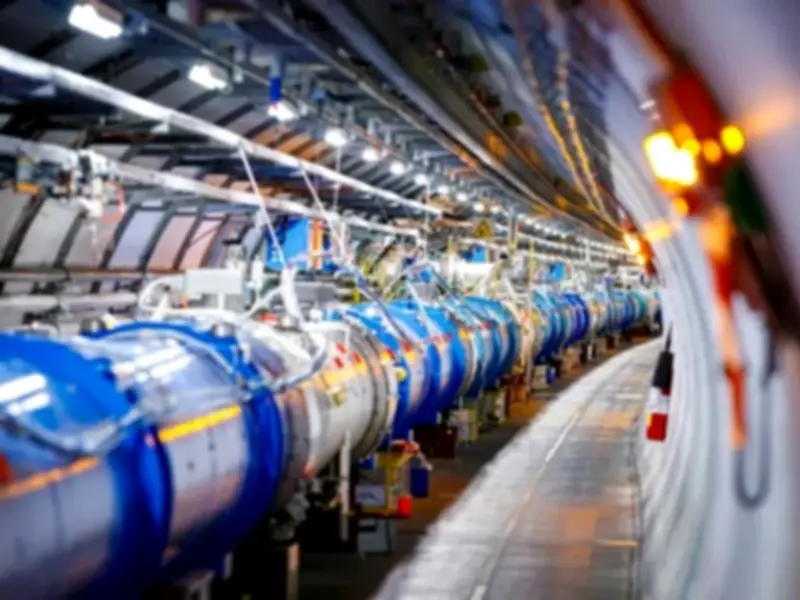
The world's most powerful particle accelerator, the Large Hadron Collider (LHC) at CERN near Geneva, will shutter operations on Monday for four years of renovations to dramatically increase its collision capacity and potentially unlock one of the greatest mysteries of the Universe: dark matter.
Upgrade to High Luminosity LHC
The 27-kilometre proton-smashing circular tunnel, located about 100 metres below the French-Swiss border, has famously proven the existence of the Higgs boson. From Monday, activity will stop as the device undergoes upgrades aimed at increasing the precision and intensity of particle collisions. The enhanced particle smasher, renamed the High Luminosity LHC (HL-LHC), is scheduled to begin operations in June 2030 and run for about a decade.
"This is a very important moment. From Monday, we will be entering a new phase," HL-LHC project chief Markus Zerlauth told reporters. "We still have lots of physics questions without answers. There are still many discoveries to be made."

Goal: Tenfold Increase in Collisions
The goal is to increase the "luminosity" — the total number of collisions produced over a given period — by a factor of 10 compared to the LHC. The total cost of the upgrade is expected to be 1.2 billion Swiss francs ($1.5 billion), covered by CERN membership fees and in-kind contributions from the United States, Japan, Canada, and China, making up 10-15 percent of the total.
The upgrade requires fully replacing components in 1.2 kilometres of the 27-kilometre tunnel. New superconducting magnets capable of further concentrating particle beams will be installed to increase the number of collisions. Once operational, between 140 and 200 collisions will occur each time two packets of particles meet inside detectors, up from 60 currently.
"The increased number of collisions will allow us to collect up to 100 times more data," Zerlauth said. The number of collisions will be so high — several billion per second — that it will be impossible to store all data produced. Which collisions to record will need to be selected in real time, a task entrusted to artificial intelligence systems capable of identifying the most promising events.
But "AI does not replace physicists," insisted Nedaa-Alexandra Asbah, a research physicist at CERN's ATLAS experiment, which helped discover the Higgs boson using the LHC. "It is a powerful tool that helps us make better use of the data."
Search for Dark Matter and Higgs Bosons
The HL-LHC aims to deepen fundamental knowledge, CERN's primary mission. "We want to look for new particles," said Filip Moortgat, operations coordinator for CMS, the LHC detector designed to explore a wide range of physics, including the search for other dimensions and dark matter particles. Scientists believe ordinary matter accounts for just five percent of the universe, with dark matter (27 percent) and dark energy (68 percent) being invisible components yet to be detected.
The 2012 discovery of the Higgs boson broadened science's understanding of how particles acquire mass and earned physicists Peter Higgs and Francois Englert the 2013 Nobel Prize for Physics. Once the upgrade is completed, CERN hopes to dramatically expand understanding of how the "God particle" works, with the HL-LHC expected to produce around 380 million Higgs bosons over its lifetime, compared to 55 million found since LHC operations began in 2008.
The lab's main hope is to produce two Higgs bosons simultaneously, which would be a first, and see them interact. Asbah said this "may provide clues about how our Universe evolved shortly after the Big Bang."