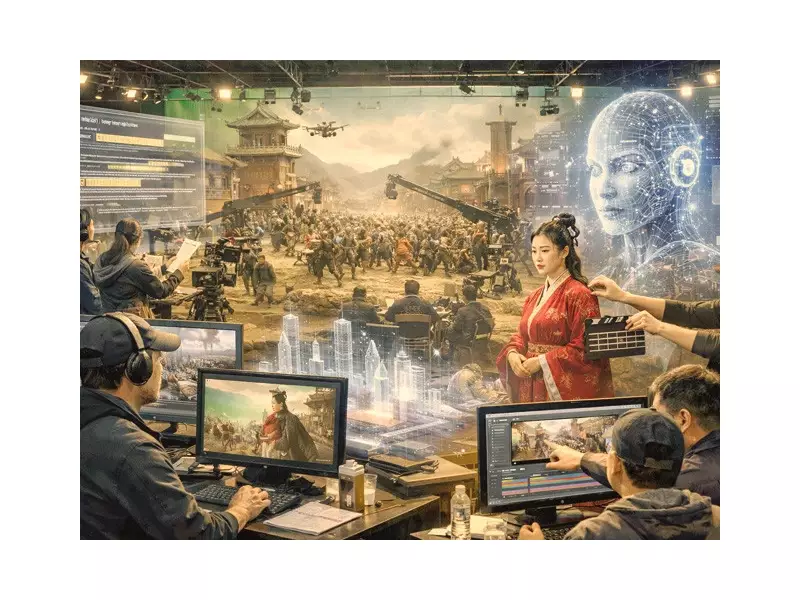
For filmmakers working on tight budgets and tighter deadlines, creating epic scenes with limited resources has long been a major hurdle. However, artificial intelligence (AI) is now turning this challenge into a problem of the past, digitally conjuring vast armies and complex visuals in a fraction of the traditional time.
AI Supercharges Post-Production and Visual Effects
Post-production technician Zhang Shiyu from Dongyang Gewuzhizhi Culture Media has experienced this shift firsthand. He highlights the dramatic impact of advancements in AI large language models this year, making processes smoother and far more efficient. "What used to take me long days to create, AI can deliver in mere minutes with even greater continuity and realism," Zhang stated. The integration is seamless, with AI-generated high-quality visuals now a standard part of the editing workflow. Techniques like precise texture mapping allow AI-enabled visual effects to merge virtual elements with live-action footage, producing strikingly realistic results.
This transformation is widespread at his company. Chairman Lu Caijian confirmed that "AI plays a crucial role in every step of post-production." The company is based in Hengdian World Studios, known as "China's Hollywood," which has developed a robust industrial chain. The local government is actively supporting this tech-driven evolution. Lu Pingping, deputy director of the Hengdian Film and Television Cultural Industry Development Service Center, noted that integrating technology with film and television has been a priority this year to power industry growth.

Expanding AI's Role: From Scripts to Copyright Protection
The application of AI is rapidly moving upstream in the creative process. For tech firms like Dongyang Yuanying Technology Co., which set up in Hengdian in October and has worked on over 20 short dramas, AI initially helped create grand scenes and special effects. Now, the focus is shifting to story development. AI's role is expanding into scriptwriting and project evaluation, fundamentally reshaping the industry's workflow from conception to marketing, as reported by the China Society of Motion Picture and Television Engineers.
Companies are building specialized tools for this purpose. Hangzhou-based Huace Group has developed its own AI model, trained on a vast repository of 50,000 hours of film and TV assets and 30 years of accumulated data like scripts and reports. This model can perform rapid preliminary evaluations of novels up to 1.2 million words. Tasks that took a human team 10 to 14 days are now completed by AI in one or two hours, boosting overall efficiency by more than 50%. Huace Group's president, Fu Binxing, said the model, which is about 90% accurate, helps identify suitable projects and inspires creators by optimizing scripts.
AI as a Creative Partner, Not a Replacement
Industry leaders emphasize that AI is a tool to augment human creativity, not replace it. "AI is not meant to replace humans. It has altered certain production processes, but in the short term, the core of creation is still people," explained Lin Ju from Yuanying. He stressed that screenwriters must still control the visual language and final output. The true value lies in harnessing AI's power to execute routine tasks, freeing creators to focus on innovation.
Fu Binxing highlighted how AI democratizes filmmaking: "For new directors, AI lowers the barriers to entry into the industry." They can use AI tools to visually present their ideas to investors. As AI makes creation more accessible and accelerates content output, protecting intellectual property has become crucial. The industry is fighting fire with fire, using AI as a guardian. Hengdian has launched an AI-powered monitoring system that automates the detection of online copyright infringement. Furthermore, Jiangxi Province established its first agency in 2024 to protect micro-short drama copyrights using AI, which has already resolved eight cases and recovered tens of millions of yuan in losses by May this year.

Experts believe this is just the beginning. Li Zhenlin, dean of the College of Film at the Shanghai Theatre Academy, predicts that AI is likely to give rise to entirely new cinematic styles and narrative methods that are currently unimaginable, fundamentally expanding the boundaries of visual expression.