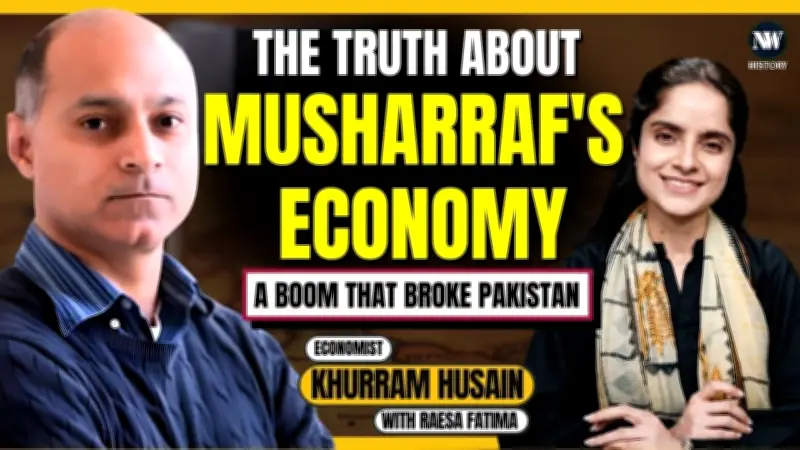
Veteran economic journalist Khurram Husain has provided a detailed explanation of the structural causes behind Pakistan's recurring economic crises and its repeated reliance on International Monetary Fund (IMF) bailout programmes. In a comprehensive discussion, he traced the roots of the country's fiscal deficit, debt trap, and the flawed economic model that has led to more than two dozen bailout programmes over the decades.
The Musharraf-Era Economic Model and Its Aftermath
Husain pointed to the economic model adopted during the Musharraf era as a key turning point. He explained that the model prioritized high growth fueled by foreign capital inflows, particularly through privatization and liberalization, but failed to address structural weaknesses. This created a cycle where growth was followed by balance-of-payments crises, forcing Pakistan to seek IMF assistance repeatedly. According to Husain, the model relied heavily on consumption rather than investment in productive sectors, leading to a widening current account deficit.
Dr. Ishrat Husain's Reforms and the Debt Trap
The discussion also covered the reforms implemented by Dr. Ishrat Husain during his tenure as governor of the State Bank of Pakistan. While these reforms brought some stability, they did not resolve the underlying issues of low tax revenues and a narrow export base. Husain noted that Pakistan's debt trap worsened over time, with a growing portion of revenue going to debt servicing. He cited statistics indicating that debt servicing consumes a significant share of the federal budget, leaving little room for development spending.

CPEC and the Role of Independent Power Producers (IPPs)
Husain highlighted the impact of the China-Pakistan Economic Corridor (CPEC) and the Independent Power Producers (IPPs) on the economy. He explained that CPEC investments, while bringing infrastructure development, also added to external debt and created a dependency on imported fuel for power generation. The IPPs, he said, contributed to circular debt due to high capacity payments and inefficiencies in the power sector. According to Husain, the power sector's problems have become a major drain on the national exchequer, exacerbating the fiscal deficit.
Taxation, Productivity, and Exports
The journalist emphasized that Pakistan's tax system is regressive and insufficient, with a tax-to-GDP ratio among the lowest in the region. He argued that without broadening the tax base and improving tax collection, the government cannot fund essential services or reduce the deficit. On productivity and exports, Husain pointed out that Pakistan's export sector has stagnated due to lack of competitiveness, energy shortages, and a focus on low-value-added products. He noted that exports have not kept pace with imports, leading to persistent trade deficits.
National Security and Institutional Reforms
Husain also discussed the intersection of national security and economic policy, noting that defense spending and security concerns have often diverted resources from productive investments. He called for institutional reforms to break the cycle of IMF dependence, including improvements in governance, rule of law, and the autonomy of economic institutions. According to Husain, without such reforms, Pakistan will continue to face repeated crises.
In conclusion, Husain provided one of the clearest explanations of why growth repeatedly turns into crisis in Pakistan. He stressed that the country needs to move beyond short-term fixes and address the deep-rooted structural issues that have kept it dependent on the IMF for decades.