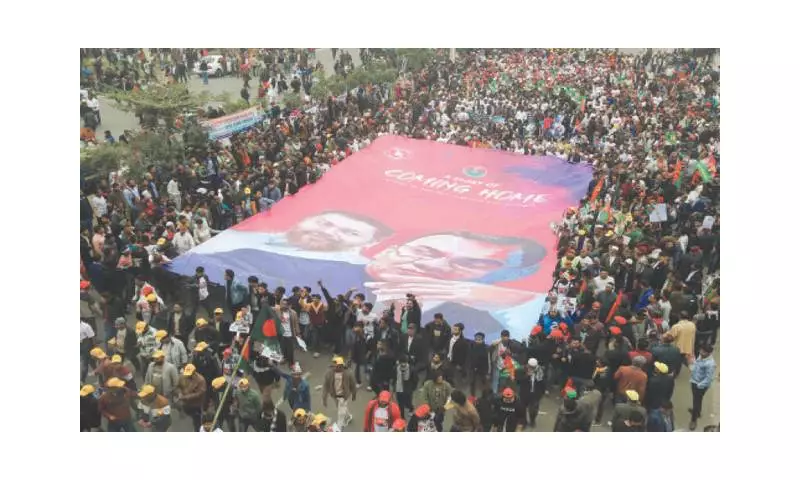
In a dramatic political homecoming, Tarique Rahman, the acting chairman of the Bangladesh Nationalist Party (BNP) and a prime ministerial hopeful, touched down in Dhaka on Thursday, ending his 17-year self-imposed exile. The heir apparent to the BNP leadership was greeted by ecstatic crowds of supporters who had flooded the capital to welcome him back.
A Historic and Emotional Return
Rahman arrived at Dhaka airport accompanied by his wife and daughter. Visibly moved, he performed a symbolic act of reverence upon landing: he removed his shoes, stood on the grass, and scooped up a handful of Bangladeshi soil. After shaking hands with senior party leaders, he waved to the massive gathering before being whisked away in a heavily secured convoy.
His supporters had begun assembling since early morning, transforming the streets with banners, festoons, and large cut-outs. One prominent image depicted the 60-year-old politician riding a stallion. The air was filled with the sound of patriotic songs blaring from loudspeakers, creating a festival-like atmosphere.

A Nation at a Crossroads
Rahman's return is set against a backdrop of significant political upheaval and public unrest. He left Bangladesh for London in 2008, citing political persecution. His comeback comes just weeks before the crucial general election scheduled for February 12, the first polls since the ouster of former Prime Minister Sheikh Hasina following a student-led uprising last year.
The BNP, now led by Rahman, is considered a frontrunner in the upcoming election. If the party secures a majority, Rahman is expected to be nominated for the prime minister's position. His return has ignited hope among his base. Alamgir Hossain, a BNP supporter, expressed a common sentiment, stating the country was in a "dire situation" and that only Rahman "can fix it."
Former BNP lawmaker Jahan Panna, 55, echoed this, telling AFP that "Tarique Rahman is the symbol of hope for this country" and that his return could end the prevailing "cycle of anarchy."
Complex Political and Social Backdrop
The political landscape remains tense. Rahman's ailing mother, 80-year-old former Prime Minister Khaleda Zia, remains hospitalized in Dhaka. Despite vowing in November to campaign, she was admitted to intensive care soon after.
Recent months have also seen violent protests triggered by the killing of popular student leader and India-critic Sharif Osman Hadi, 32. His death led to mobs torching buildings, including two major newspapers perceived as pro-India, and pelting stones at the Indian High Commission in Chattogram.
Diplomatic relations with India, a historical ally, have deteriorated. The interim government in Dhaka has sought the extradition of Sheikh Hasina, who was sentenced to death in absentia for her role in cracking down on last year's uprising. Anti-India sentiments were further inflamed recently after a Hindu garment worker was lynched over blasphemy allegations on December 18.
On the legal front, Rahman, who faced multiple criminal cases, has seen a turnaround since Hasina's fall. He has been acquitted of the most serious charge—a life sentence given in absentia for a 2004 grenade attack on a political rally, which he always denied.
As Bangladesh prepares for a pivotal election, the return of Tarique Rahman marks a seismic shift in the political arena, setting the stage for a high-stakes contest that will define the nation's future trajectory.