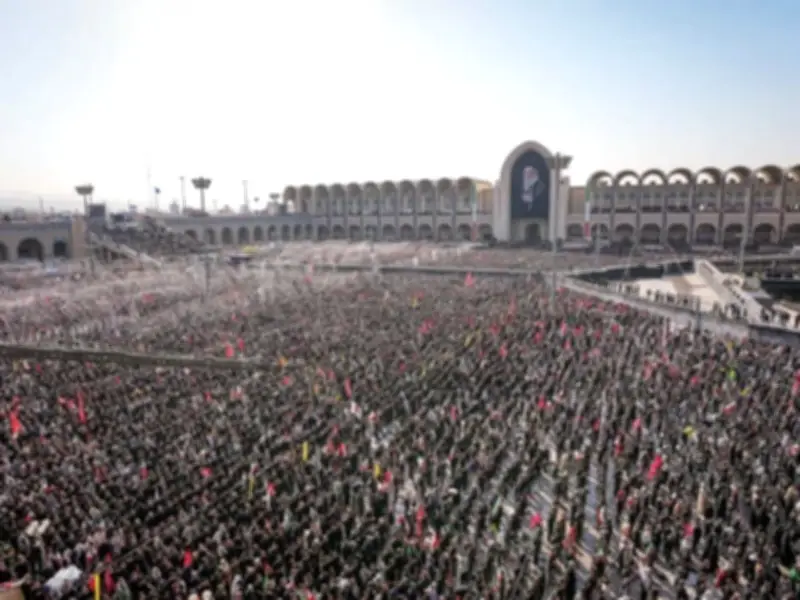
Millions of weeping mourners thronged Tehran on Sunday as Iran held a mass public funeral prayer for its late supreme leader, Ayatollah Ali Khamenei, who was assassinated along with multiple family members in the opening US-Israeli airstrikes of the Middle East war on February 28. The sprawling religious complex of the Imam Khomeini Grand Mosalla Mosque became the epicentre of a massive, state-mobilised display of grief and geopolitical defiance.
Sunday was declared a national public holiday as tens of thousands of soldiers, seminary students, and ordinary citizens filed into the vast courtyard to view the coffins. The Iranian metro railway network reported clocking an unprecedented 7 million trips from late Saturday night into Sunday morning alone, as citizens flooded central Tehran.
Funeral Amid Fragile Ceasefire
The marathon funeral ceremonies, which officially began on Friday, take place at an extraordinary and volatile crossroads for the Islamic Republic. After four months of intense, destructive hostilities that left more than 3,000 Iranians dead—including many of the country's most senior politicians and military commanders—the war is currently paused under a fragile interim ceasefire agreement brokered with Washington.

Led by Ayatollah Jafar Sobhani, the funeral prayers were attended by Iran's highest-ranking political, military, and religious echelons, including Iranian President Masoud Pezeshkian and Parliament Speaker Mohammad Bagher Ghalibaf. The caskets of the 86-year-old supreme leader, who had ruled Iran since 1989, rested on a raised dais at the front of the courtyard. Atop Khamenei's coffin lay his signature black turban. Beside his remains were four separate caskets containing his family members who perished in the same February attack: his daughter, his son-in-law, his daughter-in-law, and his 14-month-old granddaughter.
Massive Turnout and Emotional Scenes
The caskets had spent Thursday and Friday lying in state indoors for foreign dignitaries and senior officials before being displayed outdoors under glass. Mourners dressed in black and draped in the red, white, and green flags of the Islamic Republic wept openly, beat their chests, and waved banners promising vengeance against Washington and Jerusalem. Women in black chadors used white visors and umbrellas to shield themselves from a brutal mid-morning heatwave that threatened to nudge 40°C. To prevent crowd crushes and heat exhaustion, organisers sprayed the massive crowds with mists of water.
"The leader was a father to us all. With his passing, we have all been left orphaned," said Mohammad Mirsalehi, a 38-year-old cleric in attendance. Through loudspeakers, a compere led the stadium-sized crowd, shouting, "Let us wail!" while thunderous chants of "Death to America" and "Revenge, revenge" echoed across the prayer complex. "Everyone here has come to avenge the blood of their supreme leader," said 40-year-old Arash Rahimi to reporters in the crowd. "As our leader has said, we have a blood feud with the United States. Our relations with the United States will never be good."
Absence of Successor Sparks Speculation
While the state used the mass gathering to project seamless continuity and institutional strength, a glaring mystery hung over the courtyard. Three of Khamenei's sons—Mostafa, Meysam, and Masoud—were visible on state television, praying directly behind the caskets. Masoud Khamenei was seen openly weeping, wiping tears away with a chequered keffiyeh scarf, a potent symbol of militant revolutionary ideals and Palestinian solidarity. However, Mojtaba Khamenei, the son who has officially succeeded his father as the Supreme Leader of the Islamic Republic, was entirely absent from public view. Mojtaba has not been seen or photographed in public since being named the new head of state.
The new leader's absence left some of the faithful disappointed. "Until the last moment, before the prayer began, I kept telling those around me that I hoped he himself would come. That was our only wish," a young female mourner told the semi-official Tasnim news agency.

International Reactions and US Comments
The highly visible funeral has drawn intense scrutiny from abroad, functioning as an external test of domestic support for the regime. Speaking to the Axios news website, US President Donald Trump confirmed that peace talks between the two nations had been intentionally paused for a week to allow the funeral events to conclude. In characteristic fashion, Trump courted immediate controversy by pointing out that because all of Iran's top leadership was gathered in a single venue, Washington could theoretically eliminate them all with "one shot, but we are not going to do that because then we would have nobody to negotiate with."
The Iranian Embassy in Armenia issued a fiery, direct response on the social media platform X, blasting the American president: "You don't understand these things because you have neither civilisation, nor history, nor honour."
Elaborate Multi-Day Funeral Itinerary
Among Muslims burials take place at the earliest but because of the extreme military risks of gathering millions of citizens under an active bombardment, the state officially postponed Khamenei's funeral rites until a formal truce could be guaranteed. Now, authorities are executing an elaborate, multi-day itinerary designed to mobilise over 10 million people across two nations, providing state-subsidised transportation, food, and lodging for the masses.
Following Monday's massive central procession through the streets of Tehran, state media confirmed that the late leader's body will be transported by land in a specially designed vehicle to the seminary city of Qom on Tuesday, July 7—the historic heart of Iran's clerical hierarchy. On Wednesday, July 8, the body will be flown to neighbouring Iraq. There, the caskets will be received by top Iraqi political and religious figures for processions through Baghdad and the major holy shrine cities of Najaf and Karbala. Finally, on Thursday, July 9, the remains will return to Iran for a definitive processional and burial at the Imam Ali Reza Shrine in the northeastern city of Mashhad, one of the holiest sites in Iran.
While world leaders and regional delegations—including representatives from Houthis, Islamic Jihad, Hamas, and Hezbollah—continue to hold high-level meetings with Iranian Foreign Minister Abbas Araghchi in Tehran, the state's primary focus remains internal. For a government emerging from the ashes of a brutal foreign war and deep internal fractures, this week of mourning is being staged as an ultimate message of institutional resilience and survival.