Historiography in Pakistan has reached a new maturity. Works by Ilyas Chattha, Ali Qasmi, and Tahir Kamran are refreshing, stimulating, and invite critical thinking in Pakistan Studies. These historians raise fundamental questions: Who is a citizen? Are citizens aware of their rights and responsibilities? What happens when the state-citizen relationship fractures? What are the state's obligations, and how can a national identity narrative be constructed? These complex issues demand deliberation among scholars, policymakers, and civil society.
Outstanding Features of Chattha's Book
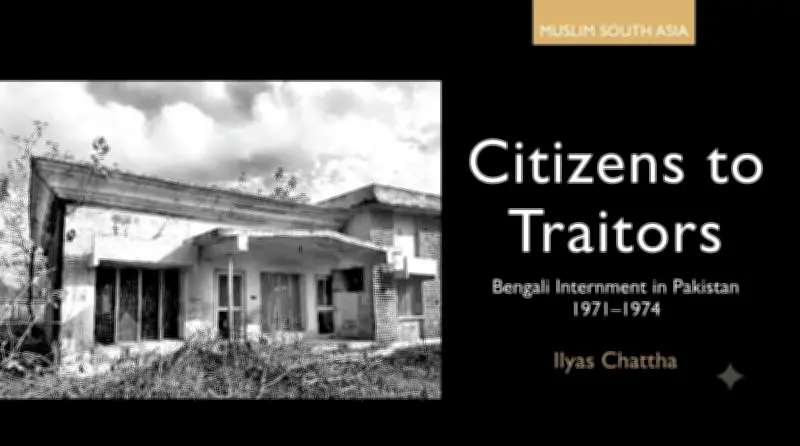
In my assessment, Ilyas Chattha's Citizens to Traitors: Bengali Internment in Pakistan, 1971–74 has three outstanding features. First, it is trailblazing research on a sensitive topic, disentangling state behavior and the breakup story. Second, it uncovers substantive new data from intelligence and police sources, with academic rigor. Third, it draws attention to the pivotal issue of broken state-citizen relationships, tracing how the term 'traitor' becomes part of societal narrative.
Central Argument: Citizenship Suspended
Chattha argues that the Pakistani state, facing national collapse in 1971, redefined Bengalis as suspect 'traitors' through internment, surveillance, and movement restrictions. Citizenship was effectively suspended. The book studies how states redefine loyalty during crisis. The state collectively categorized Bengalis as traitors yet distinguished among them by rank and profession. Drawing on Thiranagama and Kelly, Chattha contends that 'traitor' is a political construction; the key question is who has power to define traitors.

Internment and Hierarchy
An estimated forty thousand Bengalis in West Pakistan were perceived as potentially inimical. Chapters 2-5 document harsh camp conditions, family separation, and trauma. Interestingly, internment was not uniform: military officers, civil servants, and professionals received better treatment. This hierarchy shows that bureaucratic distinctions survived even when basic rights were denied. The state recognized their institutional utility while questioning loyalty, revealing contradiction: collective categorization as traitors yet differential treatment.
Repatriation Negotiations
Chapters 6-7 discuss 'Escape or Die' and 'Triangular Repatriation' involving Pakistan, India, and Bangladesh. Three groups were entangled: 40,000 Bengali internees in Pakistan, 90,000 Pakistani POWs in India, and non-Bengalis stranded in Bangladesh. Bengali internees became bargaining tools, their fate linked to POW release and normalization. This shows how citizens were converted into objects of political negotiation, highlighting tension between morality and statecraft.
Repatriates vs. Prisoners of War
An important analytical distinction: POWs are combatants protected under international law; repatriates are civilian citizens returned after displacement. Bengali internees were citizens of Pakistan, yet treated like wartime prisoners. This blurring illustrates the central theme: citizens transformed into rights-suspended people, labeled traitors. After Bangladesh's creation, many internees belonged neither fully to Pakistan nor Bangladesh, occupying an ambiguous position between two states.
Bangladesh Military Tensions
Chattha identifies struggle between two officer groups: Mukti Bahini veterans (liberation legitimacy) and repatriated officers (professional competence). Repatriates rose to high ranks, creating tension between revolutionary legitimacy and professional continuity. This struggle shaped civil-military relations in early Bangladesh, as noted in the foreword by Naeem Mohaiemen.
Memory, Trauma, Silence
The concluding chapter explores silence as a historical phenomenon. Many former internees chose not to discuss experiences due to humiliation and trauma. In Pakistan, public memory of 1971 focuses on military defeat; in Bangladesh, on liberation. Internees' experiences fit neither narrative, occupying marginal space in both states' memory. Recovering suppressed stories restores dignity to overlooked individuals.

Three Takeaways
First, the book is a study of citizenship's tenuousness during state breakdown. Chattha shows how citizens become suspects, ethnic identity overrides legal rights, and people become political bargaining tools. Second, internment was not merely a humanitarian episode but culmination of deeper political rupture where mutual trust had collapsed. The state viewed Bengalis as disloyal; Bengalis ceased to see the state as representing their interests. This trust deficit remains troubling in Pakistan today. Finally, Chattha's work challenges both Pakistan and Bangladesh to confront a 'chequered past' that is politically uncomfortable but historically essential. The book is a must-read for understanding the breakup, violation of citizens' rights, and building a humane, citizen-trusting Pakistan.