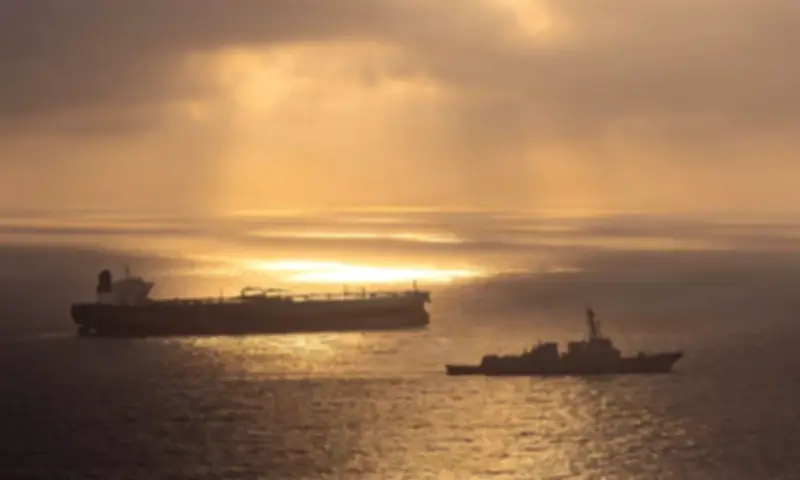
President Donald Trump is advancing a radical transformation of US military strategy, proposing that American forces operate as a paid security service for allies rather than upholding traditional alliance commitments. In recent remarks, Trump has framed military protection as a commodity to be purchased, including naval escorts through the Strait of Hormuz and a broader guardian role financed by Middle East oil revenues.
Transactional Shift in Security Policy
Washington has historically justified its global military presence as serving America’s own economic and security interests. Trump’s approach replaces that logic with a transactional model where military intervention is expected to generate direct financial returns. According to Politico, Trump administration officials have explored ideas to encourage reluctant shippers to return to the Strait of Hormuz after the US-Iran ceasefire deal, including a VIP pass system where shippers pay for US naval escorts.
In an interview with the New York Times’ David Sanger, Trump suggested that if Iran violates its deal, he might make the United States “the guardian of the Middle East” in return for 20 percent of the region’s revenues—effectively a regional police force paid in oil money. Trump expanded on this in a Truth Social post, stating that no tolls would be imposed in the Hormuz Strait during a 60-day ceasefire period, but afterward, tolls could be imposed by the US for “services rendered as the Guardian Angel to the countries of the Middle East.”

From Carter Doctrine to Mercenary Model
This marks a departure from Trump’s earlier skepticism of costly military deployments and foreign wars. The Carter Doctrine of 1980 held that any attempt to gain control of the Persian Gulf region would be regarded as an assault on US vital interests, justifying military action to ensure oil flow. Trump’s vision replaces that with a system resembling a state-backed mercenary force, akin to Russia’s Wagner Group or state-run paramilitaries in Africa.
Political scientists Henry Farrell and Abraham Newman have described this evolution as the “enshittification of American power,” borrowing from Cory Doctorow’s term for online platforms that degrade quality to extract value. The US has locked allies into a security framework and is now jacking up fees.
Diminished Appeal and Capability
However, potential customers may be reconsidering. The disappointing results of the Iran war, depleted US military resources, and regional diversification of alliances raise questions about demand. The conflict with Iran taxed US missile and interceptor stocks, forcing resource diversion from other hotspots. Trump recently gathered defense contractors at the White House to pressure them to ramp up production.
Moreover, US military dependence on private contractors like SpaceX and Anthropic creates vulnerabilities. During the Iran war, SpaceX raised internet connectivity prices for US kamikaze drones, and Anthropic pushed back on product use. As Farrell and Newman noted in Wired, Ukraine’s reliance on Starlink became a liability when Elon Musk cut service in 2022.
Gulf countries were already reconsidering reliance on the US before the war, which ended with Iran’s regime intact and its missile and nuclear programs largely preserved. Trump has even said it’s fair for Iran to have ballistic missiles given regional rivals’ capabilities. Talks are now ongoing for a regional security framework including Gulf countries and Iran but excluding the US.
Short-Term Profit Over Long-Term Security
Trump’s guardian role may resemble a landscaping service—periodic missions to degrade adversaries rather than achieve lasting security. This reflects Israel’s “mowing the grass” doctrine, which Trump has embraced. The notion of everlasting peace promised after the Gaza ceasefire deal a year ago has given way to a transactional, profit-driven approach that may leave the US without customers for its military services.