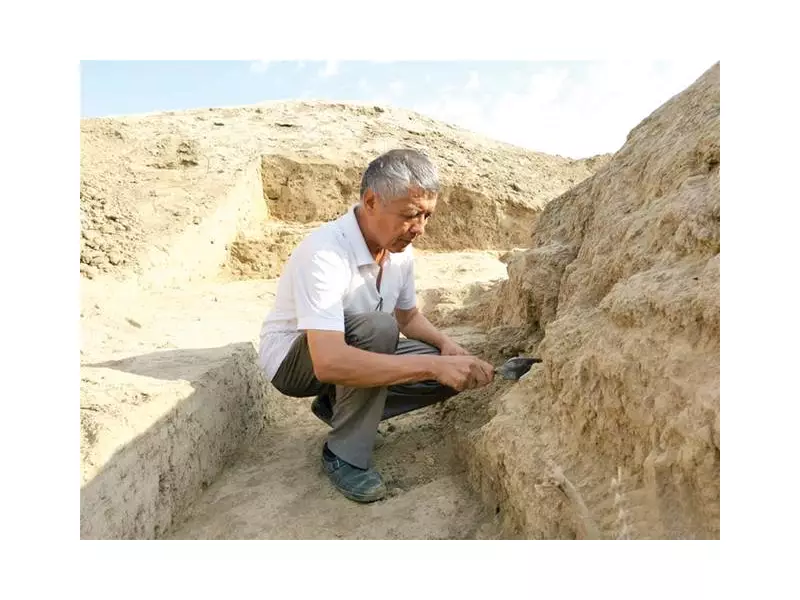
A groundbreaking discovery has emerged from the sands of time in Uzbekistan, thanks to the diligent work of a joint archaeological mission. Chinese and Uzbek researchers have successfully unearthed the remains of ancient city walls, shedding new light on the region's rich historical tapestry and its pivotal role along the legendary Silk Road.
A Collaborative Effort Yields Historic Results
The significant find is the result of a collaborative project between the Institute of Archaeology at Uzbekistan's Academy of Sciences and a team from China's Northwest University. This partnership, focused on the ancient site of Mingtepa, has proven exceptionally fruitful. The excavation efforts, which concentrated on the site's northern section, led to the remarkable discovery of the city's defensive structures.
Archaeologists meticulously uncovered a section of the ancient city wall, revealing its impressive construction. The wall features a main section measuring 11 meters in length and 2.5 meters in height. Flanking this central structure are two protruding watchtowers, or bastions, which would have served as critical defensive and observational points for the city's inhabitants. This architectural layout provides tangible evidence of sophisticated urban planning and military defense strategies from a bygone era.

Dating the Discovery and Understanding Its Significance
The unearthed walls are not merely stone and earth; they are a direct portal to a specific period in history. Based on the analysis of artifacts and construction techniques found at the site, researchers have confidently dated the structures to between the 1st and 4th centuries AD. This places the city's active lifespan squarely within a vibrant period of Silk Road trade and cultural interchange.
The discovery at Mingtepa is monumental for several reasons. Firstly, it provides the first physical evidence confirming historical descriptions and theories about the city's layout and fortifications. Prior to this excavation, knowledge of Mingtepa's urban design was largely based on texts and surface surveys. Secondly, the findings offer invaluable insights into the construction methods, military architecture, and daily life of a key settlement along the Central Asian segment of the Silk Road. Understanding how such cities were built and defended helps historians piece together the political and economic dynamics of the region.
Broader Implications for Silk Road Studies
The success of the Chinese-Uzbek team at Mingtepa transcends the discovery itself. It stands as a powerful testament to the value of international scientific cooperation in uncovering shared human heritage. The Silk Road was a network that connected diverse civilizations, and its study today benefits immensely from collaborative efforts that pool expertise and resources from different nations.
This discovery adds a crucial piece to the complex puzzle of Central Asia's ancient history. It allows scholars to better understand:
- Urban Development: How cities along trade routes were planned and expanded.
- Cultural Exchange: The movement of ideas, technologies, and goods through sites like Mingtepa.
- Historical Geography: The mapping of ancient political and commercial landscapes.
The ongoing analysis of the site and its artifacts promises to yield even more information in the future. Each layer of soil removed brings researchers closer to comprehending the full scope of life in this ancient city. The joint mission has announced plans to continue its work, suggesting that further revelations about Mingtepa and its role on the Silk Road may be forthcoming.
For historians, archaeologists, and anyone fascinated by the ancient connections between East and West, the unearthing of Mingtepa's walls is a reminder that history is still being written—or rather, uncovered—one careful excavation at a time.