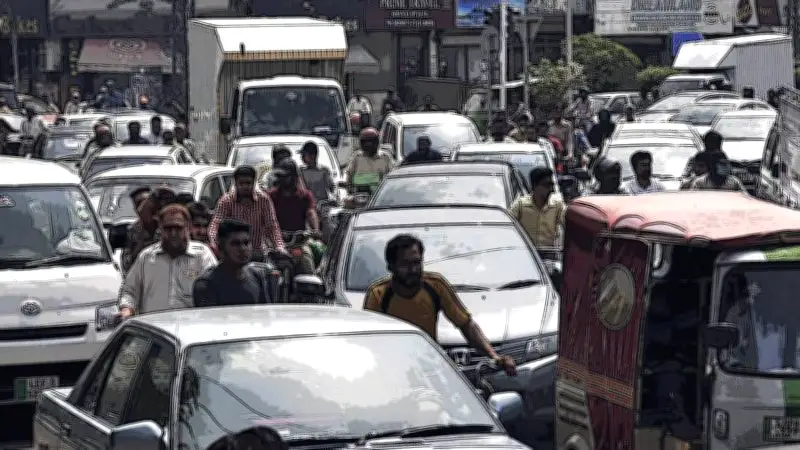
At the gates of Karachi Port, just after dawn, a line of container trailers stretches so far back that drivers switch off their engines and settle onto makeshift charpoy beds laid out on the tarmac. Inside the customs zone, a shipping agent checks his watch for the tenth time. His vessel, a Panamax carrier laden with 8,000 tonnes of rice bound for East Africa, should have begun loading two hours ago. The hauliers carrying the cargo are still crawling through the Mauripur Road snarl, trapped in a tangle of water tankers, overloaded mini-trucks, and the exhaust-belching motorcycles that have become Karachi’s default mobility.
The Wealthy Are Not Immune
The agent, a polished man in his late forties who sends his children to private schools and moves between air-conditioned spaces, experiences a kind of helplessness that no amount of wealth can buy off. In this city, no one escapes the gridlock—not the factory floor worker, not the stockbroker, not the multinational executive. The difference is that the wealthy can afford to insulate themselves better, but the insulation is wearing thin, and with it the patience of the one percent whose investments drive the nation’s economy.
Karachi’s traffic paralysis is too often dismissed as an unfortunate quirk of a chaotic city, a punchline for dinner-party conversation in the air-conditioned drawing rooms of Clifton and DHA. The reality is starker and far more consequential. This is not a nuisance; it is an economic haemorrhage that bleeds Pakistan’s most vital urban engine day after day, slowing the movement of goods to its two deep-water ports, suffocating labour productivity, and eroding the very competitiveness that keeps the country’s exports alive.

Karachi's Economic Weight
Karachi contributes at least 20 percent of Pakistan’s gross domestic product and more than half of all federal tax receipts, yet its policymakers have spent decades treating its mobility not as a foundation of national prosperity but as an afterthought, a problem to be solved with a succession of disconnected flyovers bearing the names of incumbent politicians. The result is a city where a freight container spends nearly as much time crawling 30 kilometres from a factory in Korangi to Port Qasim as it does crossing the Arabian Sea.
To understand the true magnitude of the crisis, one must look not at the distant hope of a metro but at the asphalt arteries that feed the ports. Karachi Port and Port Qasim together handle roughly 95 percent of Pakistan’s seaborne trade—over 3.5 million twenty-foot equivalent units of containers each year, along with millions of tonnes of bulk grain, coal, cement, and petroleum products. Every export shipment, whether it is a consignment of denim jeans for a European retailer or a batch of surgical instruments destined for a hospital in Chicago, must first survive Karachi’s road network.
Industrial Heartbeat
The city’s industrial estates—SITE, Korangi, Landhi, North Karachi, and the emerging zones along the Superhighway—house more than 10,000 manufacturing units, from textile mills and pharmaceutical plants to steel re-rolling mills and electronics assemblers. They collectively employ an estimated 3 million workers, a labour force larger than the entire population of many sovereign nations. When these factories cannot get their raw materials in on time or ship finished goods without incurring punitive demurrage charges, the cost is not borne by the factory owner alone. It cascades through the supply chain, inflating the prices of everything from bread to banking services, and ultimately appears on the Pakistani state's balance sheet as lost foreign exchange and stunted growth.
What makes Karachi’s gridlock a tragedy of political design is that it is not primarily a consequence of poverty or a lack of engineering talent. It is, above all, a failure of institutional imagination and a wilful neglect of public goods in favour of private interests. The city’s elite, the executives who run the banks headquartered on I.I. Chundrigar Road and the industrialists who sit on the boards of export associations, have too often bought their way out of the chaos through private security convoys and residential enclaves with guarded gates.

Global Comparisons
The port of Singapore processes more than 37 million containers annually without generating the kind of urban paralysis that 3.5 million containers induce in Karachi. This secession of the wealthy from the shared urban experience has robbed the public sphere of the most influential voices that might otherwise have demanded a functioning mass transit system. Instead, the political class has found it far more expedient to cut ribbons at flyover inaugurations, delivering visible if fleeting relief to car owners, while leaving the fundamental geometry of the city untouched. A flyover at a choked intersection simply moves the bottleneck 500 metres down the road, but it photographs beautifully against a campaign banner.
The numbers reveal the depth of the dysfunction. Karachi’s registered vehicle fleet has swollen past 4.5 million, with motorcycles—now numbering more than 2.8 million—multiplying at a rate that far outstrips population growth. Cars and sport-utility vehicles account for another 1.2 million registrations, while the city’s bus fleet has collapsed to fewer than 30,000 units, most of them privately operated, poorly maintained, and running on routes designed for profit maximisation rather than public service. Every day, an estimated 24 million trips are made across a road network of just over 10,000 kilometres, of which only a fraction consists of arterials capable of handling heavy traffic. The average one-way commute now consumes well over 90 minutes, and for residents of the outer districts—Surjani Town, Malir, Keamari, Bahria Town—it is not unusual to spend five hours daily simply getting to work and back.
Cost of Congestion
The Asian Development Bank has placed the annual cost of congestion at a conservative $2 billion, a figure that grows steeper when one accounts for lost productivity, fuel waste, and the health consequences of air pollution so severe that Karachi’s particulate matter readings routinely spike into the hazardous zone.
Nowhere is the disconnect between ambition and action more maddening than in the saga of the Karachi Circular Railway (KCR). In the 1970s, this 43-kilometre loop carried up to six million passengers a month, knitting the port, the factories, and the dense inner neighbourhoods into a single accessible labour market. By the late 1990s, the KCR had been allowed to die a death of a thousand cuts: illegal encroachments sanctioned by powerful political patrons, stolen track, and a pervasive official indifference that treated rail as an afterthought. Today, the proposed revival of the KCR as an elevated, modern line carries a price tag of $2.5 billion and has spent so many years trapped in feasibility studies and memorandums of understanding that it has become a standing joke among urban planners. Meanwhile, the freight rail link that once carried containers directly from the port to inland dry ports has atrophied, forcing all that cargo onto roads never designed to bear it.
Political Economy of Paralysis
The political economy of this paralysis is worth dissecting. Multiple agencies—the Karachi Metropolitan Corporation, the Sindh Building Control Authority, the transport department, the traffic police, the cantonment boards, the Defence Housing Authority, and the provincial works ministry—hold overlapping and often conflicting mandates over land use, road construction, parking regulation, and transit operations. None is accountable for the whole. This fragmentation is not an accident of history; it is a durable arrangement that serves vested interests. Land-use decisions that encourage low-density sprawl on the outskirts benefit politically connected developers. The continued dominance of private minibuses and the absence of a regulated public bus franchise enrich owners who have little incentive to invest in fleet modernisation. Even the ubiquitous flyover projects generate lucrative contracts for construction firms that are frequent donors to political campaigns. In this ecosystem, the idea of a single metropolitan transport authority with the power to coordinate land use, integrate fares, and enforce exclusive bus lanes is a direct threat to too many entrenched players to be realised without a political fight that few leaders have been willing to pick.
Developed nations long ago recognised that their great commercial cities could not function on the basis of private-vehicle expansion alone. London, a city of comparable economic weight, imposed a congestion charge on vehicles entering its central district two decades ago, channelling the proceeds into a bus network that has since become one of the world’s best. The Port of London, though no longer the giant it once was, remains efficiently linked to the national rail and road grid, ensuring that freight does not choke the commuter. Tokyo’s private railway companies did not simply build stations; they built entire satellite cities around them, integrating retail, office, and residential space in a way that made the train, not the car, the default mode of movement. Singapore, an island city-state whose prosperity depends entirely on the frictionless flow of goods through its port, introduced a certificate-of-entitlement system to cap vehicle numbers, invested massively in its metro, and deployed electronic road pricing decades before any other Asian city considered it.
What Karachi Needs
Karachi does not need another flyover. It needs a compact between its citizens, its business elite, and its state that prioritises the swift, dignified, and low-carbon movement of people and freight over the narrow interests that have held the city hostage for decades. Seoul tore down an inner-city expressway, restored a buried stream, and redesigned its entire bus network with colour-coded routes and dedicated median lanes, demonstrating that even a megacity can reverse course when political leadership is committed to the public realm. Curitiba and Bogotá proved that bus rapid transit, when built with rigidly enforced exclusive corridors and integrated with land-use planning, can move millions at a fraction of the cost of heavy rail. All of these cities shared one common trait: they entrusted transport planning to powerful, technically competent, and politically insulated authorities that were allowed to operate with a time horizon of decades rather than electoral cycles.
Karachi, by contrast, has lurched from one half-measure to the next. The Green Line BRT, which opened in late 2021, was a genuinely transformative moment for the city’s central belt, carrying roughly 80,000 passengers daily along 21 kilometres from Surjani Town to the business district. The Red Line BRT, funded by a $503 million loan from the Asian Development Bank, promises to link the eastern suburbs with the industrial zones around Port Qasim once it begins service in 2025, using biogas-hybrid buses and off-board fare collection. A Yellow Line corridor has been sketched for the western districts, though its funding is uncertain. A small fleet of electric buses made a tentative debut last year, a symbolic bow to climate realities. Yet these are drops in a bucket that needs an ocean. Even if every announced project were completed tomorrow, Karachi’s mass transit network would serve at most 400,000 daily riders in a city that generates 24 million trips—a share of less than 2 percent. London’s public transport system, by comparison, captures nearly half of all motorised journeys, Tokyo more than 60 percent. The gap is not one of resources alone but of political will and institutional design.
A Serious Remedy
So what would a serious remedy look like? It begins, unglamorously, with the creation of a single metropolitan transport authority that controls arterial road space, bus franchising, parking policy, and fare integration across all modes—BRT, rail, ferries, and eventually private bus services. Without this consolidation, every new bus corridor will remain an island, and every transport investment will continue to be plundered by uncoordinated agencies pursuing contradictory objectives. Second, the city must prioritise the movement of goods every bit as much as the movement of people. A dedicated freight corridor linking the port terminals with the industrial estates and the national highway network, combined with a serious effort to shift containers back onto the rehabilitated rail line, would remove thousands of heavy trucks from city streets and slash logistics costs that make Pakistani exports uncompetitive. The KCR, even if built in phases and initially at grade on cleared rights-of-way, would reconnect the labour force of the inner city with the job centres near the port, reversing the spatial mismatch that forces millions into ruinous commutes.
Pedestrian and cyclist infrastructure, long treated as a charitable afterthought, must become a core concern. Karachi’s wealthiest residents may walk only from their air-conditioned SUVs to the door of a private club, but the vast majority of the city—factory workers, domestic help, students—walk considerable distances every day on surfaces that are either non-existent, broken, or occupied by parked motorcycles and vendors. Shaded, safe, and continuous footpaths, particularly along the dense corridors of Saddar, Liaquatabad, and Orangi, would pay immediate dividends in women’s mobility, road safety, and air quality.
Technology offers a more immediate multiplier. Adaptive traffic signals that respond to real-time flow, a single digital payment card usable across buses, BRT, and the eventual railway, and an intelligent freight logistics platform that staggers port-bound trucks outside peak hours could together extract meaningful capacity from the existing road network without laying a single new kilometre of asphalt. Financing for these interventions need not rely solely on an already over-burdened federal budget. Land-value capture around transit stations, a modest congestion charge on private cars entering the central business district, a surcharge on fuel dedicated to a public transport fund, and carbon credits tied to fleet electrification can all contribute to a revenue stream that is stable, predictable, and insulated from political patronage.
The Cost of Inaction
The political class must be forced to confront an uncomfortable truth: the interests of the construction and transport mafias that profit from the current chaos are not aligned with the interests of the country. Every hour that a container sits immobile on a road outside the port is a tax on Pakistani exporters, every motorcycle accident that kills a breadwinner is a drain on the public health system, and every day of delay in building a coherent transit network cements Karachi’s reputation as a city that cannot get out of its own way. The top one percent, who have long believed that their wealth can shield them from the city’s dysfunction, are beginning to realise that there is no fortress high enough to escape the cost of collective neglect. Their capital, after all, is tied up in the very factories, ports, and banks whose productivity is eroded by the daily paralysis.
Karachi does not need another flyover. It needs a compact between its citizens, its business elite, and its state that prioritises the swift, dignified, and low-carbon movement of people and freight over the narrow interests that have held the city hostage for decades. This is not a utopian demand; it is the baseline condition of any city that aspires to compete in the 21st century. The textile worker from Surjani Town and the CEO in a DHA penthouse share a single, inescapable fate: they both need Karachi to move. The difference is that the worker has no choice but to endure the gridlock, while the CEO is rapidly running out of alternatives. When the pain of doing nothing finally exceeds the pain of reform, the political calculus will shift. The question is how much more economic damage, how many more lost export orders, and how many more wasted human lifetimes it will take to reach that breaking point. For Pakistan’s sake, it had better be soon.