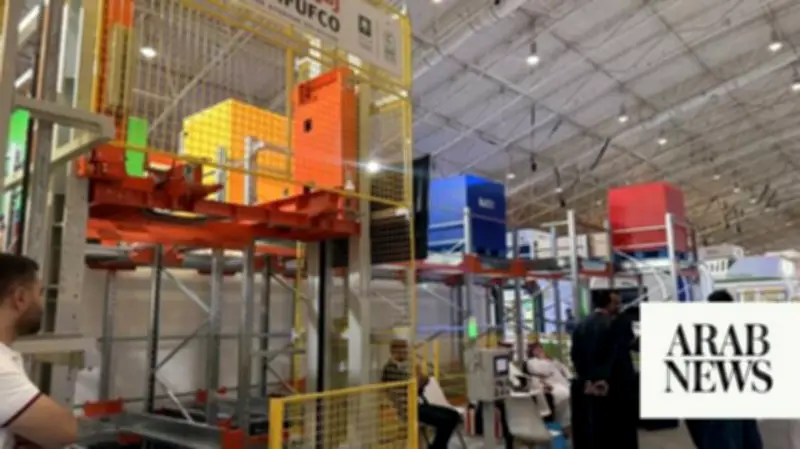
Automated Warehouses Transform Saudi Logistics
Inside an industrial warehouse located 150 km north of Riyadh, automated systems now lead storage and retrieval operations, replacing forklifts and manual labor. Storage capacity within the same floor space has risen significantly compared to traditional models, while workforces have shrunk from dozens of employees to just one or two.
Ahmed Al-Ansi, CEO of Rfufco, told Al-Eqtisadiah on the sidelines of an industrial conference in Riyadh that automated storage systems represent a paradigm shift in warehouse management, raising storage capacity by up to 70 percent compared to conventional warehouses. The exhibition, Riyadh International Industry Week, opened earlier this week with participation from more than 400 exhibitors from over 20 countries, alongside investors, experts, and decision-makers, as the Kingdom continues to accelerate efforts to diversify its economy under Saudi Vision 2030.
Rfufco: A Saudi Storage Solutions Pioneer
Rfufco is a Saudi company specializing in storage solutions and systems, founded roughly 20 years ago. Its factory is located in Sudair City, spanning 25,000 sq. meters, and is engaged in the design, manufacture, and installation of various warehouse storage systems. It serves clients across different regions of the Kingdom and exports to Gulf countries.

Handling Speed Increases by 400%
Al-Ansi explained that these systems contribute to accelerating material handling by up to 400 percent by eliminating reliance on forklifts and manual processes and replacing them with automated systems that operate continuously. He noted that a warehouse previously requiring 20 to 25 workers can today be run by just one or two employees, with the ability to operate around the clock without interruption. He pointed out that the cost of these systems may be about five times higher than that of traditional warehouses, yet the return on investment is achieved in roughly two years.
Saudi Arabia is witnessing a rapid transformation in its storage and logistics sector, with the entry of smart warehouse systems and industrial automation that now offer advanced alternatives to traditional manually operated warehouses. According to Al-Ansi, logistics zones near King Khalid International Airport’s free zone are seeing a growing trend toward adopting fully automated systems over conventional warehouses.
Eliminating Aisles to Maximize Space
Hussam Abu Fares, commercial director of Rifaf, told Al-Eqtisadiah that the concept of smart warehouses relies on increasing storage density by reducing wasted space inside warehouses. He explained that automated storage and retrieval systems eliminate the internal aisles dedicated to forklifts and workers, allowing the entire warehouse floor to be used for storage. He noted that a 1,000-square-meter warehouse can go from holding 500 pallets under a traditional system to 5,700 pallets using automated systems.
Abu Fares said these systems rely on a combination of hardware and software, with warehouse design tailored to the client's operational data, including product types, weights, handling methods, and building height, which can reach up to 40 meters, enabling full vertical storage utilization.
Growing Demand Driven by Multiple Factors
Both Al-Ansi and Abu Fares said demand for smart warehouse solutions in the Kingdom is on the rise, driven by the expansion of e-commerce, the evolution of supply chains, and the shifts brought about by the post-COVID era. Abu Fares also highlighted a vertical lift module system, operating much like an elevator, in which materials are stored inside enclosed units with electronic access control and user permissions. He noted that this system is suited for small and medium-sized items, particularly high-value materials such as spare parts, electrical components, and cosmetics, given the high security it provides and the reduction in waste and theft.

He added that these systems have been implemented across various sectors, including energy, where the Saudi Energy Co. collaborated with the manufacturer to adopt this type of solution. The system is manufactured domestically in several models with heights ranging from 6 to 15 meters and is capable of bearing loads of up to one ton. This trend reflects a broader transformation in the storage sector, where warehouses are no longer merely conventional spaces but have become operational systems powered by automation and software to boost efficiency and reduce costs.