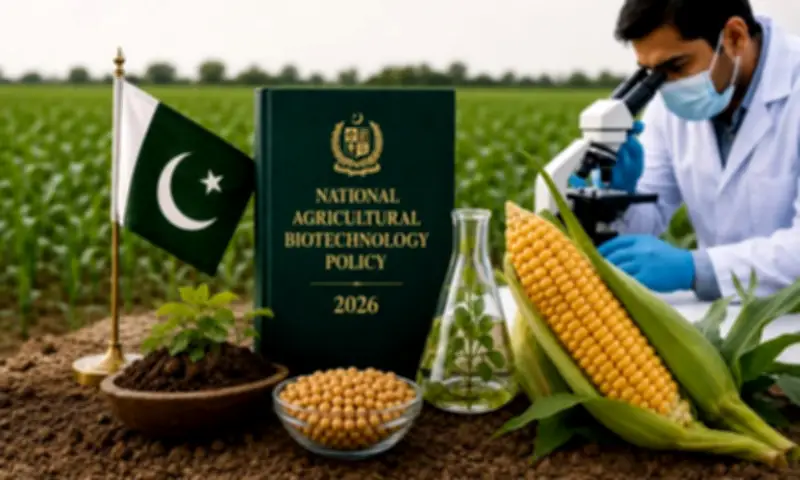
CropLife Pakistan Association has expressed strong support for the government's approval of the National Agricultural Biotechnology Policy and the National Seed Policy 2026, urging immediate commercialisation of genetically modified (GM) maize. The association's Executive Director, Rashid Ahmed, praised Prime Minister Shehbaz Sharif and the Federal Cabinet for these landmark decisions, which he said demonstrate a commitment to improving food security, increasing agricultural productivity, and supporting farmers through innovation.
Policy Approval a Milestone for Agriculture
The policies were approved in April 2026 after nearly two years of rigorous consultation involving over 30 sessions with government ministries, regulatory bodies, scientists, provincial representatives, private sector stakeholders, and other key partners. According to Rashid Ahmed, the National Agricultural Biotechnology Policy provides Pakistan with a clear pathway for the responsible adoption of modern agricultural technologies, including biotechnology, improved seed systems, and research-based innovation.
Ahmed expressed concern over recent misleading claims in the media and urged all stakeholders to rely on verified data and factual evidence. He specifically rejected inaccurate claims regarding biosafety work on GM maize in Pakistan.

GM Maize Trials and Commercialisation History
Ahmed clarified that some CropLife member companies were granted licenses to begin GM maize trials in 2009. Multi-year trials for insect protection and herbicide tolerance were conducted in different regions with approvals from the Technical Advisory Committee (TAC) and the National Biosafety Committee (NBC) under the Pakistan Biosafety Rules and Guidelines 2005. All statutory requirements were fulfilled, and the trial data was reviewed by the Field Monitoring Committee, TAC, TAC Subcommittee, and NBC.
Following these trials, companies were granted commercialisation approval in 2016/17. However, due to the absence of a comprehensive biotechnology policy at that time, these commercialisation licenses expired after the standard three-year period. Ahmed emphasised that the licenses were not suspended or cancelled due to any safety concerns, contrary to incorrect framing in the media.
Global Adoption of GM Maize
Responding to claims that China has not adopted GM maize, Ahmed clarified that China is proceeding through a regulated and phased approval process. China's Ministry of Agriculture and Rural Affairs has granted biosafety certificates, variety registrations, and seed production and operation licenses for several GM maize and soybean varieties. These approvals include varieties developed by leading Chinese companies for glyphosate tolerance and resistance to selected insect pests.
Ahmed also addressed claims that India has rejected GM maize technology. India's Genetic Engineering Appraisal Committee has allowed multinational corporations to conduct confined field trials of selected GM maize events that provide herbicide tolerance and insect resistance.
He noted that Pakistan started regulatory trials for GM maize in 2009, when only the Philippines had adopted GM maize in Asia. Since then, countries such as China, Indonesia, and Vietnam have moved forward, while Pakistan is still waiting to commercialise the technology.
Economic Impact and Export Potential
Addressing concerns about contamination risk, Ahmed stated that the majority of maize grain in Pakistan is used by the poultry and animal feed industries. These industries already utilise imported GM soybean and GM canola as feed ingredients. Therefore, GM maize grain production would enter a feed market already familiar with and reliant on GM products.
Ahmed added that maize seed producers in Pakistan already follow isolation-distance and quality-control protocols to maintain seed purity, and similar stewardship measures can be applied for the responsible adoption of GM maize hybrids. Pakistan earns approximately $350–400 million from maize exports, including grain, forage, and fodder. This export value can increase if farmers adopt better maize technologies, including GM maize hybrids, that improve crop quality and production.

Referring to local wet millers' role in maize exports, Ahmed said they contribute only less than 9% of Pakistan's total maize exports, with the remaining export share coming from other market players.
Misinformation and the EU Market
Ahmed also discussed a common myth regarding the EU being non-GM, which he called totally misleading. The EU is the second largest importer of GM grain for food, feed, and processing. He warned that years of uncertainty driven by misinformation and vested interests have weakened confidence in Pakistan's policies and regulatory system.
Ahmed concluded that technology developers cannot keep waiting indefinitely. If GM maize commercialisation licenses are not renewed now, Pakistan will fall further behind in agricultural innovation, investment will move elsewhere, and the real losers will be Pakistan's farmers, who will be deprived of urgently needed technology that can improve productivity, income, and livelihoods.