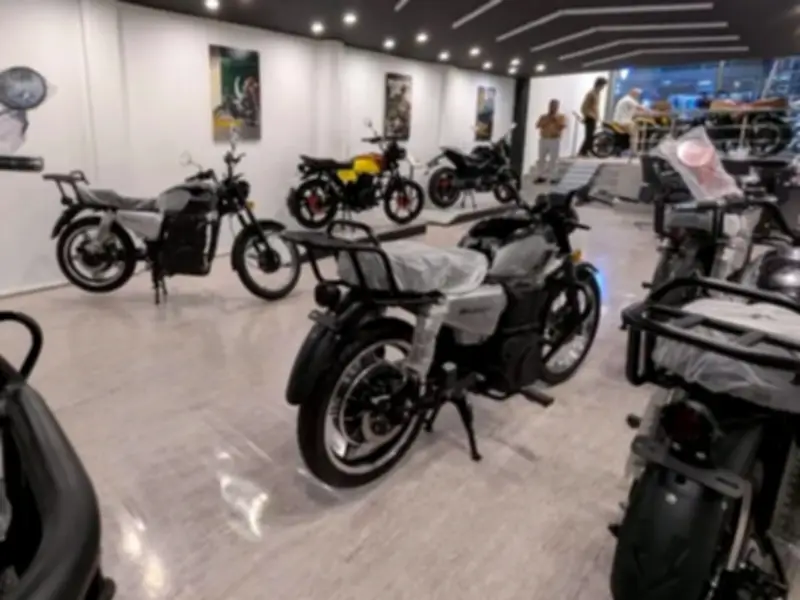
PESHAWAR: Electric bikes are rapidly gaining traction in Khyber-Pakhtunkhwa (K-P), particularly in Peshawar, as soaring fuel prices drive commuters toward more economical transportation options. However, the absence of charging stations, frequent power cuts, and ambiguous registration procedures cast doubt on the sustainability of this emerging trend.
Market Expansion Amid Infrastructure Gaps
In Peshawar, the e-bike market is expanding swiftly, especially in areas such as Gulbahar, Kohati Gate, Sarki Gate, Saddar, Tehkal, and Ring Road. Despite this growth, charging infrastructure remains virtually nonexistent across the province. No charging facilities are available in public parks, bus terminals, markets, or key entry points to the city. Neither the government nor private enterprises have made any plans for establishing e-bike charging stations, jeopardizing the future of this nascent small-scale industry, even as investors from K-P have poured millions of rupees into the sector.
Registration Delays and User Experiences
The Excise Department of Khyber-Pakhtunkhwa has yet to begin registering e-bikes, even though hundreds of electric bikes have appeared on the roads in recent weeks. Asif Khan, who has been riding an e-bike in Peshawar for three months, shared his experience: he purchased an e-bike for Rs200,000. "There was no load shedding during winter, but now unannounced electricity outages have made it very difficult to charge the bike for five to six continuous hours. Due to incomplete charging, the bike does not perform as expected. Now we only use it for going from home to the tandoor or nearby market," said Khan.

Types of E-Bikes and Charging Challenges
Abdul Ghani, who runs an e-bike showroom in Peshawar, explained that three types of electric bikes are being imported from China: priced at Rs90,000, Rs150,000, and Rs250,000. These bikes can travel 70 to 80 kilometers, and their batteries require six to seven hours of continuous charging. "If the batteries are not fully charged, the bikes do not deliver proper performance. These bikes can only work if they are fully charged, but in areas with load shedding or low voltage, they are not very effective," Ghani noted.
Regional Power Outages
According to information gathered by The Express Tribune, southern districts of Khyber-Pakhtunkhwa face 18 to 20 hours of load shedding, while Malakand experiences eight to 10 hours. Similarly, urban areas of Peshawar face 10 to 12 hours of load shedding, while suburban areas experience 14 to 18 hours. In regions with prolonged power outages, charging these bikes remains the main and most basic issue.
Student Perspectives
Naveed Khan, who bought an electric bike for commuting to college, told The Express Tribune that electric bikes are good for short-distance travel. "If charging units were established at colleges, universities, and public places, these bikes could become a very useful mode of transportation," urged Khan.
Registration Woes
Surprisingly, hundreds of electric bikes are operating on the roads of Peshawar, but none of them have any formal registration. Just as Peshawar has around 400,000 to 500,000 motorcycles, of which only about 150,000 are registered while the rest operate without registration, electric bikes are now also being used without any formal registration. Masood Khan, Excise and Taxation Officer of the Excise Department in Peshawar, noted that the same laws that apply to motorcycle registration will also apply to e-bikes. "Citizens will be able to register their e-bikes with the Excise Department, and a comprehensive plan is currently being prepared for this purpose," claimed Khan.