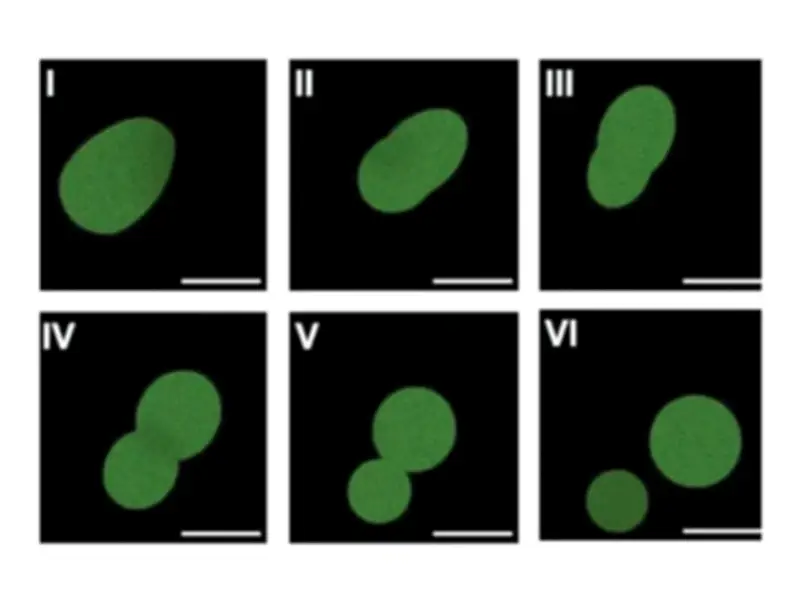
Researchers have created tiny, quivering blobs called SpudCells that use lab-made DNA to feed, grow, and multiply, claiming they are closer to creating life from scratch. According to a report in The Guardian, these synthetic cells were built from chemical compounds and are the first to demonstrate the complete cell cycle of growth, genetic replication, and splitting to produce the next generation.
Breakthrough in Synthetic Biology
Dr. Kate Adamala, who led the research at the University of Minnesota, said: "It is not as robust, as fast, or as good at most of its functions as a natural cell, but it is proof of principle that molecules can reconstitute behaviours that up until now we only associated with natural living cells. If we want to be able to engineer biology, we really have to understand exactly the blueprint, every component of it, so we know what we're changing."
The work raises the prospect of artificial organisms designed to produce drugs, foods, fuels, and other materials. It may also shed light on how inanimate matter crosses the threshold to become life.

Building SpudCells from Scratch
Unlike previous efforts that modified natural cells, Adamala's team built SpudCells from the bottom up to ensure every component was known. They started with tiny water-filled spheres called liposomes, a few thousandths of a millimetre wide, and added synthetic DNA to provide basic functions. The name SpudCells evokes Sputnik and the space age, but also reflects Adamala's Polish heritage: "I'm mostly made of potatoes."
SpudCells work only in a liquid rich with vital chemicals like ATP, the main energy-carrying molecule. To grow, they fuse with minuscule "feeder" liposomes containing molecules, enzymes, and ribosomes needed to make proteins. The SpudCell's genome carries instructions to copy its genome and divide.
Evolution and Competition
To mimic survival of the fittest, researchers showed that SpudCells with a genetic growth advantage spread through the population, outcompeting original SpudCells. Prof. Tom Ellis at Imperial College London called this the field's "biggest breakthrough in recent times." He added: "Making a synthetic cell helps us understand the exact minimum requirements for life and how life might have emerged from chemistry."
Limitations and Future Goals
SpudCells are not alive but could become a chassis to build life. They rely entirely on the liquid's substances, cannot build protein-making machinery, control metabolism, or clear waste. When they divide, they often pass on the wrong amount of DNA and conk out after a few generations. Adamala and others are launching Biotic, an institution to pool global expertise and improve SpudCells. Co-founder Prof. Drew Endy, a bioengineer at Stanford University, aims to build "an operating system for life" from genes and biochemistry.
The study has been released as a preprint for peer review, allowing other labs to scrutinize the work.
Philosophical Questions
Prof. John Dupré, a philosopher at the University of Exeter, questioned the point of synthetic cells for making drugs, food, or fuel compared to modified bacteria. He said: "It will provide a compelling argument against those who think there is some immaterial substance that breathes life into material stuff. But almost no scientist now believes this." He added: "What is missing is the relational aspect of life, which is almost universally symbiotic."