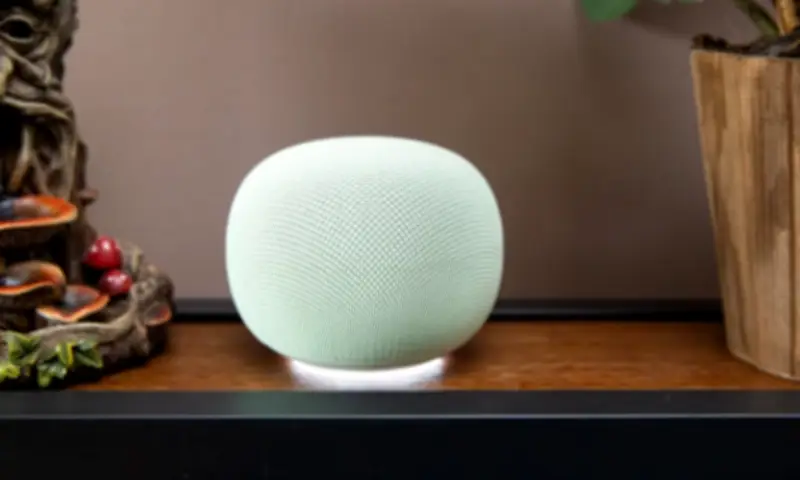
The Google Home Speaker is the company's first new smart speaker in six years and its first built for Gemini. Priced at $99.99, the hardware is a delight: the Goldilocks of smart speakers, big enough to sound good, small enough to blend in, and inexpensive enough to consider buying more than one. However, Gemini for Home—Google's new AI-powered voice assistant—still feels unfinished, according to a review by The Verge.
Hardware Highs: Design and Sound
The Home Speaker fits seamlessly on a bedside table, kitchen counter, or paired under a TV. It comes in four colors: jade, berry, porcelain, and hazel. The soft green jade color blends in without being dull. The mesh fabric-covered body has no visible controls, and the subtle light ring at the base can be turned off in settings—a feature no other smart speaker offers. The invisible controls are much more responsive than previous Google speakers. A tap on top stops or starts sound or shuts up the assistant, and taps on either side adjust volume, with faint glowing dots confirming the touch.
Sound quality is good for its size, with 360-degree audio. Stereo pairing of two units provides a significant upgrade, delivering clear, crisp sound at high volumes. However, bass is lacking; for example, the bass drop in Bad Bunny and Rosalía's “La Noche de Anoche” is more of a bump. Compared to competitors—the $99.99 Echo Dot Max and the $129 HomePod Mini—the Home Speaker came in a close third in audio quality. The Echo Dot Max offered more bass and fuller sound, while the HomePod Mini was quieter but cleaner. The Home Speaker is loud and clear on mids and vocals, though they can stretch thin.

The Home Speaker is the first Google smart speaker that can pair with a Google TV Streamer as an audio output. Using two speakers provides simulated spatial audio. Streaming YouTube was great, with voices loud and clear. However, during a World Cup match, commentators sounded tinny, necessitating a switch back to a more expensive Sonos system. The feature only works with content played through the Streamer; switching HDMI inputs cuts audio from the Home Speaker.
Listening and Connectivity
The Home Speaker has three far-field microphones and a neural processing unit for background noise. It heard commands from across the room even during loud music, being more responsive than the HomePod Mini but slightly less than the Echo Dot Max. It is a Matter controller and the first Google Home audio speaker that acts as a Thread border router (currently Thread 1.3, with support for Thread 1.4 planned).
Software Lows: Gemini for Home
Gemini for Home works on all Google Home speakers, so there is little reason to upgrade if you have a Nest Audio or Nest Hub. The Home Speaker was not noticeably faster than the Nest Audio; some cloud requests took nearly 10 seconds, and even local commands like “Turn on the lights” sometimes lagged. Gemini handled complex requests well—e.g., turning off one room, setting the thermostat, and turning on lights in another room in one sentence—but took 10 seconds, while Alexa Plus completed the same request in under three seconds.
Gemini excels at natural conversational control. Saying “Hey Google, I’m cooking and I don’t want to get too hot” turned down the AC. “Hey Google, it’s too dark in here” brightened the lights. When the user said they thought someone was outside, Gemini offered to show the camera feed on a smart display and check locks. However, Gemini has poor memory: while following a recipe, it lost the thread after a pause. Gemini Live keeps conversations open but is invoked separately with “Hey Google, let’s chat” and cannot take actions for the home. It is behind a $10-a-month Google Home Premium subscription.
For general knowledge, Gemini is excellent, answering questions about World Cup brackets and summarizing matches without revealing scores. But as a household assistant, it is less dependable. Mid-cook, asking “When do I add the tomatoes?” resulted in Gemini requiring voice verification, despite Voice Match being set up. This happened frequently when adding items to a shopping list.

Trust Issues: AI Misses the Mark
The biggest problem with Gemini for Home is unreliability. It announced the correct song title for “La Noche de Anoche” but played a different song, then another incorrect one when corrected. When asked about changing the Home Speaker's voice, it insisted there were no alternative voices—though there are. On a Nest Hub Max, it hallucinated a list of names including Dimitrix, Impetus, Cameo, and Russell Gethy (actual voices are named after plants). It misinterpreted a thermostat command as a security request, suggesting an upgrade to Google Home Premium Advanced and spelling out the URL. TV controls were least reliable: sometimes “Turn on the TV and play YouTube TV” worked, sometimes Gemini claimed content was unavailable, and occasionally it announced an action but did nothing.
Similar hiccups occur with Alexa Plus. These are tradeoffs of replacing rigid voice assistants with more powerful LLMs. After five days of testing, the reviewer gives the edge to Alexa Plus and the Echo Dot Max. While Gemini for Home's inference skills are superior, Alexa Plus has narrowed the gap in general knowledge, offers better smart home controls, and allows voice setup of routines—something Google lacks. Alexa handles natural language queries and remembers context more smoothly. However, Gemini's voices, such as Violet (bright and British), are preferred over Alexa Plus voices.
Google Home does not have ads, unlike Amazon's Echo Show displays. But for the first time, Google is putting some features behind a paywall. The $10/month Standard plan unlocks Gemini Live and Help me create for building smart home automations. The $20/month Advanced tier adds Home Brief and AI-powered Nest camera features. The Home Speaker is a great piece of hardware, but Gemini for Home is not ready yet—it is slow, less reliable, and requires a subscription for its most interesting features.