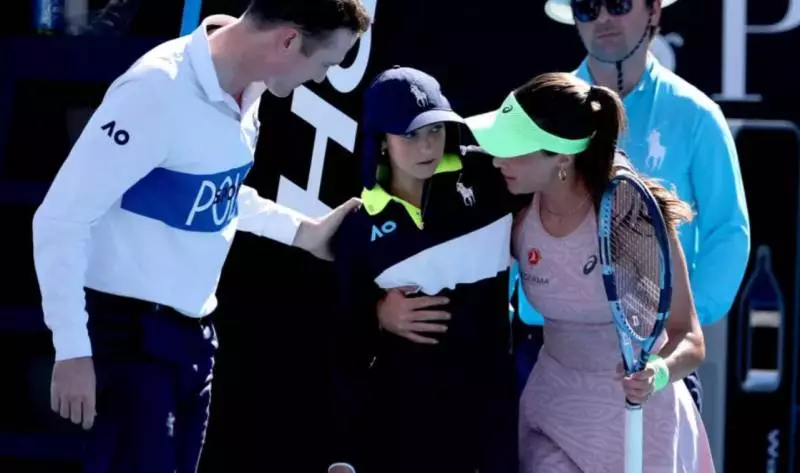
A severe heatwave gripping Melbourne brought play at the Australian Open to a dramatic halt on an outside court Tuesday, following a distressing incident where a ball girl collapsed due to the extreme conditions.
Scorching Conditions Halt Tournament Play
The incident occurred on Court 17 during a first-round match between Czech player Marie Bouzkova and France's Diane Parry. With temperatures soaring above 35 degrees Celsius and the heat index making it feel even hotter, the young official was overcome by the intense weather. Medical staff rushed to her aid, providing immediate treatment on the court before she was able to walk off with assistance.
In response to the alarming event and the dangerous playing environment, tournament officials made the decision to suspend all matches on the outside courts. This action was taken under the tournament's Extreme Heat Policy, which is designed to protect the health and safety of players, officials, and spectators alike.

Extreme Heat Policy Activated in Melbourne
The suspension, which began in the early afternoon, lasted for approximately three hours. Play only resumed after conditions had improved to a safer level. The Australian Open's heat policy is a structured set of guidelines that considers various factors, including ambient temperature, radiant heat, humidity, and wind speed. When these combined factors reach a predetermined threshold, officials can pause matches, close retractable roofs on the main show courts, and advise players on extended breaks.
This is not the first time the Melbourne heat has impacted the Grand Slam event. The tournament has a history of dealing with extreme weather, leading to the refinement of its heat rules over the years. The policy aims to balance the competitive schedule with the very real health risks posed by heat stress and heatstroke.
Broader Implications for Athlete Safety
The collapse of the ball girl underscores a critical concern in professional sports: the safety of all participants, not just the competing athletes. While players are often the focus of heat-related discussions, officials, ball crews, and line judges are equally vulnerable when stationed in direct sunlight for prolonged periods.
The incident has sparked renewed conversations about whether current measures are sufficient. Some observers and analysts are calling for even more proactive steps, such as:
- Mandatory cooling breaks for officials and ball crews, similar to those for players.
- Enhanced shaded areas and cooling stations around all courts.
- Stricter thresholds for suspending play to prevent incidents before they occur.
As climate patterns shift, sporting events worldwide are increasingly forced to contend with extreme weather. The Australian Open, as the first Grand Slam of the year, often sets a precedent for how the tennis world responds to these challenges. The well-being of the ball girl is paramount, and the swift medical response was a positive outcome in a dangerous situation. However, the event serves as a stark reminder of the escalating environmental pressures facing outdoor global sports.