The World Bank has highlighted severe spending disparities between provincial capitals and other districts in Pakistan, with Quetta receiving 475% more per person funds and Lahore 440% more compared to other districts in their respective provinces. The findings come from the Strengthening Fiscal Federalism report, which underscores growing inequality in human and infrastructure development despite a surge in provincial shares after the 7th National Finance Commission award of 2010.
Per Capita Spending Gaps Across Provinces
The report shows that per person spending gaps are relatively smaller in Khyber Pakhtunkhwa, where Peshawar received 335% higher spending than other districts. In Karachi, the disparity is the lowest but still significant, with the metropolis receiving 178% more funds than other districts. According to the World Bank, although the gap in real per capita spending between provincial capitals and other districts has narrowed since 2009, capitals continue to absorb a disproportionate share of resources.
In Quetta, per person spending stood at Rs57,000 compared to just Rs12,000 in other districts of Balochistan. In Peshawar, per capita spending was Rs35,000 against Rs10,000 in other districts. Lahore saw per person spending of Rs31,000 compared to only Rs7,000 in other districts. Fifteen years ago, per capita spending in Lahore was as high as Rs67,000 while in other districts it was Rs5,000. In Karachi, per capita spending was Rs25,000 compared to Rs14,000 in other districts.

Pronounced Disparity in Balochistan
The disparity is most pronounced in insurgency-hit Balochistan, where Quetta captures five times more per capita spending than other districts. The underdevelopment and lack of job creation are cited as key reasons for insurgency in the province. Despite being cash-rich and running budget surpluses, the provincial government has not addressed the imbalance.
The World Bank noted that in Punjab, real per capita spending in Lahore remained approximately four times higher than in other districts, but the gap has narrowed mainly due to decreased spending in Lahore. Spending in other Punjab districts was almost stagnant. In Khyber Pakhtunkhwa, spending in Peshawar was about 375% higher, and in Karachi, 178% higher than other districts.
Allocations Not Aligned with Socioeconomic Needs
The report stated that district-level allocations continue to diverge from socioeconomic needs. There is an apparent inverse relationship between lagged poverty levels and current district-level per capita spending allocations. Wealthier districts consistently receive larger budgets, perpetuating a cycle of low-budget traps in poorer areas. This pattern is evident across all provinces and particularly pronounced in capital districts.
According to the World Bank, district-level allocations do not appear to be guided by any metric of socioeconomic needs, such as infrastructure, healthcare, or education. The absence of a clear connection between spending and needs may be undermining the quality and efficiency of provincial spending on key social services, contributing to slow progress in human development indicators since at least 2009.
Declining Local Government Spending
Spending at the local level remained very low. Despite constitutional provisions for local government, few additional resources allocated to provinces were made available to local governments. Provincial finance commissions have not been established, and ruling parties are reluctant to hold local elections on a party basis. The share of total government spending by local governments declined from around 10% in 2005 to about 4.7% in 2024, after the 18th Constitutional Amendment.
Quality of Spending in Education and Health
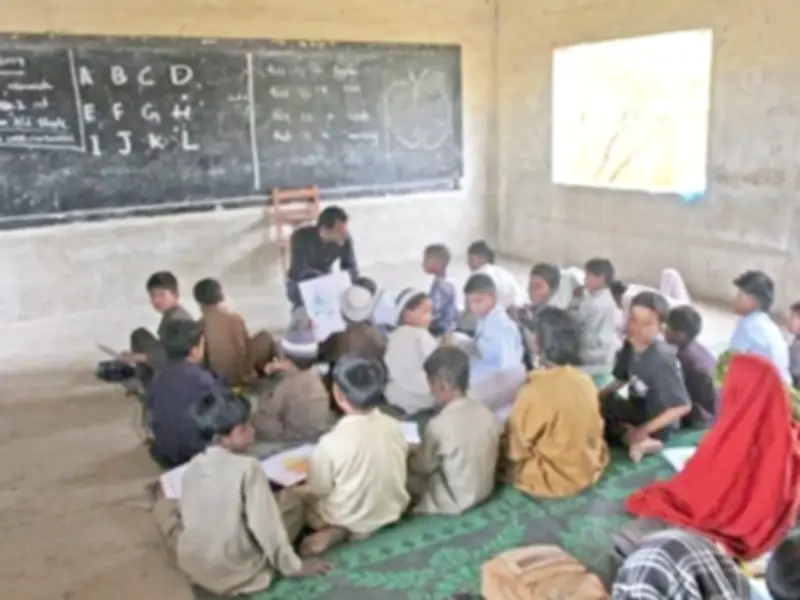
The report raised questions about the quality of spending, particularly in health and education. Despite increased spending, indicators in certain provinces worsened. In FY23, real per capita provincial spending on education in Khyber Pakhtunkhwa was less than one-third of Balochistan's level. However, K-P's net enrollment was 23% and adult literacy rate 9% higher than Balochistan, according to the 2024-25 Household Integrated Economic Survey. These gaps reflect factors including quality of public services, interprovincial income differences, and private sector provision.

According to the 2025 Annual Status of Education Report, 30 to 40% of children aged 6 to 16 were enrolled in private schools in Punjab, compared to 20 to 30% in Sindh and K-P, and less than 10% in Balochistan. During FY09-23, real per capita provincial spending on education increased between 200% and 650% in Punjab, Sindh, and Balochistan. However, net school enrollment fell by 4% in Sindh and 11% in Balochistan, while adult literacy declined by 1% in Sindh, based on the 2008-09 PSLM and 2024-25 HIES. In contrast, K-P achieved gains of 2% in net enrollment and 9% in adult literacy with virtually no increase in real per capita spending.
In health, real per capita provincial spending rose between 200% in Punjab and 440% in Balochistan over 15 years. Yet the share of the population living within 15 minutes of a health facility decreased by 3% to 18%.