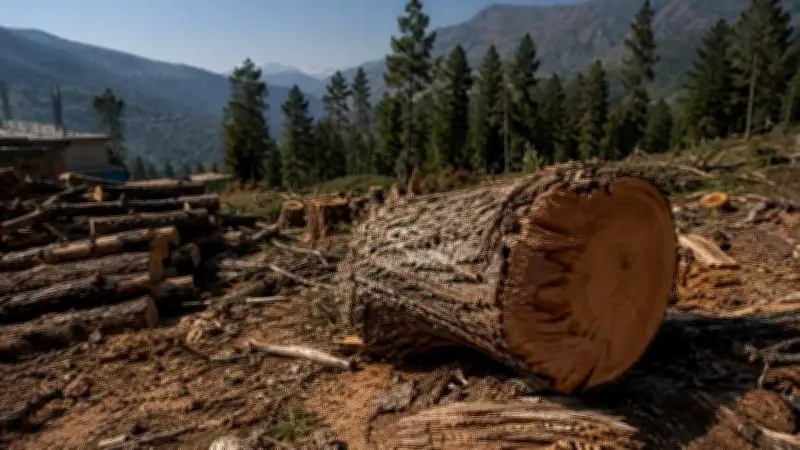
Climate change is no longer a distant warning in Pakistan; it is a daily reality marked by floods, glacial melt, droughts, heatwaves, and falling crop yields. In this crisis, forests have become a matter of national survival, yet governance systems still treat them as timber banks. The uncomfortable truth is that many forest policies prioritize extraction over protection. The phrase 'scientific forest management' has often been twisted to justify commercial logging. In practice, forests are valued not for the climate, water, and livelihoods they protect, but for the revenue they generate when cut.
The Imbalance in Forest Governance
This imbalance is no accident. Conservation offers few immediate financial gains to powerful stakeholders, while cutting delivers quick profits. The result is a system of perverse incentives that quietly favors exploitation, even as standing forests provide vastly greater long-term value to society. Forests are natural infrastructure: they regulate climate, reduce floods, prevent erosion, recharge groundwater, and sustain vulnerable communities. Pakistan cannot credibly pursue climate resilience while allowing weak governance and commercial interests to destroy its forest wealth.
Socio-Economic Realities of Forest Communities
We must also recognize an uncomfortable socio-economic reality: for many mountain communities, timber remains the primary source of energy, heating, shelter, and construction material. These populations live on the margins of the national economy and possess longstanding rights over local lands and forest resources. As noted by Arshad Durrani, a senior member of the Sustainable Conservation Network (SCN), forest governance cannot ignore the survival needs of vulnerable communities. At the same time, urban demand for timber continues to rise unchecked. He observes that while rural communities depend on forests for basic needs, affluent urban consumers often drive commercial timber extraction for aesthetics and luxury construction — despite having access to alternative fuels and materials. This imbalance exposes a deeper injustice within forest governance.

Climate Goals and the Need for Policy Reform
Durrani further argues that meaningful climate action requires the government to end incentives that encourage timber flows from fragile mountain ecosystems to expanding urban markets. Echoing the 2006 Stern Review on climate economics, he stresses that drastic action is now essential to prevent irreversible environmental decline. The issue, therefore, is not simply forests versus livelihoods. It is about designing policies that protect ecological systems while ensuring dignified alternatives for forest-dependent communities. Environmental sustainability and economic justice cannot be separated.
Expert Perspectives on Forest Management
As noted by Muhammad Rafiq — internationally recognized forestry, biodiversity, and sustainable development expert, former senior officer of the Khyber Pakhtunkhwa Forest Service, former senior leader with the International Union for Conservation of Nature Pakistan and the Rainforest Alliance, and senior member of the Sustainable Conservation Network (SCN) — 'There is an urgent and compelling need for a fundamental rethink of the purpose of forestry and forest management in Khyber Pakhtunkhwa. That is where the most pivotal shift is needed for policy reorientation and corresponding reforms in legislation and implementation.' He argues that forest governance has gradually drifted away from conservation towards extraction, where 'scientific management' is too often interpreted through the lens of timber revenue rather than ecological security.

The high-profile Breathe Pakistan movement launched by Dawn from 2025 onwards has also helped bring climate and environmental concerns into mainstream national discourse, highlighting the widening gap between official narratives and ecological realities on the ground. As Dr. Adil Zareef — founding member of the Sustainable Conservation Network (SCN), an advocacy group for sustainable development and conservation — argues, 'Public statements by the federal government, and particularly the Khyber Pakhtunkhwa government, stand in sharp contrast to the realities on the ground. Discussions around carbon credits ring hollow in the face of illegal and large-scale deforestation in Khyber Pakhtunkhwa, reflected in Global Forest Watch estimates showing an annual forest cover loss of nearly 1.5 per cent. Even these figures may underestimate the actual scale of deforestation in the province.'
Urgent Need for Fundamental Reform
We must move beyond symbolic plantation drives. What Pakistan urgently needs is a fundamental reform of forest laws and policies — redrafted not around timber calculations, but around ecological sustainability, climate adaptation, watershed protection, and community resilience. This reform must include ground-level realities. Forest-dependent communities, environmental experts, and local stakeholders possess knowledge that top-down planning routinely ignores. Conservation fails without understanding local pressures and governance failures.
There is also a deeper crisis of trust. Many citizens no longer believe forest departments can independently safeguard our woodlands when institutional incentives remain tied to extraction. Political leadership has too often prioritized short-term gains over long-term environmental security. Yet meaningful change does not require unanimous support. History shows that even one sincere policymaker in authority — willing to listen and act in the public interest — can transform the policy environment. Environmental reform has always begun with a few committed voices.
The Window of Opportunity
Pakistan still has time, but the window is closing. Climate change demands that we stop treating forests as commercial assets and recognize them as ecological lifelines central to national resilience. As the renowned ecological economist Herman Daly rightly stated, 'The economy is a wholly owned subsidiary of the environment, not the reverse. Without ecology, there is no economy.' If our policies continue to value timber more than ecosystems, the price will be devastating: worse floods, drier fields, hungrier communities, and a hotter country. The question is no longer whether forests should be conserved. It is whether our policies are genuinely designed to conserve them at all.
On 26 May 2026, a huge sheesham tree trunk was seen chopped and stacked for firewood in Lalazar Market, Hayatabad — a disturbing reminder of how deeply deforestation has penetrated everyday economic activity, often without any collective consciousness about its consequences for our future.