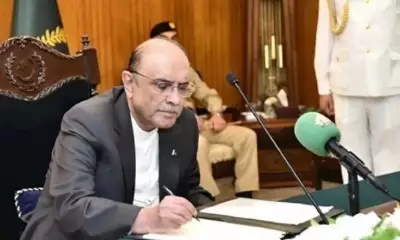
The Economic Coordination Committee (ECC) of the Pakistani cabinet, chaired by Finance Minister Muhammad Aurangzeb, approved a supplementary grant of Rs10.2 billion for the Hangor Project of the Pakistan Navy under the Armed Forces Development Package (RAFDP)-2030. This additional funding supports the development of Hangor-class submarines, the first of which was delivered to Pakistan in April during President Asif Ali Zardari's visit to China. According to the Pakistan Navy, these submarines are equipped with state-of-the-art weapons, advanced sensors, and air-independent propulsion systems, and will be crucial for maintaining maritime order and stability in the region. They are expected to deter aggression and ensure the security of vital sea lines of communication across the Arabian Sea and the wider Indian Ocean.
The ECC also approved Rs693 million for security arrangements during the first round of US-Iran peace talks hosted by Pakistan in Islamabad in April. The committee appreciated the successful conduct of talks and commended all stakeholders involved.
Additionally, the ECC restored Rs7 billion for discretionary spending under parliamentarians' schemes, which had been cut earlier as part of a Rs173 billion reduction in the federal development budget. The restoration aims to ensure continuity of development projects, prevent cost escalations, and achieve program objectives timely. However, allocations for critical water sector projects were not restored.

Other approvals included Rs241 million for compensation related to a suicide bomb blast at Imambargah Khadijah-tul-Kubra in Taralai, Islamabad; Rs528 million for operational needs of the Pakistan Land Ports Authority; Rs800 million for fast patrol boats and infrastructure for the Pakistan Coast Guards; and Rs1.9 billion for expanding Safe City Islamabad. The government plans to recruit 400 personnel for the National Cyber Crimes Investigation Agency, 219 for Safe City, 1,200 for Islamabad Traffic Police, and 400 for Islamabad Capital Territory Police.
The ECC also approved Rs150 million for the National Counter Terrorism Authority (NACTA) and Rs414 million for security charges related to the Reko Diq project. A sum of Rs733 million was released to Pakistan Television Corporation (PTVC) for salary requirements for June 2026, despite the information ministry's failure to make PTVC self-sustainable. Rs120 million was approved for increased salaries and allowances for parliamentary secretaries during FY 2025-26, amid the prime minister's austerity drive.
Development funds were placed into the current account of Pakistan Infrastructure Development Company Limited (PIDCL), including Rs8.8 billion for Karachi and Hyderabad urban infrastructure packages and Rs2.8 billion for parliamentarians' schemes in Khyber-Pakhtunkhwa. The finance ministry received a Rs1.3 billion supplementary grant for modernizing the Pakistan Mint. A Rs4.4 billion grant was approved for Gilgit-Baltistan to support current expenditures and priority initiatives.
The ECC also approved a policy for budget honorarium and allowed inclusion of the Ministry of Commerce, Ministry of Law and Justice, and the Office of the Accountant General Pakistan Revenues (AGPR) for routine budget work. Sovereign guarantees were issued to facilitate Pakistan State Oil (PSO) in obtaining Rs100 billion loans from Habib Bank Limited and the Bank of Punjab, Rs50 billion each. PSO faces acute funding shortages with receivables exceeding Rs903 billion, including a principal amount of Rs543 billion, and SNGPL owes Rs563 billion to PSO.