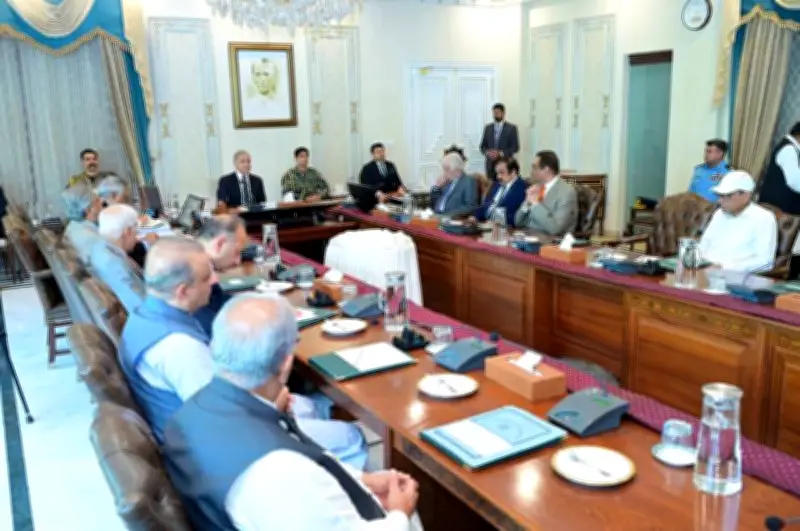
Prime Minister Shehbaz Sharif approved Pakistan's first-ever four-year Hajj Policy and Plan covering 2027 to 2030 during a federal cabinet meeting on Tuesday. The policy mandates transparent, merit-based appointments of Hajj assistants and third-party validation of both government and private Hajj operations to enhance services for pilgrims.
Long-Term Framework Approved
The cabinet endorsed the long-term Hajj framework aimed at improving planning, operational efficiency, and facilities for intending pilgrims. Federal Minister for Religious Affairs Sardar Muhammad Yousaf and his team were commended for successfully managing Hajj arrangements this year, according to a Prime Minister’s Office news release.
Unlike previous annual policies, the new framework provides a four-year roadmap to facilitate long-term planning. Standard operating procedures and regulations will be developed for implementation, with amendments to ensure compatibility with Saudi laws.

Key Features for Pilgrims
Under the approved policy, intending pilgrims can register once for any Hajj season up to 2030 instead of undergoing annual registration, enabling a priority waiting list. A Shariah-compliant Hajj savings scheme will help citizens plan financially for future pilgrimages.
The entire Hajj management system—including payments, complaints handling, and monitoring—will be digitized to enhance transparency and efficiency. The policy also provides separate quotas for government and private Hajj schemes, introduces long and short Hajj packages, and includes mandatory pilgrim training, Takaful coverage, and emergency response arrangements.
Merit-Based Appointments and Validation
Prime Minister Shehbaz Sharif directed that the appointment of Hajj assistants be carried out through a transparent and strictly merit-based process. He also instructed authorities to ensure independent third-party validation of services provided under both public and private Hajj schemes.
Healthcare Outsourcing Approved
The cabinet approved a policy to outsource services of the Isolation Hospital and Infectious Treatment Centre (IHITC) and the Regional Blood Centre (RBC) in Islamabad to improve healthcare quality. The Ministry of National Health Services was directed to complete the outsourcing process per prescribed rules.
Pakistan Railways Performance Reviewed
The cabinet reviewed Pakistan Railways' performance during a briefing by Railways Minister Hanif Abbasi. Railway revenues increased from Rs95 billion in 2024-25 to more than Rs115 billion in 2025-26, reflecting a growth of 24.19 percent.
The briefing highlighted over Rs8 billion increase in freight revenue, over Rs7 billion in other income, over Rs6 billion in property and land revenue, while passenger revenue rose by 3.37 percent. Improved operations and freight movement were key contributors. The prime minister and cabinet appreciated the railways minister and his team for enhancing financial and operational performance.
Ratification of Previous Decisions
The federal cabinet also ratified decisions from the Cabinet Committee on Legislative Cases (CCLC) meeting held on May 19, 2026, and the Economic Coordination Committee (ECC) meeting held on July 2, 2026.