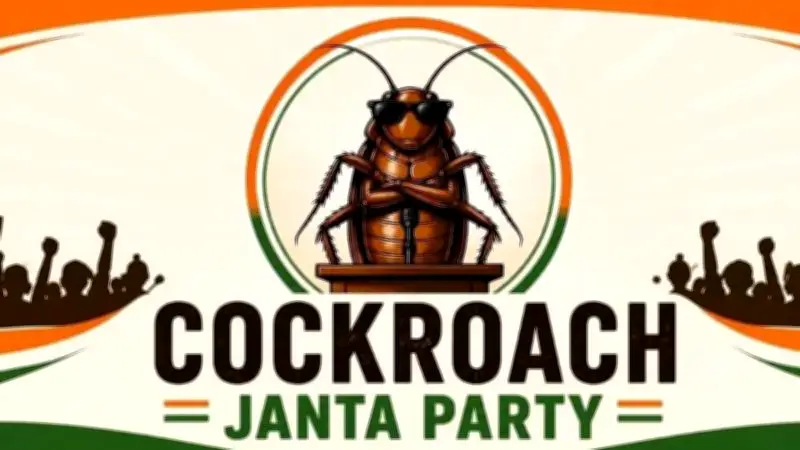
What began as a throwaway political joke mocking India’s political culture has transformed into one of the country’s most viral online movements. The “Cockroach Janata Party,” sparked by a Supreme Court quip, quickly mutated into a flood of memes, biting sarcasm, and raw public frustration. Within days, its follower count outpaced that of the ruling Bharatiya Janata Party’s official channels, a startling reminder of how satire can outstrip serious politics in reach and resonance.
Fueled by dark humor, absurd promises, and razor-sharp commentary, the parody campaign has struck a nerve with millions of young Indians. For Gen Z, it has become a cathartic outlet, a way to vent anger, exhaustion, and disillusionment with mainstream politics without the baggage of traditional activism. What unsettles the ruling establishment is not just the ridicule, but the déjà vu.
Political observers note the uncanny resemblance to the public mood that powered Anna Hazare’s anti-corruption crusade more than a decade ago. That wave of youth anger, irreverent slogans, and disdain for the political class eventually created the conditions for Narendra Modi and the BJP’s rise in 2014. Now, the sudden popularity of the “Cockroach Janata Party” is being read as a similar undercurrent, a generational frustration with the Modi government, expressed through satire rather than street protests. Whether it fizzles out as comic relief or snowballs into a serious political moment remains to be seen, but its viral energy has already exposed the fragility of India’s political establishment in the age of memes.

Background
The Congress Party’s second term under the late Dr. Manmohan Singh was overshadowed by a string of corruption scandals. Anti-incumbency had set in, and almost every audit report from the Comptroller and Auditor General of India (CAG) seemed to unearth a fresh controversy, from the coal block allocations to the Commonwealth Games fiasco and the infamous 2G spectrum scandal. In 2011, social activist Anna Hazare ignited the India Against Corruption movement, demanding the enactment of the Jan Lokpal Bill to curb graft. His indefinite fast at Delhi’s Jantar Mantar became the rallying point for a restless youth desperate for a cleaner political space. Support poured in from across the country; professionals took leave from work to join the protests.
The air was charged with slogans like “Main bhi Anna, tu bhi Anna; ab to sara desh hai Anna” (I am Anna, you are Anna, now the whole country is Anna). That summer, India witnessed an uprising unlike anything millennials had seen before. Crowds swelled, donations flowed, and the movement captured the national imagination. From this surge of public sentiment emerged the Aam Aadmi Party (AAP), which rode the wave of anti-corruption fervor to power in Delhi not once, but twice, and later formed the government in Punjab. Yet, a decade later, the sheen began to fade. Allegations of corruption, internal rifts, and high-profile defections chipped away at the party’s credibility, exposing the fragility of movements born in moments of rage but tested in the grind of governance.
Is History Repeating Itself?
By 2026, India’s political landscape will have witnessed a generational shift. Gen Z, the country’s first true digital natives, has given rise to the Cockroach Janata Party. Amid shrinking spaces for dissent, runaway inflation, compromised institutions, and repeated examination cancellations that have derailed academic calendars and employability, anger against the government is simmering across all levels. The Supreme Court’s remark likening unemployed youth to ‘cockroaches and parasites’ proved to be the final spark. The Cockroach Janata Party was born overnight, founded by Boston-based student Abhijeet Dipke. With a tongue-in-cheek five-point manifesto addressing the plight of unemployed youth, its eligibility criteria were deliberately absurd. Members must be jobless, lazy, chronically online, and skilled at professional ranting. Dipke even launched a Google Form for sign-ups.

Within days, the parody party amassed 20 million followers across social media, surpassing the Bharatiya Janata Party’s online presence. What began as satire quickly became a rallying cry. Politicians like Mahua Moitra and Kirti Azad joined the bandwagon, amplifying its reach. The Congress Party’s youth wing has sought to occupy the vacuum, launching its own campaign under the banner of “Real Cockroaches” to target the government over inflation and unemployment. For students like Astha Arora, who sat for the NEET medical entrance examination only to learn later that her effort was invalidated, the movement struck a nerve. “Why should a common student suffer because of the incompetence of the system? Who is accountable for our effort, money, and future? At least there is some party talking about the youth,” she says. Soon, “the Cockroaches” were trending across platforms, drawing global press attention. What started as a joke has become a symbol of generational frustration, echoing the same disillusionment that once fueled Anna Hazare’s anti-corruption movement. Whether satire evolves into substance remains uncertain, but the viral energy has already unsettled India’s political establishment.
This is No Congress Era, but Modi’s India
When Anna Hazare spearheaded the India Against Corruption movement, donations poured in from across the country. Those close to the developments recall how the movement, not registered as a formal body or non-governmental organization, channeled funds into multiple NGO accounts run by Arvind Kejriwal, Kiran Bedi, and other key figures at the forefront. Journalist and activist Raju Parulekar, once a confidant of Hazare, told The Friday Times that contributions were being diverted into these NGO accounts. Reflecting on the political climate then and now, he notes that the Congress government could easily have frozen those accounts, but chose restraint. “The Congress government understood the power of the voter in a democracy. They did not want to upset the people,” he recalls.
The contrast with today’s ruling establishment is stark. “To this government, elections and votes make no difference. They have their own formula for winning elections,” Parulekar adds. The implication is clear: where the Congress once hesitated to antagonize public sentiment, Modi’s India operates with a different calculus, one less concerned with voter backlash and more confident in its ability to secure power regardless of discontent.
After Farmers and CAA Protesters, Are Online Cockroaches a New National Threat?
Unlike the farmers’ agitation or the CAA protests, the Cockroach Janata Party was not born on the streets. Its members did not block highways or march to Parliament. Yet, in no time, the government’s IT Cell branded the parody party a “national threat from across the border” and moved to ban all its social media pages. In today’s era of digitization and artificial intelligence, social media is both a weapon of information and misinformation. While banning platforms may curtail negative publicity, Parulekar cautions, “The real revolution happens on the ground. Movements take shape when people put in their sweat and blood.” Indeed, while the online surge has rattled the establishment, dissent has yet to spill onto the streets in the way it did during the India Against Corruption movement or the protests after the Delhi gang rape of 2012, when demonstrators reached the Prime Minister’s doorstep.
Professor Ajay Gudavarthy of Jawaharlal Nehru University observes, “Cockroach Janata Party is indeed a new phenomenon, but what it seems to reflect is discontent with the existing regime and state of affairs. This is not turning into a groundswell for the opposition parties. In effect, it is discontent without trust.” A phenomenon that the BJP understands very well. A BJP cabinet minister once, at an informal gathering, told the press that elections are not won on manifestos or on development alone. They are won on perception. He had then pointed out that late Sheila Dikshit would not have faced a rout if people voted for development. His conclusion was striking. The Congress government did not lose because of a lack of development. It lost because a perception had been successfully built against it, and the Arvind Kejriwal-led Aam Aadmi Party capitalized on that mood.
That old conversation now appears relevant again. What may be pinching the BJP and Shah today is not necessarily governance alone, but the emergence of a perception that could slowly gain traction beyond the party’s political calculations. Meanwhile, the Congress Party’s youth wing has sought to occupy the vacuum, launching its own campaign under the banner of “Real Cockroaches” to target the government over inflation and unemployment. “The only way the opposition can gain ground and allow Gen Z to hit the streets is by offering an effective alternative to the current situation. Mere critique of the existing state of affairs is no longer sufficient to draw the youth into protests. We should also, therefore, ask why the opposition is unable to articulate a credible alternative,” adds Gudavarthy.