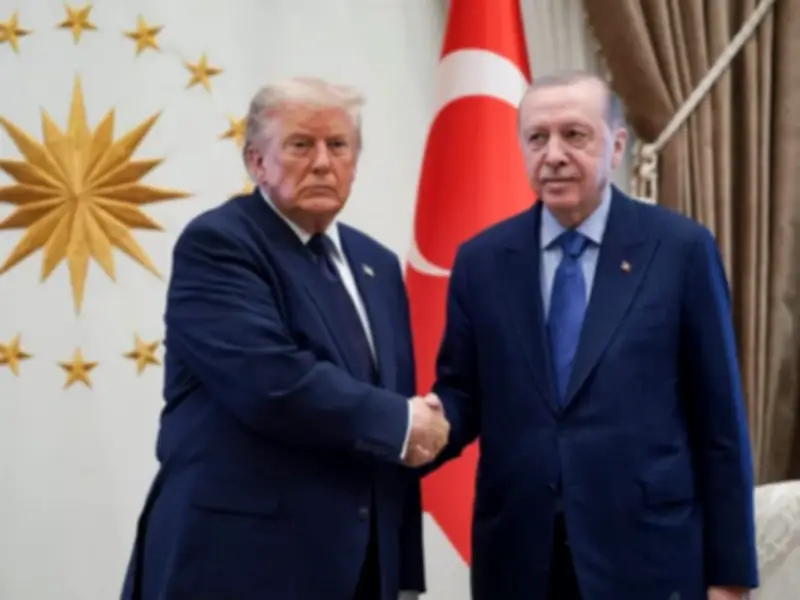
President Donald Trump announced on Tuesday that he would lift sanctions on Turkiye imposed under the Countering America's Adversaries Through Sanctions Act (CAATSA) and consider selling F-35 fighter jets to Ankara, as he began talks with Turkish President Tayyip Erdogan on the sidelines of a NATO summit in Ankara.
Sanctions and F-35 Programme Review
"We're going to be taking the sanctions off," Trump told reporters when asked about the CAATSA measures. Washington had imposed those sanctions in 2020 after Ankara acquired Russian S-400 air defence systems. The US also removed Turkiye from the F-35 programme, a move Ankara called unjust and illegal. Trump said, "It's a decision we're going to make," adding that he and Erdogan would also discuss trade.
Two sources familiar with the matter indicated Trump was expected to support the possible sale of F-35 jets during his visit, though legal and congressional hurdles remain unresolved. A potential breakthrough in US-Turkiye relations could come if Trump allows Ankara to rejoin the F-35 stealth fighter programme, sources told Reuters.

NATO Unveils Billions in Arms Deals
Meanwhile, NATO leaders began unveiling arms deals worth tens of billions of dollars in Turkiye, signalling a response to US calls for greater defence spending. At a defence industry forum in Ankara, NATO Secretary General Mark Rutte announced a series of initiatives displayed on a large screen. "We don't have the luxury of time. We need capabilities now to ensure we remain ready. The security situation demands it," Rutte said. "The hum of machinery must become a roar."
Rutte called for a "revolution" in the alliance's defence industry, warning of growing military spending by Russia, as well as challenges from China, North Korea and Iran. The announcements were aimed at encouraging Western defence companies to increase production capacity and governments to commit to long-term orders. European defence industries have faced criticism for fragmentation, bureaucracy and competition between companies and countries, leaving the region heavily dependent on US weapons supplies.
Key Deals and Investments
The deals, which had been mostly kept under wraps to make a splash at the summit, included European countries buying surveillance drones from US company Northrop Grumman, and NATO buying planes from Sweden's Saab. Saab shares were the biggest gainers in Europe, up more than 5% as investors bet on the company benefitting from European rearmament. Morgan Stanley upgraded the stock.
US defence company Lockheed Martin and Germany's Rheinmetall signed a draft deal to jointly produce ATACMS missiles in Germany, a move that would mark the first non-US manufacture of the short-range ballistic missile. Rutte said NATO allies will invest more than $40 billion in the next five years in their anti-drone capabilities.
European NATO members and Canada spent $90 billion more on defence in real terms in 2025 than in 2024, reaching more than $570 billion, according to Rutte. He described these increases as "staggering," driven partly by fears over Russia following Moscow's 2022 invasion of Ukraine and Trump's pressure.
NATO Tensions and Iran War Fallout
Tensions within NATO have deepened since the US attacked Iran in February. Trump has repeatedly criticised alliance members for insufficient support during the conflict and threatened to leave NATO. European officials said they largely honoured commitments to allow US forces to use their airspace and bases, despite not being consulted about a war that caused economic disruption.
The US has also announced troop withdrawals from Europe and launched a six-month review of its military presence on the continent. European officials said they were prepared for further criticism from Trump and were uncertain about the outcome of the summit. NATO members are expected to reaffirm support for Ukraine and pledge €70 billion ($80 billion) in assistance for 2026.
Russia's missile and drone strikes on the Kyiv region on Monday, which killed at least 28 people, highlighted Ukraine's shortage of US-made air defence interceptors.