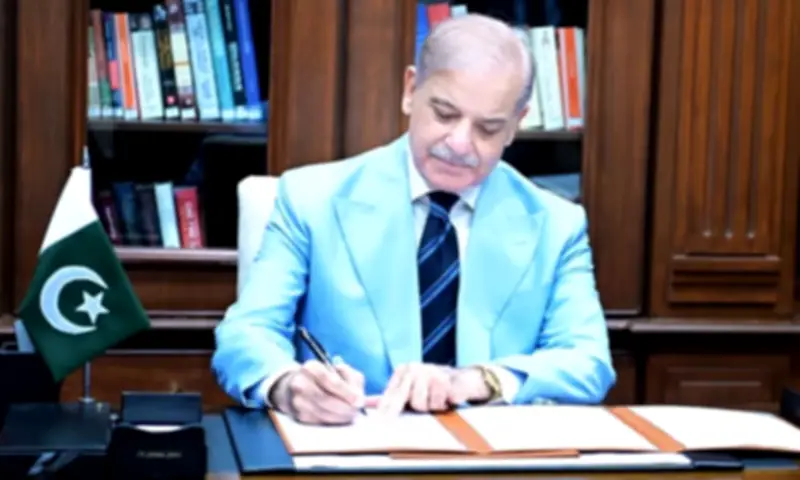
Prime Minister Shehbaz Sharif on Thursday signed the 'Islamabad Memorandum of Understanding' as a mediator, formalising a major diplomatic breakthrough between the United States of America and the Islamic Republic of Iran, according to a post made by the Prime Minister's Office (PMO). The memorandum also carries the signatures of US President Donald Trump and Iranian President Masoud Pezeshkian.
Earlier today, Sharif said, “I am honoured to announce that the historic ‘Islamabad Memorandum of Understanding’ has been electronically signed today between the United States of America and the Islamic Republic of Iran. The Memorandum has been signed by the honourable presidents of both countries and also endorsed by me as the mediator,” the prime minister earlier announced on his X timeline. He added that the memorandum would enter into force immediately and as a "first step, the Islamic Republic of Iran will instantly reopen the Strait of Hormuz and the United States of America will immediately lift the naval blockade".
The US and Israel launched the war on Iran on February 28, assassinating the 86-year-old Supreme Leader Ayatollah Ali Khamenei and military leaders on the first day. It quickly spiralled into a regional conflict that has killed more than 7,000 people, mostly in Iran and Lebanon; driven up energy prices; renewed inflationary pressures and sparked concerns about a major food supply crisis in developing countries.

The 14-point agreement extends a ceasefire announced in April by another 60 days, including in Lebanon, to allow the two sides to negotiate a final truce. Both Trump and Iranian President Masoud Pezeshkian have digitally signed the memorandum in English and Farsi, US and Iran officials said, with Iran's foreign ministry saying the agreement was already in effect as of Wednesday. Trump signed just before a grand dinner with French President Emmanuel Macron at the Palace of Versailles, the site of the signing of the eponymous treaty that formally ended World War One.
The US and Iran released the text of the Islamabad MoU that their presidents have signed to end their war on Wednesday. However, US President Donald Trump had threatened to resume attacks and kill Iranian officials if they failed to honour their commitments. Trump, attending the G7 with other leaders in France, also withdrew at least one of his stated rationales for attacking Iran in the first place, saying it would be "unfair" for Tehran not to have ballistic missiles, having previously vowed to obliterate them.
"We're going to bomb the hell out of them if they violate the agreement," Trump said of Iran at a press conference. "I don't want them to. I want them to honour the agreement." He also called Iranians "smart people" as US and Iranian negotiators work on a permanent truce over the coming 60 days, which Trump said he hoped would usher in peace in the Middle East and lower oil prices.
Iran's leaders did not address the new threats while celebrating the moment, releasing photographs of what is believed to be the first agreement signed by both a US and Iranian president since the Islamic Republic's founding in 1979.
Switzerland says talks planned for Friday between Iran and US
Initial talks between the United States and Iran are planned at the Buergenstock mountaintop resort in Switzerland on Friday, following the signing of a ceasefire agreement between Tehran and Washington, the Swiss government said on Thursday. "As things stand, the plan is still for the US and Iran, along with mediators Pakistan and Qatar and other involved countries, to meet tomorrow at Buergenstock for initial negotiations about implementing the agreement. No further information is currently available regarding the schedule and details of this meeting," the Swiss foreign ministry said in a statement.
Iran releases 14-point draft agreement outlining US deal
IRNA on Wednesday published the text of an Islamabad memorandum of understanding between Iran and the US that outlines a roadmap to end their military conflict and negotiate a final agreement. Below is the 14-point document released by Tehran:

- Ceasefire: The Islamic Republic of Iran, the United States of America, and their respective allies in the current war, by signing this memorandum of understanding, declare the immediate and permanent cessation of military operations on all fronts, including in Lebanon. They commit not to initiate any war or military operation against one another in the future, to refrain from the threat or use of force against each other, and to guarantee Lebanon’s territorial integrity and sovereignty. The final agreement will confirm the permanent end of the war on all fronts, including in Lebanon, and the remaining provisions of this clause.
- Sovereignty: Iran and the United States commit to respecting each other’s sovereignty and territorial integrity and to refraining from interference in each other’s internal affairs.
- Negotiation timeline: Iran and the United States commit to conducting negotiations and reaching a final agreement within a maximum of 60 days, extendable by mutual consent.
- Naval blockade: Immediately upon signing this memorandum, the United States will begin lifting its naval blockade and any harassment or obstruction directed against Iran and will completely terminate the blockade within 30 days. During this period, maritime traffic will be maintained at levels corresponding to pre-war traffic as restored by Iran. The United States also commits to withdrawing its military forces from the area surrounding Iran within 30 days of a final agreement.
- Strait of Hormuz: Upon signing this memorandum, Iran will make its utmost efforts to ensure the safe passage of commercial vessels, free of charge for 60 days, between the Persian Gulf and the Gulf of Oman. Commercial shipping will resume immediately and, subject to the removal of technical and military obstacles and mine-clearing operations by Iran, will be fully restored within 30 days. Iran will hold discussions with the Sultanate of Oman regarding the future administration and maritime services of the Strait of Hormuz in accordance with applicable international law and the sovereign rights of the littoral states, and will also consult with other Gulf littoral states.
- Reconstruction aid: The United States commits, together with its regional partners, to establish an agreed program providing at least $300 billion for Iran’s reconstruction and economic development. The implementation mechanism for this program will be finalised within 60 days as part of the final agreement. The United States will provide all necessary approvals, waivers, and licenses for related financial transactions.
- Sanctions relief: The United States commits to ending all sanctions against Iran, including those stemming from UN Security Council resolutions, resolutions of the International Atomic Energy Agency Board of Governors, and all US unilateral sanctions, both primary and secondary, according to a mutually agreed timetable as part of the final agreement. Both sides acknowledge the fundamental importance of sanctions relief and express their intention to address the issue promptly during negotiations.
- Nuclear program: Iran reaffirms that it will neither produce nor acquire nuclear weapons. Iran and the United States agree to resolve the status of stored enriched materials through a mutually agreed mechanism and in accordance with the timetable set out in Clause 7, at a minimum through on-site dilution under IAEA supervision. The parties also agree to discuss enrichment and other mutually agreed nuclear issues related to Iran’s nuclear needs within a satisfactory framework to be established in the final agreement. The final agreement will confirm the provisions of this clause. Both sides recognise the fundamental importance of these nuclear issues and intend to address them promptly in negotiations.
- Status quo: Iran and the United States agree to maintain the status quo until a final agreement is reached. Iran will maintain the current status of its nuclear program, while the United States will impose no new sanctions on Iran and will not deploy additional military forces to the region.
- Oil exports: The United States commits, immediately upon signing this memorandum and until sanctions are terminated, to issue Treasury Department waivers for the export of Iranian crude oil, petrochemical products and derivatives, and all related services, including banking transactions, insurance, transportation, and other associated activities.
- Frozen assets: The United States commits to making all restricted or frozen Iranian funds and assets fully available for use upon implementation of this memorandum. The two sides will agree bilaterally on the procedures for releasing these funds during negotiations. Whether the funds remain in their original accounts or are transferred, they must be fully usable for payments to any final beneficiary designated by the Central Bank of Iran. The United States commits to issuing all necessary approvals and licenses in this regard.
- Implementation mechanism: Iran and the United States agree to establish an implementation mechanism to monitor the successful execution of this memorandum and future compliance with the final agreement.
- Negotiations on remaining clauses: Following the signing of this memorandum, and subject to the commencement and continuation of implementation of Clauses 1, 4, 5, 10, and 11, Iran and the United States will begin negotiations on a final agreement exclusively concerning the remaining clauses.
- UN endorsement: The final agreement will be endorsed by a binding resolution of the United Nations Security Council.