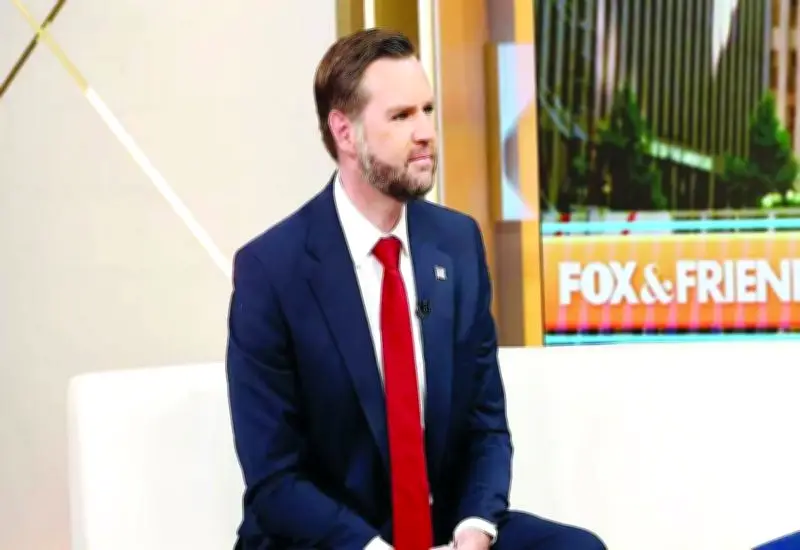
US Vice President JD Vance disclosed in an interview with UnHerd that the deconfliction channel established between Washington and Tehran includes representatives from the Islamic Revolutionary Guard Corps (IRGC) and the US Army’s Central Command (CENTCOM), who will both be stationed in Doha, Qatar. The channel was agreed upon during US-Iran talks in Switzerland over the weekend.
Vance Confirms Military-Level Engagement with IRGC
“They were like, ‘OK, fine, we’ll send somebody from the IRGC to go hang out in Doha with somebody from CENTCOM,’ and that’s how we’re going to settle a lot of these disputes,” Vance told UnHerd in an interview conducted on Monday while returning from the talks but published Thursday. The admission is significant as the US has designated the IRGC as a Foreign Terrorist Organization, making direct military-level engagement a sensitive development.
Before departing Switzerland, Vance announced two mechanisms agreed upon during the negotiations: one to ensure the Strait of Hormuz remains open, and another to maintain a regional ceasefire, particularly in Lebanon. It remains unclear which mechanism the IRGC-CENTCOM hub in Doha will oversee, or if it will handle both issues.

Israel Opposes Iran’s Role in Lebanon Ceasefire Mechanism
The deconfliction mechanism for Lebanon has angered Israel, which contends that Iran should have no say in Lebanese affairs. However, due to Iran’s leverage in the Strait of Hormuz or Washington’s belief that Iran is needed to rein in Hezbollah, the US agreed to Tehran’s demand that the memorandum of understanding (MOU) include a ceasefire in Lebanon and allow Iran to participate in the deconfliction mechanism.
Vance insisted that the final deal sought with Iran through the MOU will be “radically different” from the 2015 nuclear agreement signed by former President Barack Obama, with a more intense inspection regime and the elimination of Iran’s enriched uranium stockpile. Iran has stated it will not accept such terms.
Vance Says Deal Will Transform Middle East; Analysts Cite Gulf Security Concerns
The vice president argued that the deal will lead to greater cooperation between Iran and the region. “The Emiratis — by far the most hawkish, by far the most pro-Israel country in the GCC — they’re having conversations with the Iranians that have never happened before, including with the IRGC, about various types of economic incentives,” Vance claimed. Analysts, however, contend that these new conversations stem from Gulf states’ conclusion that they cannot rely solely on the US for security, following the recent war.
Gulf Cooperation Council (GCC) foreign ministers, in a joint statement after a summit in Bahrain chaired by US Secretary of State Marco Rubio, emphasized that lasting peace requires addressing Iran’s ballistic missiles, drones, and support for proxies. They stated: “Any trade and investment with Iran is conditional and reversible, contingent on Iran’s compliance with the MOU and the final agreement, cessation of its destabilizing behavior, and creation of the conditions necessary for economic engagement.”
GCC Supports MOU but Stresses Need for Final Agreement
The Gulf ministers expressed support for the US-Iran MOU while stressing the need for a final agreement that stabilizes the region. They emphasized the importance of reopening the Strait of Hormuz for free navigation, rejecting tolls or control attempts, and welcomed Oman’s opening of an additional corridor for stuck vessels.
The statement also stressed GCC support for the territorial integrity of Syria and Lebanon, an apparent reference to Israeli buffer zones. The ministers welcomed ongoing Israel-Lebanon talks and agreed on disarming non-state actors like Hezbollah.
GCC Backs US Plan for Gaza, Rejects Forced Displacement
The statement expressed support for the US 20-point plan for stabilizing Gaza, overseen by the Board of Peace, a Trump-chaired international body. The ministers reiterated support for disarming Hamas and handing Gaza control to a committee of Palestinian technocrats. They touted President Donald Trump’s rejection of Israeli West Bank annexation and underscored that progress on Gaza redevelopment and PA reforms would create conditions for Palestinian statehood.

“The ministers further reaffirmed that no one will be forced to leave Gaza, and those who wish to leave will be free to return,” the statement said, rejecting Israeli efforts encouraging Palestinians to leave the Strip.
GCC Condemns Attacks by Iranian Proxies in Iraq
The statement concluded with a condemnation of attacks against GCC countries by Iranian proxies in Iraq and stressed the importance of Baghdad taking measures to rid itself of Iranian influence.