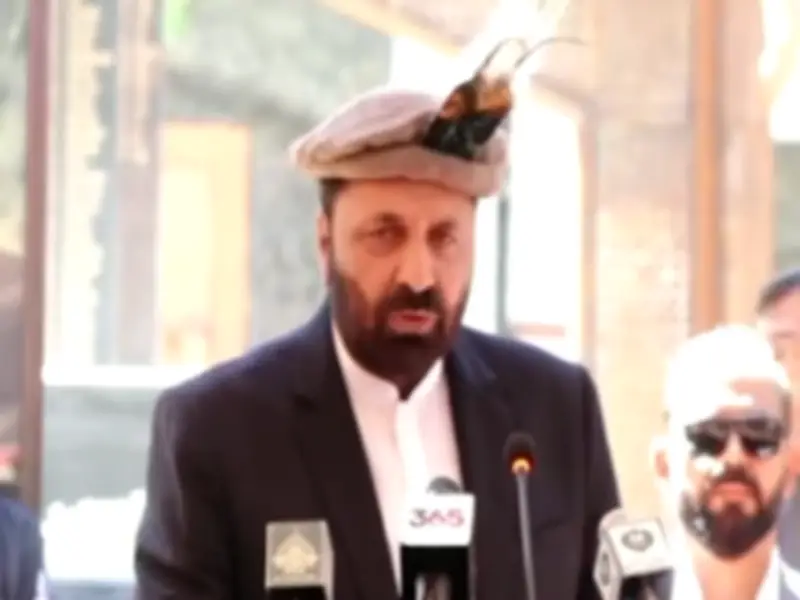
Amjad Hussain of the Pakistan Peoples Party (PPP) was sworn in as chief minister of Gilgit-Baltistan (G-B) on Monday, with Governor Syed Mehdi Shah administering the oath at a ceremony attended by senior political figures, including PPP Chairman Bilawal Bhutto Zardari.
Constitutional and Economic Priorities
In his first address, Hussain called for advancing the region's long-pending constitutional rights from an administrative arrangement to provisional provincial status. He identified funding shortfalls, energy shortages, and economic development as top priorities. “We must now move this administrative journey forward,” he said. “The time has come to complete the journey towards provisional provincial status.”
Electoral Mandate and Cross-Party Consensus
Hussain described the election result as a vote of confidence and a heavy responsibility, attributing the PPP's victory to decades of trust between the party and the people of G-B. “I am grateful to Almighty Allah that the PPP emerged as the largest party in G-B,” he said, also thanking party workers and voters. He acknowledged the role of youth and women in the campaign, stating, “The youth and women of G-B played a tremendous role.” Hussain thanked political rivals, including Prime Minister Shehbaz Sharif and former premier Nawaz Sharif, for enabling a smooth democratic transition. He noted that G-B now has an unopposed speaker, deputy speaker, and chief minister.

Tourism and Natural Resources
Hussain emphasized G-B's strategic importance, noting its 7,000 glaciers, which feed the Indus River system and support agriculture and hydropower for 260 million people. He called for improved tourism infrastructure, including visa-on-arrival facilities and better road and air connectivity. “The entire world wants to visit G-B,” he said. He also highlighted untapped mineral resources, including gold, silver, and rare earth minerals, pledging to develop the mining sector for local benefit.
Agriculture and Regional Connectivity
The chief minister announced a “One Village, One Product” programme to boost agriculture, livestock, and fisheries. He stressed G-B's role as a crossroads linking Central Asia, South Asia, and East Asia, calling for stronger links with Afghanistan and Tajikistan. He praised Bilawal for converting seasonal cross-border trade with China into year-round trade.
Funding Deficits and Energy Crisis
Hussain revealed that G-B's annual financial requirement is Rs258 billion, but the federal government allocated only Rs145 billion, leaving a deficit of over Rs100 billion. He urged the federation to provide adequate resources. On energy, he questioned why G-B faces 22 hours of load-shedding despite its hydropower potential. He set a target to end load-shedding within five years, emphasizing completion of projects like Harpo, Henzel, and Shagarthang. “Our promise is that when these five years are complete, load-shedding should become a thing of the past in G-B,” he said.
Good Governance and Reform
Hussain pledged transparency and reform, aiming to make G-B a model province. “We consider transparency our guiding principle,” he said. He called for greater Chinese investment through public-private partnerships and joint ventures.