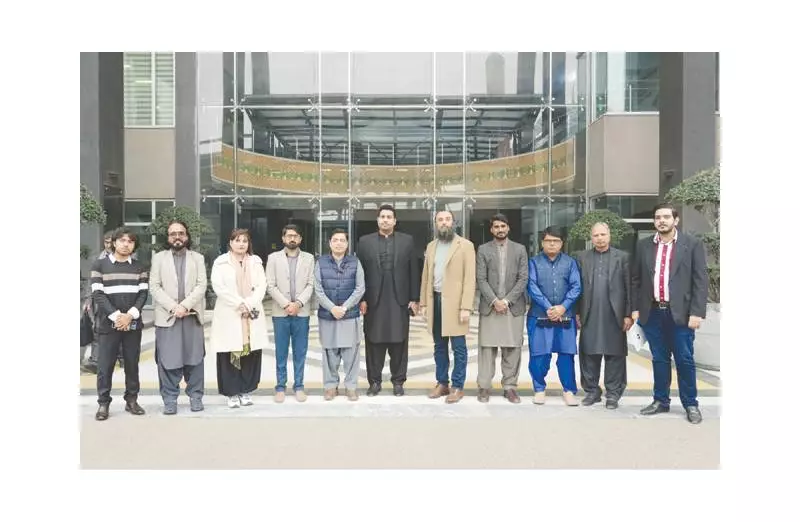
A high-profile delegation from the Pakistan Federal Union of Columnists and Creators (PFUC) conducted a significant visit to The University of Lahore (UOL) to review its newly established Well-Being Centre. The initiative, focused on addressing mental and psychological health for the university community, received strong endorsement from the visiting thought leaders.
Delegation Hails Timely Initiative for Student Welfare
The PFUC group included prominent figures such as renowned motivational speaker Qasim Ali Shah, PFUC Chairman and anchorperson Farrukh Shahbaz Warraich, Central President Fareed Razaqi, Vice President Azhar Tharaj, and Secretary General Waqar Aslam. Other members were President Women Wing Mahwish Fazal, Member BOG Abdul Majeed, Shahzad Chaudhry, Sajid Khan, and Madho Lal, alongside several senior columnists.
During the visit, Prof Dr Shamaila Asad, Director of the UOL Well-Being Centre, provided a comprehensive briefing. She detailed the centre's objectives, the range of services offered, and its operational framework.

Combating Stigma and Preventing Crises
Speaking on the occasion, Qasim Ali Shah underscored the global scale of mental health challenges, noting that nearly 30 percent of people worldwide suffer from psychological issues. He directly referenced recent unfortunate incidents at UOL, stating that the launch of the Well-Being Centre was a timely and crucial step.
He emphasized that such a centre would not only facilitate treatment for those struggling but also play a proactive role in preventing similar crises within educational institutions. Shah issued a strong call to action, stressing that universities across Pakistan should follow UOL's example and set up comparable support systems.
He also tackled the pervasive social stigma attached to mental health in Pakistan, where individuals are often wrongly labelled as "mentally ill." Contrasting this with practices in many developed nations, he pointed out that some countries teach happiness as an academic subject and regularly engage motivational speakers, highlighting the urgent need for awareness and mindset change in Pakistani society.
Free, Accessible, and Professional Support System
Prof Dr Shamaila Asad informed the delegation that the UOL Well-Being Centre will provide free-of-cost treatment and awareness services to students, teachers, and university staff. A structured assessment program has been designed for the entire campus.
Under this mechanism, teachers, class representatives (CRs), and graduate representatives (GRs) can refer students facing mental health challenges. The centre also allows students to approach directly and confidentially.
To ensure professional care, the centre has appointed a team of clinical psychologists, counselling psychologists, and health psychologists. These professionals will conduct assessments and provide appropriate psychological support and guidance to those in need.
The visit concluded with a consensus on the critical importance of such institutional support mechanisms in fostering a healthier, more productive academic environment across the country.