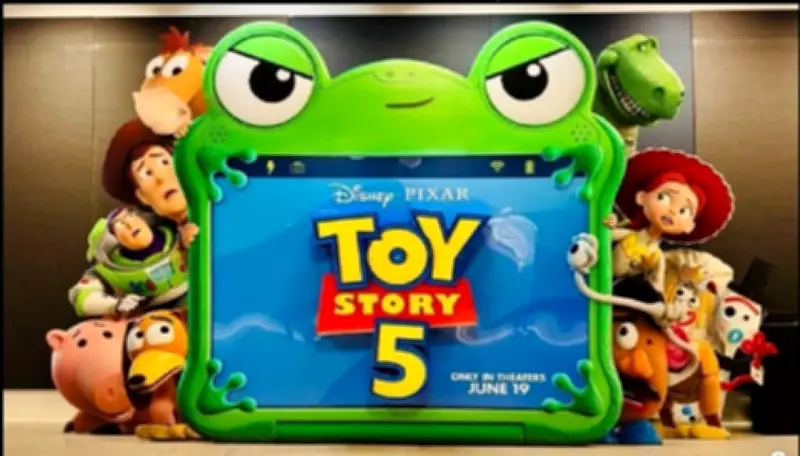
Toy Story 5 debuted to a massive $312 million worldwide, making it the largest opening weekend in Disney and Pixar's animated series history. In North America, it raked in $160 million, marking the biggest domestic film opening of 2026 and the second-best animated opening ever.
Plot: Toys vs. Technology
The film follows Jessie and the toy gang trying to win back the attention of their owner Bonnie after her parents gave her a high-tech, disruptive tablet device named Lilypad. Exploring the clash between traditional play and modern technology, the film asks an uncomfortable question: Have screens stolen childhood?
Global Screen Time Statistics
Globally, children's daily screen time averages range from 2.5 hours for toddlers to over 8.5 hours for teenagers. The World Health Organisation (WHO) recommends no screen time for children under age 2 and a maximum of one hour per day for ages 2 to 5. Research shows that co-viewing, educational content, and parental involvement greatly reduce many risks.

Polarizing Reactions
Toy Story 5 has become Pixar's most polarising film in years, splitting parents, critics, and lifelong fans into two fiercely opposed camps. One side sees it as an overdue wake-up call about the quiet disappearance of creative play. Critics argue the toys are no longer competing with another toy—they are competing with an algorithm.
Dr. Michael Rich, paediatrician and director of the Centre on Media and Child Health at Boston Children's Hospital, said, “Boredom is the space in which creativity and imagination happen.” He noted that much of what happens on screen provides “impoverished” stimulation of the developing brain compared to reality.
Tom Hanks on Screen Addiction
Tom Hanks, who voices Woody, said the latest sequel highlights children's addiction to screens, an issue that strikes “terror in the heart.” Hanks revealed that the cast related to the storyline because they had all “met that disinterest” of young people who “look down at their phone, look up, look down, look up.” He added, “This is a generational thing, where one generation has this thing that defines them technologically in society, and they pour everything into it.”
Cyberbullying and Digital Life
The film also ventures into cyberbullying, online peer pressure, and the emotional minefield of children's digital lives. Bonnie's interactions through Lilypad expose the darker side of virtual socialisation, echoing the anxieties of parents negotiating screen limits.
Criticism and Hypocrisy
Critics argue the film romanticises an era that no longer exists and feels like adults wagging a finger at children for living in the world adults created. Fans pointed out the irony of Disney—a company earning billions through streaming platforms and digital games—warning about screen dependence. Disney is reportedly marketing real-life Lilypad merchandise, turning the film's villain into a commercial opportunity.
An awkward exchange where Jessie dismissively refers to digital toddler toys as “your kind” sparked accusations of a clumsy metaphor for prejudice and exclusion, causing a social media backlash.
Parental Perspectives
Many parents view tech as a survival tool to cook meals, work, or catch their breath. Surveys show it is a daily battle of meltdowns and exhaustion to enforce strict rules, leading parents to give in and use screens as a recovery aid.
Why Screens Are Irresistible
Apps and games are deliberately designed by software engineers and behavioural psychologists to keep children engaged through colourful visuals, endless novelty, rewards, sounds, and constant feedback. Traditional toys simply cannot compete with a tablet that evolves every minute, remembers preferences, and adapts to hold attention.
The Other Side of Childhood
Nine-year-old J said, “When the kids in my building come out to play, we have a lot of fun playing football, cricket, and hide-and-seek.” He added, “Yesterday my friends sat in a parked auto rickshaw, I pretended to be the driver and my friends were my passengers. We pretended to be on a journey to Lahore!”

Today's children build worlds in Minecraft, design houses in Roblox, collaborate with friends online, and learn dance routines from TikTok. Their playground extends beyond the neighbourhood park. To children, digital childhood often feels like a connection, not isolation.
Message of Balance
The film isn't asking families to throw tablets out of the window. Its message is balance—a healthy balance where kids learn to navigate both physical play and digital spaces. Technology isn't the villain; replacing every moment of imagination with a screen is.