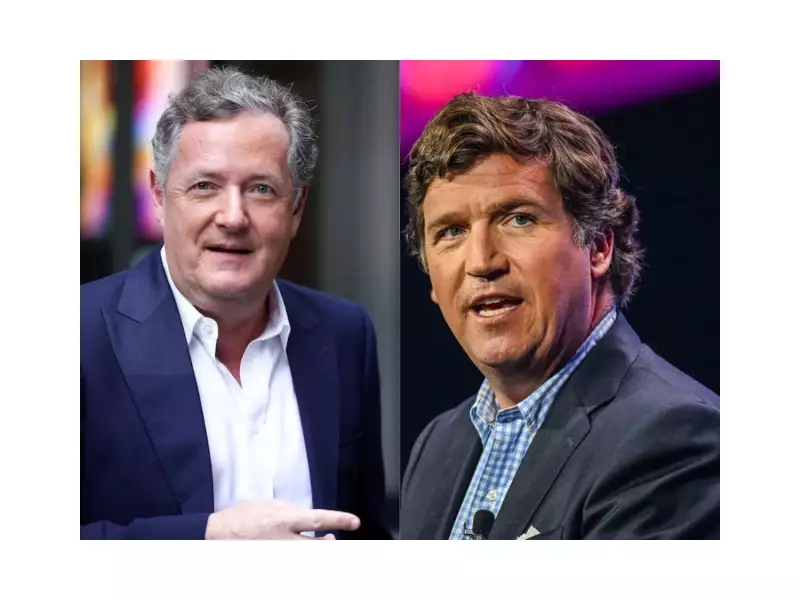
Two of media's most prominent voices, Tucker Carlson and Piers Morgan, engaged in a fiery on-air debate this week that has since captured global attention. The extensive conversation, broadcast on the Tucker Carlson Network, delved into sensitive topics surrounding sexual orientation, cultural influences, and shifting identity trends.
Clashing Views on LGBTQ+ Identification Trends
The discussion opened with Carlson raising questions about demographic implications of rising LGBTQ+ identification rates. "What's wrong with homosexuality? Well, if you encourage it and the rate goes up, people have fewer kids," Carlson stated. "Most gay people don't have kids. That's the point I'm making."
Morgan immediately challenged this premise, asserting that "People don't pretend to be gay." When Carlson questioned whether social messaging could influence identity, Morgan responded firmly: "If you're gay, you're gay."

Carlson pushed back against this certainty, referencing his own evolving understanding: "We were told that and I believed a lot of things." Morgan reiterated his position: "Yes. They're born gay."
The Scientific Evidence Debate
The conversation took a scientific turn when Carlson questioned whether sexual orientation is innate. "So there's a gay gene?" he asked pointedly. "Science has been looking for the gay gene for a long time. Where is it?" Carlson later added humorously: "I ordered a gay gene and it hasn't arrived yet — waiter, where's my gay gene?"
At this point, Morgan accused Carlson of homophobia, stating: "You're sounding quite homophobic." Carlson defended his line of questioning: "I'm not afraid of gays at all. I'm just asking actual questions."
Carlson also referenced personal accounts from gay individuals he knows, noting: "I have this conversation with actual gay people. A lot of them say, 'I got molested — that's why I'm gay.'... I don't think that's always true, but I am wondering."
International Comparisons and Free Speech Concerns
The debate expanded to include international perspectives when Carlson questioned why some Asian countries report lower LGBTQ+ identification rates. "Why isn't that the case in Asia?" he asked. "South Korea, Japan, their self-described homosexuality rates are much lower. So is it genetic? Cultural? People become gay?"
Morgan argued that social acceptance plays a crucial role in disclosure rates. "They used to be repressed. They used to be illegal," he explained. "You literally were put in a prison cell if you were openly homosexual."
The exchange then shifted to UK speech laws, with Carlson noting: "You've got people arrested for using the word 'faggot.'" Morgan countered by asking why Carlson didn't express equal concern for LGBTQ+ people jailed in countries where homosexuality remains criminalized.
"Why don't you feel as angry about people being arrested and put in a prison cell for their sexuality?" Morgan challenged. Carlson responded: "It's not my culture. It's not my country. I'm not for arresting anyone."
The heated discussion concluded with Carlson expressing frustration about the emotional nature of such conversations. "Why can't we have a non-emotional conversation?" he asked. "Why are you gay? And no one will answer it."
The debate has since circulated widely online, prompting extensive commentary from viewers and observers across social media platforms and news outlets worldwide.