Leo Tolstoy's Lifelong Fascination with Islam and Muslim Societies
In 2012, while examining the devastating effects of the war on terror on Muslim tribal communities in regions like Pakistan, Yemen, and Somalia, researchers sought a framework to understand the persistent violence in these areas. They discovered a powerful metaphor in Leo Tolstoy's novel Hadji Murad, completed in 1904. This work depicts the real-life struggle of a Muslim tribal leader against the Russian Empire in the Caucasus, mirroring the modern conflict between central states and independent tribal margins.
Tolstoy's Early Encounters with Islam
Leo Tolstoy's relationship with Islam and Muslims was both significant and influential throughout his life. As a child, he was captivated by The Arabian Nights, which he considered one of the most important works of his youth. During his university years in Kazan, Tolstoy initially studied Arabic and Turco-Tatar languages. Later, while serving in the Caucasus, he interacted directly with Muslim peoples, leaving a lasting impression on him.
His early story, "The Raid" (1853), which portrayed Russian troops grappling with the horrors of war in the Caucasus, faced government censorship. Authorities removed passages that questioned the justification of Russian soldiers attacking Muslim tribesmen in their villages.

Immersive Experiences with the Bashkir People
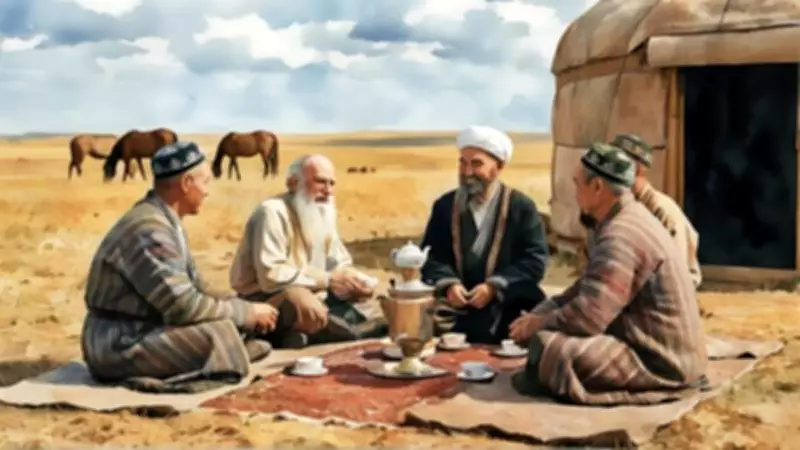
In 1862, feeling fatigued and depressed, Tolstoy traveled to the Samara province to recuperate. For over two months, he lived with nomadic Muslim tribesmen of the Bashkir people. Staying in a tent, breathing fresh air, and drinking kumyss (fermented mare's milk), he found restoration. His knowledge of Tatar facilitated communication, and the tribesmen affectionately called him "the Count" and "Prince Tul."
Nearly a decade later, in 1871, Tolstoy returned to the steppe for health reasons. The Bashkirs welcomed him back warmly, and he lived in a tent next to a mullah, following the local diet. He observed with pleasure the religious tolerance between Orthodox peasants and their Muslim neighbors in the region.
Tolstoy was deeply impressed by the Bashkirs, remarking that listening to their speeches was more engaging than debates in the English Parliament. During this trip, he read the Quran, influenced by his experiences with the Bashkir people.
Literary Reflections and Social Consciousness
Tolstoy's time in Samara profoundly shaped his thinking. He initially admired autonomous agricultural communities but later saw them as steps toward civilization that led to centralization and oppression. In his short story "How Much Land Does a Man Need?" (1886), a Russian peasant's greed for land leads him to the Bashkir steppe, where he overexerts himself and dies, highlighting Tolstoy's critique of materialism.
In Hadji Murad, Tolstoy juxtaposes Russian and Muslim societies with empathy, depicting both as fully human with their own customs. He invites readers to see the conflict from the perspective of the tribes, questioning the logic of modern state oppression.
Other works, like "A Prisoner of the Caucasus," aimed at children, show compassion through characters like Dina, a Muslim girl who helps a captured Russian officer. This story emphasizes humanity amid war's brutality.
Intellectual Engagement with Islam
Tolstoy's A Calendar of Wisdom includes sayings from the Prophet Muhammad, Quranic verses, and works by Persian poets like Saadi Shirazi and Omar Khayyam. He featured a Sufi saying advocating interfaith harmony, reflecting his universal outlook.
In 1884, Tolstoy described himself as "a good Mohammedan" to counter criticisms from various groups. He corresponded with Muhammad Abduh, the Grand Mufti of Egypt, expressing gratitude for their dialogue despite religious differences.
In 1910, Tolstoy published The Sayings of Mahomet Not Included in the Koran, a collection of hadiths intended to educate Russians about Islam. He wrote that the essence of Islam is "the unity of God" and "love for God."

Critique of Patriotism and Advocacy for Non-Violence
Tolstoy viewed patriotism as a form of exclusive love that leads to conflict and war. He argued that it is promoted through education, media, and state spectacles, embittering people against foreigners. He believed that true progress comes from increasing love, not technological advances.
Inspired by Christ's teachings, Tolstoy advocated for loving all people without national distinctions. He warned that patriotism causes internal conflict and oppression of minorities, as seen in historical examples like the suppression of Jews or Poles.
For colonized peoples, Tolstoy advised non-violent resistance, influencing figures like Mahatma Gandhi and Martin Luther King Jr. He believed that public opinion, not force, drives social change, and that love and unity are essential for peace.
Legacy and Relevance Today
Tolstoy's fears of large-scale violence were realized in World War I and II, with millions killed. Despite this, his ideas on non-violence and interfaith dialogue inspired movements worldwide. In 1991, after the Soviet Union's fall, his works experienced a renaissance in Russia.
Today, Tolstoy's lessons on love, unity, and rejecting exclusivist patriotism remain crucial. In an era of nuclear threats, AI weaponry, and social division, his call to embrace the "Other" and cultivate inner morality offers a path toward global harmony.
Tolstoy emphasized that small actions matter, and that pursuing ideals of love can transform societies. He urged people to start with simple steps, like responding to evil with good, to create a chain reaction of compassion.
As Tolstoy taught, "The time is now, this minute; the person is the one you are now dealing with; and the act is to save your own soul, i.e., to perform an act of love." His legacy continues to inspire efforts for peace and understanding across cultures.