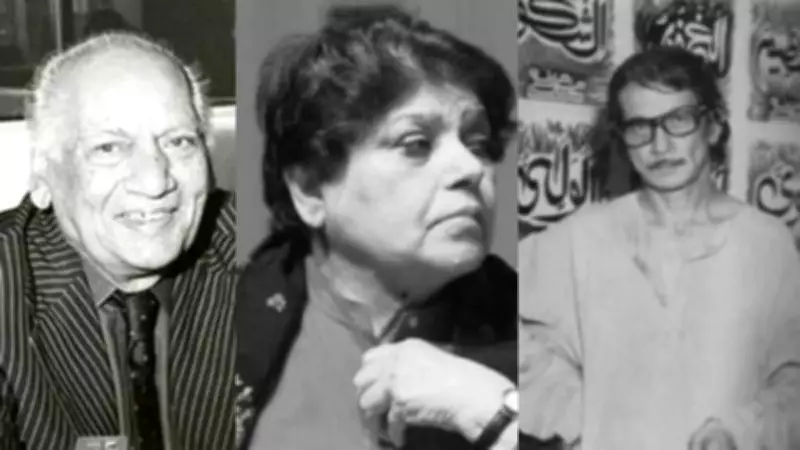
The Urgent Question of Representation in a Digital Age
In our contemporary world, where algorithmic identities shape perceptions, publics are increasingly fractured, and attention spans continue to shrink, the fundamental question of who speaks for whom has regained critical urgency. Representation today is overwhelmingly mediated through digital screens, profoundly shaped by entrenched power structures, and frequently stripped of meaningful depth and nuance. This complex landscape demands careful examination of how narratives are constructed and whose experiences are centered or erased.
Faiz Ahmad Faiz: Representation as Ethical Imperative
Faiz Ahmad Faiz approached representation not as abstract theory but as lived, contested, and morally charged reality. Writing during Pakistan's fragile post-colonial emergence, Faiz understood with piercing clarity that political independence did not automatically translate into genuine justice for ordinary citizens. His seminal poem "Subh-e-Azadi" (Dawn of Freedom) captures this profound unease, articulating how political freedom had arrived while the promise of human dignity remained painfully deferred for countless people.
Faiz's postcolonial vision insisted that a nation must represent its people authentically and wholeheartedly, avoiding the traps of mythologizing populations, romanticizing suffering, or silencing dissent under false banners of unity. He masterfully transformed classical Urdu poetic imagery—the beloved, exile, longing—into powerful metaphors for homeland, estrangement, and collective aspiration. Through this artistic alchemy, Faiz created a literary language where the personal and political could coexist without collapsing into mere propaganda.

For Faiz, genuine representation meant giving voice and language to those systematically pushed to the margins of national narratives while steadfastly refusing to let power define reality unchallenged. His work mapped the profound anxieties of a newly decolonized nation struggling to fulfill its emancipatory promises.
Kishwar Naheed: Expanding the Map of Representation
If Faiz mapped the anxieties of postcolonial nationhood, Kishwar Naheed dramatically expanded that cartography to include voices historically excluded from dominant narratives, particularly women's experiences. While both poets reclaimed marginalized voices, Naheed sharpened the fundamental inquiry: freedom for whom? Her iconic poem "Hum Gunahgaar Auratein" ("We Sinful Women") radically reframes representation by directly confronting patriarchal structures embedded within postcolonial society itself.
Where Faiz broadened the language of resistance, Naheed intensified and particularized it, insisting that authentic representation must actively dismantle gendered silencing and exclusion. Together, their works reveal that postcolonial representation is never static but rather an ongoing, dynamic negotiation between state and citizen, man and woman, tradition and modernity. Both poets resolutely refused cosmetic nationalism that papers over injustice.
Sadequain: The Visual Grammar of Resistance
Similarly, if Faiz gave resistance a lyrical voice, Sadequain developed its powerful visual grammar. His monumental calligraphic murals, dense with restless energy, depict human figures perpetually struggling, reaching, and straining against invisible confines. These figures are never merely decorative; they embody both profound aspiration and deep anguish simultaneously.
Sadequain's art, much like Faiz's poetry, resists simplistic interpretation. Steeped in classical Islamic calligraphic traditions yet fiercely modern in both form and social critique, Sadequain democratized representation by placing his art in civic spaces rather than elite enclosures. By painting ceilings and public walls, he affirmed that art fundamentally belongs to the people, not just privileged institutions.
Both artists understood with acute clarity that postcolonial societies risk replacing one form of domination with another—whether bureaucratic, ideological, or cultural. Their work stands as enduring witness, recording hope and disillusionment side by side, refusing to let either emotional pole erase the other.

The Enduring Power of Ethical Art and Literature
What ultimately binds Faiz, Naheed, and Sadequain together transcends mere authenticity. It is their unwavering faith in literature and art as indispensable instruments of ethical clarity. In periods of rapid societal transformation, cultures often privilege speed over reflection and information over wisdom. Art deliberately interrupts this dangerous acceleration, slowing us down and demanding genuine contemplation.
Literature preserves essential complexity in an age that increasingly rewards simplification. A single poem can hold profound contradictions without resolving them prematurely; it can articulate collective grief without surrendering hope entirely. In postcolonial societies especially, literature becomes a vital archive of feeling, safeguarding experiences and injustices that official histories routinely omit. It humanizes political discourse, restoring necessary depth and nuance to debates that might otherwise harden into empty slogans.
Art, similarly, gives tangible form to what remains unsaid or suppressed. Sadequain's strained, muscular figures visualize human struggle in ways statistics and reports never could. His calligraphy reclaims cultural tradition not as static ornament but as living, dynamic critique. Through line, form, and public placement, he demonstrates that heritage can be progressive rather than dogmatic.
Guardrails Against Commodified Narratives
Art preserves memory against systematic erasure, creates shared emotional vocabularies, and offers imaginative alternatives to oppressive realities. It functions simultaneously as mirror and map. In our current moment, where representation is increasingly commodified and narratives are strategically engineered, literature and art serve as crucial cultural guardrails. They remind societies that truth is inherently layered, identity is profoundly complex, and freedom remains perpetually unfinished work.
In our hyperconnected digital ecosystem, representation has become instantaneous yet often shallow. Social media platforms amplify voices but frequently distort them through algorithmic curation. Narratives trend and vanish within hours, while identity becomes carefully curated performance and authenticity transforms into marketable commodity.
Against this relentless velocity, Faiz, Naheed, and Sadequain offer something radically different: depth. Faiz teaches that hope without critique is naive, that celebration without accountability is hollow. Naheed demonstrates that inclusion without structural change is merely cosmetic, that symbolic gestures cannot substitute for substantive justice. Sadequain shows that tradition can be creatively reimagined without being weaponized, that the past can inspire liberation rather than impose imprisonment.
A Cultural Compass for Our Times
Together, their interconnected bodies of work form an indispensable cultural compass. They provide no easy answers but offer essential orientation. They urge contemporary societies to speak difficult truths even when the dawn feels incomplete, to expand the circle of representation continuously, and to anchor modernity in ethical imagination rather than empty spectacle.
During periods of rapid technological transformation and shifting political alignments, societies risk losing their reflective core entirely. The poetry of Faiz, the constructive verse of Naheed, and the monumental lines of Sadequain insist with unwavering conviction that representation concerns far more than mere visibility—it is fundamentally about responsibility. Their work endures precisely because it does not chase ephemeral moments but instead interrogates them deeply.
In doing so, they offer not only critique but a meaningful map—drawn in enduring ink, resonant word, and awakened conscience—for navigating the unsettled terrain of our present. Their collective legacy reminds us that a nation's moral health is ultimately measured by how honestly and compassionately it represents its most vulnerable members, and that true freedom remains a work perpetually in progress.