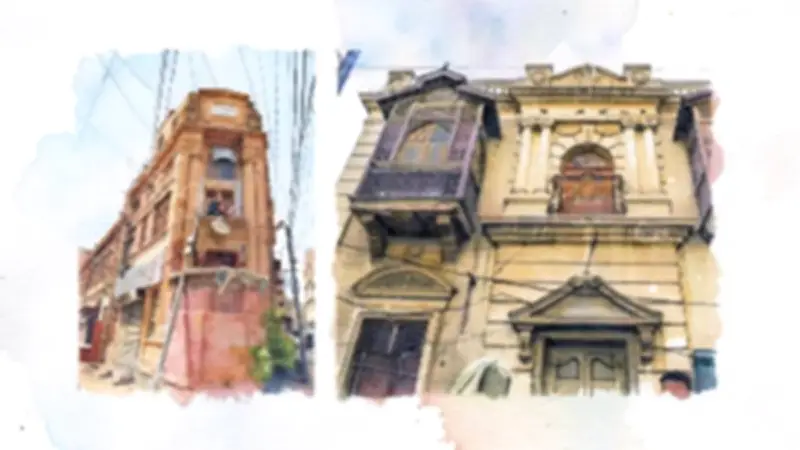
Across Pakistan, numerous buildings, streets, and institutions inherited from the colonial and pre-partition era have undergone significant renaming after 1947. Names associated with non-Muslims or British personalities were replaced with those of Muslim political or religious figures. These transformations were not merely administrative changes but were deeply intertwined with the politics of nation-building, the legacy of colonialism, and the memories of Partition. Examining the city of Hyderabad in Sindh reveals how renaming heritage spaces has reshaped the city’s toponymy and its relationship with history and collective memory.
Fading Legacies in Hyderabad
A walk through Hyderabad’s historic neighbourhoods shows how extensively such changes have occurred. One notable example is the Nava Vidyala School near Hyder Chowk, now known as Dr NA Baloch Model School. The school’s impressive Gothic-style building was established through the efforts of Rai Pirbhdas, a renowned educationist and philanthropist. Determined to promote education, he reportedly went door to door collecting donations for the school’s construction. Yet, despite his crucial role, his name has largely disappeared from public memory. Few students today are aware of who Rai Pirbhdas was or the sacrifices he made for education in the city.
Chaudhry Rahmat Ali and the Politics of Historical Memory
Original names possess an organic relationship with the places they identify, telling stories about the people who founded, funded, or shaped those institutions. Another example is Homestead Hall, a colonial-era landmark near Pakko Qilo (Fort). The building was originally constructed in memory of Dr Homestead, a British civil surgeon who served Hyderabad between 1868 and 1884. During a devastating plague epidemic, Dr Homestead worked tirelessly to treat patients and save lives, earning widespread admiration. Following Partition, however, the building was renamed after Hasrat Mohani, a poet and freedom fighter. While Mohani remains an important historical figure, the renaming effectively erased the public remembrance of the doctor whose humanitarian efforts once inspired the hall’s construction.

Erased Foundations and Educational Heritage
The story of Mira School in Hirabad further illustrates this process. The institution was established by Sadhu TL Vaswani (1879–1966), one of Sindh’s most respected spiritual leaders, educators, and social reformers. A passionate advocate for women’s education, Vaswani named the school after the princess of Chittor, Mira Bai, and introduced what he called the “Mira Movement in Education.” Today, the institution is known as the Government Girls Pilot Secondary School. During a visit several years ago, the author admired the building’s spacious verandas and historic architectural features. Only later did they discover its remarkable history through old plaques bearing the names of Hindu donors. Learning about the school’s past evoked a sense of sadness. A place founded with a distinct educational vision and cultural identity had been transformed into an institution with an impersonal name, disconnected from its historical roots.
A similar fate befell Kundan Mal Girls School, another elegant educational institution founded by the philanthropist Seth Kundanmal. Among its most distinguished alumni was Kumari Jethi Sipahimalani (1906–1978), a pioneering Sindhi politician who actively participated in the anti-colonial struggle and was imprisoned during the Quit India Movement. She later became the first female Deputy Speaker of the Sindh Assembly in 1937. Today, the school is known as Jamia Arabia Girls School. When the author shared the institution’s history with some university students who had studied there, they were surprised and largely unfamiliar with its origins. This demonstrates how the erasure of names does more than alter maps and signboards; it severs meaningful connections between communities and their past.

The Ideology of Renaming
It is important to acknowledge that figures such as Dr NA Baloch and Hasrat Mohani are themselves highly respected personalities who made valuable contributions to society. The issue, therefore, is not about the replacement of names, but concerns the loss of historical continuity. Original names often possess an organic relationship with the places they identify. They tell stories about the people who founded, funded, or shaped those institutions. By removing such names, societies risk obscuring local histories and weakening younger generations’ understanding of how their cities evolved.
Why, then, did these renaming initiatives occur? The answer lies partly in the ideological foundations of Pakistan. Following independence, the new state sought to establish a distinct national identity rooted primarily in Muslim history and culture. The Two-Nation Theory, which provided the ideological basis for Pakistan’s creation, emphasised the separate historical trajectories of Muslims and Hindus. Consequently, monuments, institutions, and public spaces associated with non-Muslim personalities were often viewed as incompatible with the emerging national narrative. Renaming them became a symbolic way of asserting ownership over inherited colonial and pre-partition spaces while integrating them into the framework of a new nation-state.
Sites of Memory and the Trauma of Partition
Another important factor relates to the memory of Partition itself. Partition remains one of the most traumatic events in South Asian history, marked by violence, displacement, and profound human suffering. As historian Urvashi Butalia observes in Partition: The Long Shadow (2015), remembering Partition inevitably involves confronting painful experiences of loss and separation. The trauma was not limited to the loss of homes, possessions, and livelihoods; it also encompassed intangible losses that were difficult to articulate or even name. Because of these painful associations, many aspects of the pre-partition past gradually receded from public memory.
The French historian Pierre Nora provides a useful framework for understanding this phenomenon. In his influential essay “Between History and Memory” (1989), Nora argues that memory is rooted in physical places, objects, images, and rituals that serve as “sites of memory.” These sites preserve connections with the past and keep historical experiences alive. Hyderabad’s pre-partition buildings function as such sites of memory. Their names, architecture, and histories remind us of a diverse social world that existed before Partition. Renaming these spaces can therefore be understood as an attempt to distance society from uncomfortable historical memories and to create a more coherent national narrative.
Reclaiming Historical Continuity
In recent years, however, attitudes toward pre-partition heritage have begun to change. The Government of Punjab’s proposal to restore the historical names of certain streets and localities in Lahore generated significant public debate. While some welcomed the initiative as an overdue recognition of the city’s multicultural past, others opposed it. Regardless of the outcome, the discussion itself is noteworthy. It suggests a growing willingness to engage with difficult histories and acknowledge the diverse communities that contributed to the region’s development.
Hyderabad deserves a similar conversation. Restoring or at least publicly commemorating the original names of its historic buildings would not diminish Pakistan’s national identity. Instead, it would enrich it by recognising the many individuals—regardless of religion or ethnicity—who helped shape the city’s educational, cultural, and social landscape. Such efforts could encourage younger generations to develop a deeper appreciation of Hyderabad’s heritage and foster a more inclusive understanding of history. Ultimately, making peace with the past requires not forgetting it, but remembering it honestly and without prejudice.