There is a story we read as children, perhaps you remember it still, of a magnificent kingdom where the boulevards were swept until they gleamed like mirrors, where fountains danced in marble courtyards, and where gardens bloomed with flowers so rare their names have faded from memory. Foreign travellers wrote odes to this realm. Merchants from distant shores praised its splendour. Yet beneath the gilded domes and along those very swept streets walked a people in tatters, their ribs countable through threadbare shirts, their children's eyes hollow with the particular darkness of hunger that no sunset can illuminate. The moral of the tale, our teachers told us, was elegantly simple: a nation is not its buildings, its gardens, or the admiring glances of foreign visitors. A nation is its people. One would have thought we learned the lesson. One would have been mistaken.
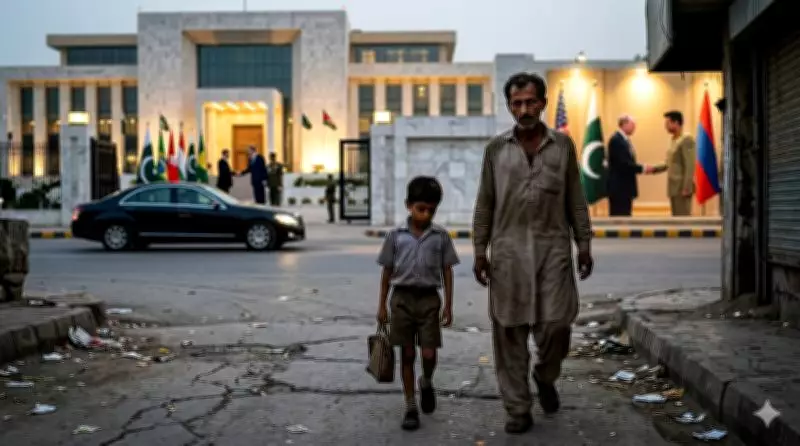
Fast forward some decades, and the parable has acquired a Pakistani accent. Our kingdom too now gleams — if not in fountains and flowerbeds, then in the sterner marble of diplomatic triumph. Peace overtures are made with historic enemies. Strategic partnerships are forged in the capitals of the world. Our Field Marshal, draped in the ceremonial gravitas of starched khaki, is received in the halls of Washington, Beijing, and Riyadh with the deference once reserved for sovereigns. The world, we are told, has taken notice. Pakistan is back on the map. The photograph albums of international diplomacy swell with handshakes and communiqués pledging eternal friendship. And all the while, in the unphotographed corners of the republic, a different story unfolds — one that no press release will ever capture.
The philosopher Frantz Fanon, writing of post-colonial societies in The Wretched of the Earth, warned of a ruling class that “is not engaged in production, nor in invention, nor in construction, nor in labour; it is completely canalised into activities of the intermediary type. Its innermost vocation seems to be to keep in the running and to be part of the racket.” The intermediary state — broker of geostrategic advantage, facilitator of great-power competition, recipient of aid and approval in exchange for services rendered — prospers in its own way. But the people? The Silent Crisis Beneath The Indus The people are the raw material of which diplomatic leverage is made, and like all raw materials, they are expendable in the calculus of high politics.

The Great Fracture: Prestige vs. Pain
This is the great fracture of our time: the widening gulf between the prestige of the state and the pain of society. For the common citizen, the day does not begin with geopolitical triumph. It begins with arithmetic. A man earning a modest salary wakes not to the promise of national recognition, but to the burden of impossible calculation. How much for transport? How much for milk? Can cooking oil wait another week? Will the school fee be paid this month, or must the child be told to stay home for a few days? The poor do not experience the nation through speeches; they experience it through prices. One may admire a state's international recovery, but admiration abroad cannot be eaten at home.
Inflation, in economic textbooks, is a rise in the general price level. In the life of the poor, however, inflation is a slow confiscation of dignity. It is the mother who waters down milk so that it may last until morning. It is the father who begins to walk to work because fuel has become a luxury. It is the graduate with a degree in hand and despair in the heart, standing in a queue with hundreds of others for a job that pays less than survival demands. Inflation is not merely a statistic; it is a daily humiliation.
Unemployment deepens this wound. In a just social contract, labour is the bridge between human effort and human worth. But what becomes of a society where effort finds no reward, where education yields no livelihood, and where the market devours aspiration? A young person without employment is not only deprived of income; he is deprived of rhythm, confidence, and place. He begins by postponing plans, then lowering expectations, and eventually doubting his own value. This is how economic failure mutates into moral injury.

The tragedy is that such suffering is often made invisible by the language of 'macro-stability', 'security imperatives' and 'strategic gains'. These phrases have their place, no doubt. States must engage the world; diplomacy matters; peace is preferable to conflict. But when these objectives are celebrated without equal concern for bread, work and welfare, governance begins to resemble theatre. The stage is lit, the curtains are rich, and the applause is loud — but backstage the actors are hungry.
Pakistan's Silent Crisis Of Medical Accountability
One may admire a state's international recovery, but admiration abroad cannot be eaten at home. Consider the lived experience of a lower-middle-class family in an urban neighbourhood. The breadwinner's salary, if he is fortunate enough to have one, no longer covers rent, utility bills, transport and food. Electricity bills arrive like legal threats. Gas supply is erratic, but the charges remain punishing. A visit to the doctor is postponed because the diagnosis itself has become expensive. Children grow up listening not to bedtime stories but to whispered parental arguments about debt. Weddings are delayed, nutrition declines, and even small pleasures — fruit, meat, a school outing, a bus journey to visit relatives — become occasions for guilt rather than joy.
In rural Pakistan, the picture is no gentler. A landless labourer, a small farmer, or a village shopkeeper lives at the mercy of rising input costs, shrinking margins, unstable markets and fragile public services. Inflation in cities becomes desperation in the countryside. When fertiliser rises, when diesel rises, when transport rises, the blow travels through the entire chain of subsistence. And when flood, drought or illness enters the scene, as it often does, the family falls from hardship into ruin.
One must ask, then: what is progress if it bypasses the people? What is stability if it stabilises only the façade? What is diplomacy worth if the diplomatic success of the state coincides with the domestic exhaustion of society? There is a point at which the patience of the poor ceases to be a virtue and becomes a resource to be exploited — a point at which the phrase "national interest" becomes indistinguishable from the interest of those who rule in the nation's name. Pakistan approaches that threshold. Every roti not eaten, every medicine not bought, every child's growth stunted by malnutrition while officials celebrate diplomatic coups — each is an entry in a ledger that history keeps with unforgiving precision.
US Foreign Policy Rules Where International Law Cannot
The school story had it right all along. The kingdom that impressed foreigners while its people starved was not a success story; it was a moral failure wearing a costume of grandeur. We are building that kingdom again, not with fountains and flowerbeds, but with memoranda of understanding and military partnerships, with carefully managed photographs and communiqués of friendship. The architecture differs; the underlying disease persists.
The school story ended with the prince, finally shamed by a wandering sage, opening the granaries and tearing his own silk to clothe the naked. It was a fairy-tale resolution, the kind that does not occur in history without struggle. But the moral remains: a state that wins the world's applause while losing its people's stomachs has not succeeded. It has merely learned to perform success more convincingly than its predecessors. And performances, as every child who has read that old story knows, eventually end.