Every year, the world's wealthiest nations emit carbon at a rate that breaks records. Yet Pakistan contributes less than one percent of the world's carbon output. Pakistan pays anyway. In Sindh's Thar Desert, where religious minority communities have lived for generations, the floods come with increasing ferocity, a debt collected from those who did not accumulate it.
Life Before the Floods
Sodhi, pregnant with her first child, sits in the courtyard of her painted mud home, rolling roti with the ease of someone who has done this ten thousand times. The painted walls are bright: blue flowers, pink circles, geometric patterns applied by hand. Behind her, her mother-in-law stands in front of the sacred Peepal tree, full of wishes about divine protection and gratitude. The tree speaks of Shakti, the energy that creates, protects, and transforms. In Thar, people live between prayer and fear, praying for water when the earth cracks, and fearing it when the skies finally answer too loudly.
Nimra works with her hands. For months, she has been stitching wedding garments for her daughter, choosing the colours, fabrics, and designs. Each stitch is a decision, a piece of knowledge passed down. She prepares the trunk in which the garments will travel with her daughter when she gets married.

Daily Life and Labour
Radha sits in the shade with her donkey, Ramo, before continuing her journey to collect firewood. In Thar, everyday life demands steady labour, constant movement, and moments of rest wherever they can be taken. Miles in the heat, Sakshi returns with water balanced on her head, her face damp with sweat, a quiet smile. She has found it. Clean water is less a thing to find than a thing longed for, and briefly held.
Jami sits in the comfort of her home with her three boys. Children play around her. This is ordinary life. A political party's flag flies above the ruins of a village. Corruption, broken promises, and no plan for the last mile when catastrophe strikes. The flag still stands. The village does not.
When the Water Came
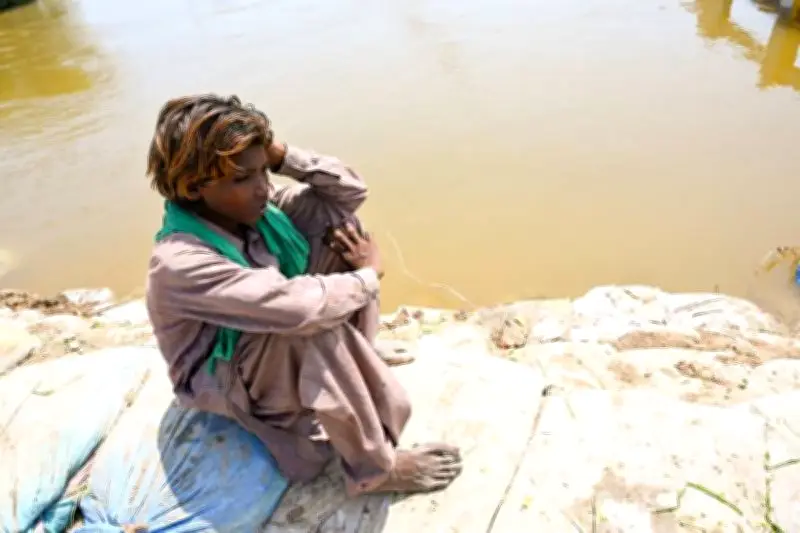
Every summer, the monsoon draws moist air across South Asia, producing up to three-quarters of Pakistan's annual rainfall. Heavy monsoon rainfall is now around 15% more intense due to climate change. Pakistan ranks among the top ten countries most vulnerable to climate change, yet contributes less than 1% of global emissions. The 2025 monsoon floods affected 18 million people, claimed 1,037 lives, and damaged over 229,000 homes.
Their belongings sit exposed at the edge of home, taken out in haste, with nowhere left to keep them safe. The same hearth. No fire. After the floods, the only thing that matters is keeping it lit: dry wood, clean food, one warm meal. Everything else can wait.
Aftermath and Loss
Jami's hearth is cold now. Ash in the fire pit. She sits in the corner of her home. The fire is out. After the floods, everything contracts to a single question: how do you keep the hearth lit when the wood is wet, the fields are underwater, and the road to the market is gone? Lakshmi stands in the flooded doorway of her brick home, floodwater at her knees. Behind her, through the stone arch, the courtyard is also submerged. There is no electricity. The water surrounding her is contaminated with sewage, pesticide, and the remains of everything the flood swept up. Her family will not leave. This house is everything, built by hand, lived in for generations, the only shelter they have.
Sakshi, 43, from Mir Deen Talpur village in Mirpur Khas, cultivated red chillies on one acre of land with her husband. After the floods destroyed her fields, she sat with her daughter and spread what remained of the harvest on the roadside to dry, a carpet of red against grey concrete. Behind her, a makeshift shelter built from cloth and sticks. She had already sold the family's bull to survive. The cattle had gotten sick from the contaminated floodwater. Even though it lived, it was weakened. She tried to treat it, but nothing helped. She had to sell it for a fraction of its value.

Impact on Children and Vulnerable Groups
Children hold their siblings in the ruins of their flooded home. The impacts of the climate crisis on the most marginalised children are impossible to ignore in Pakistan. They endure trauma during the most formative years of their lives, with insufficient coping skills, inadequate mental health support, and no guarantee of recovery. When Pratap watches his school disappear underwater, he is not just losing an education. He is losing the scaffolding that holds childhood together. Older adults and children face the highest risk from water- and mosquito-borne diseases that spread after floods.
Laalu sits on his charpai, holding the yellow quilt he rescued from his home, one of the last things he saved. Behind him, his village has disappeared under water. His cotton crop is gone. Reports highlight critical gaps in healthcare, emergency response, evacuation systems, and social protection, leaving deaths among vulnerable populations uncounted and invisible.
Rebuilding and Resilience
A few houses remain standing, their rooms flooded and unlivable. A political party's flag flies above the ruins of a village. The party has governed this province through floods before, and will again. The communities it was elected to protect lie underwater. Corruption, broken promises, and no plan for the last mile when catastrophe strikes. The flag still stands. The village does not.
In the aftermath of catastrophe, families in rural Sindh begin to rebuild. With limited external support, they work together, stone by stone, hand by hand. Hearths are relit. Fires return to kitchen stoves. Women stitch new clothes from available fabric, preparing for the next season and the routines of daily life. There is little pause for waiting. Recovery unfolds through small, steady acts: the rebuilding of shelter, the preparation of food, the making of clothes. Even after loss, the work of providing for families continues.
Women as Pillars of Continuity
Madhavi wears white bangles stacked to her elbows, a pink dupatta, a bindi, and embroidered cloth. She has lost much to the floods, but not herself. In Sindh, women like her play a central role in holding families together after disaster, preparing food, caring for others, and maintaining a sense of continuity in the midst of loss. Even as the landscape turns grey with mud and water, they carry forward the textures and rhythms of everyday life.
Recent floods have displaced millions across Pakistan, adding to cycles of loss that repeat with each passing year. These losses extend beyond lives and livelihoods. They unsettle futures and wear away ways of life shaped over generations: the rallis, painted courtyards, the daily rituals that hold a community together. Much of this resists measurement, slipping past the language of numbers and reports. Each year, people rebuild, stitching, painting, sowing again. And each monsoon, the water returns, patient and unappeased.
Disclaimer: All names of individuals have been changed to protect privacy and security.