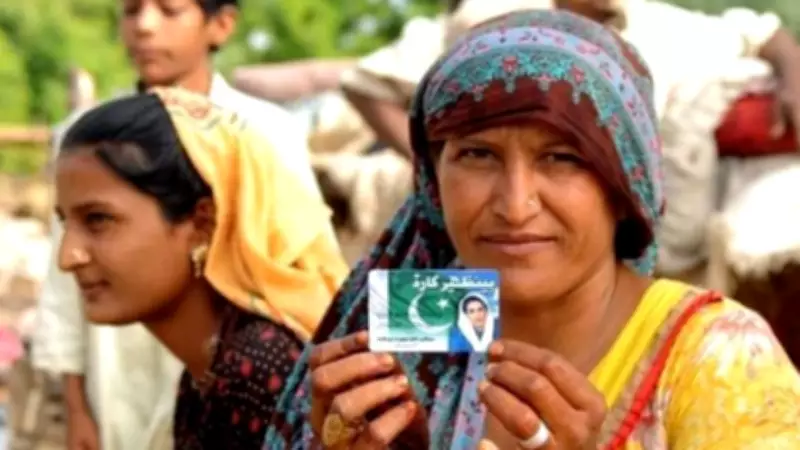
Officially launched in 2008, the Benazir Income Support Programme (BISP) was designed as Pakistan's largest social safety net to protect low-income households from rising inflation, food insecurity, and systemic economic shocks. Structured around direct cash transfers to women, particularly widows, divorcees, and persons with disabilities, the programme aimed to provide immediate financial relief while fundamentally strengthening women's economic agency within the household. Over nearly two decades, it has evolved from a simple relief fund into a sophisticated human capital framework through initiatives like Benazir Taleemi Wazaif, which provides educational stipends for school-going children, and Benazir Nashonuma, which addresses the critical window of maternal and child nutrition.
Global Recognition and Domestic Criticism
By April 2026, international financial institutions will have increasingly showcased BISP as a global model for digital social protection. The World Bank and IMF frequently cite its technical backbone—the National Socio-Economic Registry (NSER) and the Proxy Means Test (PMT)—as gold standards for identifying and reaching vulnerable populations in developing economies. Yet, despite this international acclaim and the programme's survival through multiple regime changes, BISP faces a persistent, often vitriolic, domestic critique. Opponents in television debates and policy circles frequently dismiss the transfers as 'dependency politics,' 'political bribery,' or a form of fiscally irresponsible populism that encourages a 'beggar mindset.'
Flawed Arguments Against Dependency
Behind these criticisms lies a familiar neoliberal assumption: that poverty is a result of individual failure and that welfare represents an undeserved concession by the state. This 'intellectual capture' of the poverty discourse serves to delegitimise the rights of the poor while ignoring the structural failures of the market. However, this argument collapses when confronted with the mathematical reality of the support provided. As of 2026, the Benazir Kafaalat stipend stands at approximately Rs. 14,500 per quarter, which breaks down to less than Rs. 5,000 per month. In a national economy defined by soaring utility costs, high fuel prices, and food inflation, the suggestion that such a modest amount would cause a person to abandon 'productive' work is not just logically flawed; it reflects a profound class-based disconnect from the lived realities of survival in Pakistan.

The Hidden Economy of Women's Unpaid Labour
The 'dependency' myth further ignores a vital truth: the women receiving these stipends are already working—often far more than the men in their communities. Pakistan's economy depends on a vast, hidden infrastructure of unpaid labour performed by women inside homes, on small-scale farms, and within informal family economies. The real dependency in Pakistan is not the poor woman relying on a small state stipend. The real dependency is an economic system that relies on the uncompensated, invisible labour of women to mask its own failures and inadequacies. In rural regions, women are the ones who absorb the daily failures of state infrastructure. When there is no piped water, women walk miles to fetch it. When the healthcare system fails, women provide the essential nursing care for the sick and elderly at home. When inflation shrinks the value of a rupee, women compensate by stretching household resources through additional manual labour, processing crops, and managing livestock. This is the 'shadow economy' that keeps the formal economy afloat.
Feminist Economic Perspectives
Feminist economists, most notably Marilyn Waring, have long argued that national accounts like GDP are fundamentally deceptive because they treat this 'invisible' labour of social reproduction as having zero value. If the unpaid domestic and care work performed by Pakistani women were assigned a market wage, some estimates suggest it would account for nearly one-quarter of the national GDP. For decades, the Pakistani state and the private sector have benefited from this massive, uncompensated subsidy. Seen through this lens, BISP is not an act of state generosity; it is a limited, overdue acknowledgement of this immense economic contribution. It is a social dividend paid to the very people who have been subsidising the country's survival for generations.

BISP's Role in Financial Inclusion and Crisis Resilience
Furthermore, BISP has fundamentally altered the relationship between the marginalised citizen and the state. It has transitioned women from passive observers of the national economy to recognised participants with a digital identity. Accessing BISP requires a Computerised National Identity Card (CNIC) and biometric verification. For many rural women, this represents their first sustained interaction with formal public institutions independent of male intermediaries. By funnelling cash through banking channels, ATMs, and mobile wallets, BISP has facilitated a massive wave of financial inclusion. Even a small amount of independent income can shift household power dynamics, giving women greater influence over essential spending on a child's education or a family member's medicine.
Climate and Crisis Response
The programme's impact also extends into the realm of climate and crisis resilience. During the catastrophic 2022 floods and subsequent environmental shocks leading into 2026, BISP proved to be the only mechanism capable of delivering rapid, transparent relief to millions. Because the digital infrastructure was already in place, the state could inject liquidity directly into the pockets of those most affected, preventing a total collapse of local rural markets. In these fragile economies, BISP stipends circulate immediately—they are spent at the local pharmacy, the village grocer, and on local transport. This 'multiplier effect' stabilises small-scale commerce in regions where private capital rarely ventures.
Global Comparisons and the Path Forward
Pakistan's experience reflects a broader global trend. Programmes like Brazil's Bolsa Família and Mexico's Oportunidades were once met with the same 'dependency' critiques, only to be later recognised for drastically improving child nutrition and long-term economic stability. Across the developing world, the evidence is clear: targeted cash transfers to women are among the most effective tools for human capital development. However, recognising the success of BISP does not mean the programme is sufficient. A quarterly payment of Rs. 14,500 remains a drop in the ocean compared to the scale of inflation and the sheer volume of unpaid labour women perform daily. Cash transfers alone cannot solve the structural roots of poverty. Pakistan still requires massive, sustained investment in public services—piped water, affordable childcare, accessible healthcare, and reliable transportation to relieve the physical burden currently carried by women.
Redefining Dependency
But critics who decry the 'dependency' of BISP recipients have the equation backwards. The real dependency in Pakistan is not the poor woman relying on a small state stipend. The real dependency is an economic system that relies on the uncompensated, invisible labour of women to mask its own failures and inadequacies. BISP does not create a 'beggar mindset.' On the contrary, it exposes the massive social and economic debt the state owes to its female citizens. It does not create dependency; it finally makes the existing, structural dependency of the economy on women's labour visible to the world.