Opposition Parties Condemn Government's Move to Join Trump's 'Board of Peace' Without Parliamentary Consultation
ISLAMABAD: The opposition in Pakistan has launched a scathing attack on the government's decision to participate in United States President Donald Trump's newly formed "Board of Peace" without seeking parliamentary approval. Major political parties have called for immediate withdrawal from the initiative until a comprehensive consultative process involving all stakeholders is undertaken.
JUI-F Chief Maulana Fazlur Rehman's Strong Criticism
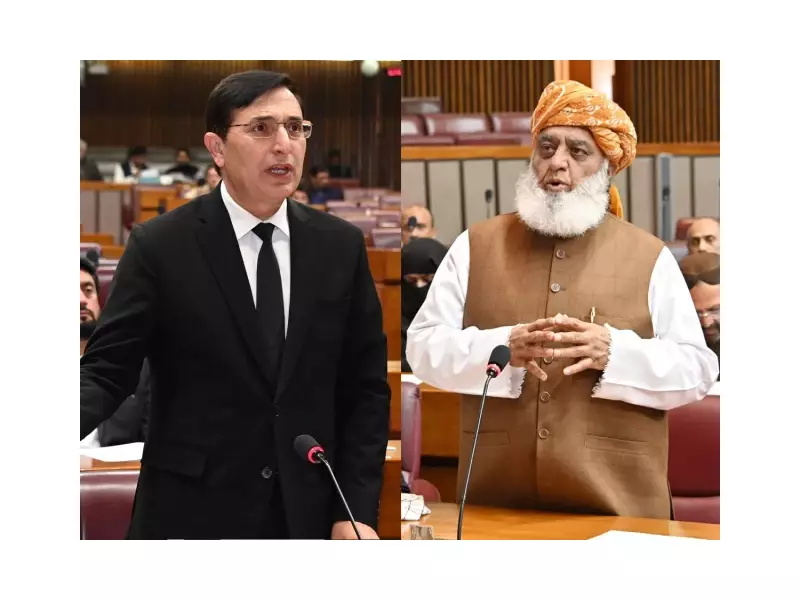
Addressing the National Assembly on Thursday, Jamiat Ulema-e-Islam Fazl (JUI-F) chief Maulana Fazlur Rehman vehemently opposed Pakistan's participation in what he described as a "so-called Board of Peace" under Trump's leadership. The religious-political leader questioned the very composition and credibility of the board, particularly highlighting Israel's inclusion as a member nation.
"If we then associate hopes of peace, economic stability and a better future for Palestinians with such a board, it would be nothing but deceiving ourselves," Rehman stated during his parliamentary address. He emphasized that Trump had formed the board according to his own wishes, deciding its membership himself while remaining its permanent chairman.

Questioning Pakistan's Foreign Policy Direction
The JUI-F leader raised serious concerns about Pakistan's foreign policy formulation, suggesting that policies were being shaped under external pressure rather than national interests. He specifically questioned whether current rulers followed Quaid-e-Azam Muhammad Ali Jinnah's stance on Israel, recalling that Pakistan's founder had called Israel an "illegitimate state."
Rehman presented grim statistics about the Palestinian situation, noting that over 70,000 innocent Palestinians had been killed in the past one to one-and-a-half years, with more than 100,000 dying due to hunger and poverty, and over 150,000 rendered homeless. He questioned the moral standing of a peace board that included Israeli Prime Minister Benjamin Netanyahu, whom he described as a "butcher."
PTI's Formal Rejection and Demands
The Pakistan Tehreek-e-Insaf (PTI) issued a formal statement rejecting the government's decision to join the "Board of Peace," emphasizing that such moves carry significant international implications and must not be undertaken without transparency and broad-based political consultation.
In their statement released on social media platform X, PTI stressed that "decisions of such international significance must always be undertaken with full transparency and inclusive consultation with all major political stakeholders." The party reiterated its position that it does not recognize the legitimacy of the current Parliament, claiming the 2024 general election results were manipulated.
PTI outlined three specific requirements for any such international engagement:
- Thorough parliamentary scrutiny and debate
- Inclusive consultation with all major political leaders, particularly former prime minister Imran Khan
- Transparent communication with the nation through a referendum to ensure public confidence
Government's Defense of the Decision
Parliamentary Affairs Minister Dr Tariq Fazal Chaudhry defended Pakistan's decision to join the "Board of Peace," stating that the move was guided by national interest and the collective priorities of the global Muslim community rather than political considerations. Responding to opposition criticism, he emphasized that the decision was taken in the interest of the Palestinian people and reaffirmed Pakistan's long-standing principled stance on the Palestine issue.
"Pakistan's participation in the Board of Peace aims to support these efforts while safeguarding both Palestinian and national interests," Chaudhry stated, urging lawmakers not to turn the issue into a matter of political point-scoring. He stressed the need for unity and consensus within Parliament on matters of national importance.

Broader Parliamentary Concerns
The controversy over the "Board of Peace" emerged during a National Assembly session that also addressed several other significant issues. Lawmakers raised concerns about poor internet and mobile services across the country, particularly in Balochistan, with officials promising improved spectrum allocation to double internet speeds.
The government admitted to constitutional violations regarding the Council of Common Interests (CCI), with only three meetings held in the past two years instead of the required quarterly sessions. Seven important bills were introduced, including amendments related to anti-money laundering, cybercrime, oil and gas regulation, housing, and national heritage preservation.
Meanwhile, the National Assembly's YouTube livestream remained suspended for a second consecutive day due to technical issues, limiting public access to parliamentary proceedings. The session was eventually adjourned for an indefinite period, leaving several matters unresolved.
Regional Security Concerns Raised
During the same session, updates were provided on the ongoing displacement from the Tirah valley in Khyber district, where thousands of families are leaving their homes for safer areas including Bara and Peshawar due to escalating security concerns. Fazlur Rehman alleged that contractors in several Khyber-Pakhtunkhwa areas were being forced to pay extortion money, suggesting that portions of the budget were being allocated to armed groups.
The JUI-F leader concluded his remarks with a strong warning: "We should clearly refuse and state that under Trump's chairmanship and with Netanyahu's presence, this Board of Peace has no credibility or usefulness, and we reject it." He announced February 8 as a "black day" to protest what he described as undemocratic practices in the country's governance.