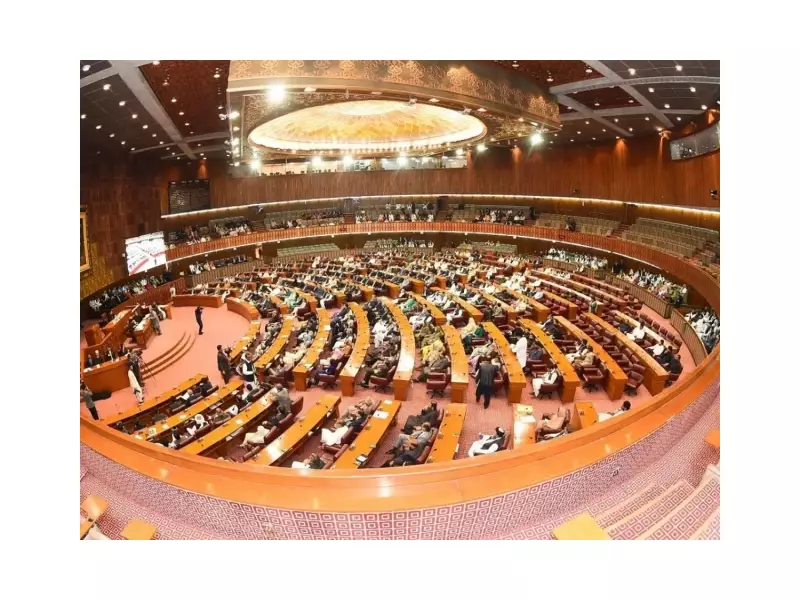
Pakistan's National Assembly has taken a strong stance against what it describes as provocative statements by Indian Defense Minister Rajnath Singh regarding Sindh province. During a parliamentary session chaired by Speaker Ayaz Sadiq, lawmakers unanimously passed a resolution condemning the Indian minister's recent comments as an assault on Pakistan's sovereignty.
Unanimous Condemnation in Parliament
The resolution, moved by Pakistan Peoples Party lawmaker Aslam Alam Niazi, declared Singh's statements highly condemnable and reaffirmed that Sindh is an inseparable part of Pakistan. The assembly expressed strong disapproval of what members characterized as India's interference in Pakistan's internal matters.
Indian Defense Minister Rajnath Singh had earlier claimed at an event in New Delhi that Sindh was historically and culturally part of India and suggested that borders keep changing. He further remarked that no one knows whether Sindh may become part of India again tomorrow, sparking outrage across Pakistan's political spectrum.

Sindh Assembly Echoes National Sentiment
The provincial assembly in Sindh mirrored the national parliament's response by passing a joint resolution condemning Singh's provocative statement. The resolution gained unanimous approval from both treasury and opposition benches, demonstrating rare political unity on the issue.
Sindh Chief Minister Murad Ali Shah led the condemnation, describing Singh's remarks as highly provocative and unfounded. He emphasized that Sindh's history predates the pre-Islamic era and noted that the Sindh chapter of the Muslim League was among the first to support Pakistan's creation.
Referring to Singh as a minister born in Uttar Pradesh and unaware of the Indus heritage, Shah stated that whoever has drunk the water of the Indus cannot betray this land. He urged the federal government to circulate the resolution internationally to highlight India's designs on the Indus River.
Cross-Party Unity Against External Remarks
Opposition Leader Ali Khurshidi endorsed the resolution, acknowledging that Pakistan's armed forces had given a befitting response to Indian aggression. He assured the House that opposition parties supported the move beyond political differences.
Provincial Minister Saeed Ghani highlighted that Pakistan's armed forces and people had bravely defeated India in recent conflicts. Meanwhile, Education Minister Sardar Shah called Singh's statement ignorant, pointing to Sindh's 6,000-year-old history and suggesting that if India could claim Sindh, Pakistan could similarly claim Gujarat and Haryana.
Other significant reactions included:
- MQM's Muhammad Wasim advising India to stop dreaming and accept reality
- PPP's Giyan Chand Essrani stating that India's leadership appeared gripped with fear
- Lawmakers from Sunni Ittehad Council, MQM, and Jamaat-e-Islami joining the condemnation
During the same session, the National Assembly also passed several bills, including the King Hamad University of Nursing and Associated Medical Sciences (Amendment) Bill 2025, demonstrating the parliament's ability to handle multiple legislative matters simultaneously while addressing national security concerns.