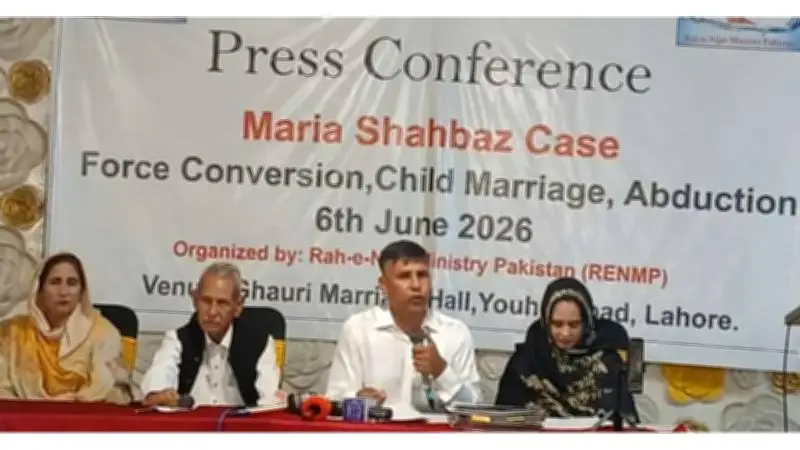
In March 2026, a Lahore court upheld the marriage of a thirteen-year-old Christian girl, despite her family's allegations of abduction and forced conversion. The ruling sparked protests from Catholic bishops and human rights groups, finally pushing the Punjab Assembly to act after six years of inaction. I wish I could say I was surprised.
The Policy That Was Ignored
In 2020, I led the design of the Punjab government policy "Harmonious, Tolerant and Safe Punjab for Everyone." Developed under the Ministry of Human Rights, Minority Affairs and Interfaith Harmony, it involved twenty consultation sessions with religious scholars, legislators, lawyers, journalists, and citizens. The policy identified a clear pattern: minor girls from Christian and Hindu families, some as young as twelve, were being abducted, converted, and married, with no legal protection because Pakistan lacked a law criminalizing forced conversion. Our top recommendation was to pass such a law immediately.
Six Years of Inaction
The policy was not passed. Similar bills failed in 2016 and 2019. Our 2020 recommendation was rejected by the Punjab Assembly's Standing Committee on Religious Affairs. A federal version was dismissed in 2021 after objections from the Council of Islamic Ideology. Between 2021 and 2024, monitors recorded 421 forced conversion cases nationally, 70% involving minors. In Punjab alone, one rights group documented 83 cases involving Christian girls in 2024.

The 2026 Case That Broke the Stalemate
In March 2026, a Lahore court ruled that the marriage of a thirteen-year-old girl to a man in his thirties was legally valid, despite her family's abduction claim. The ruling ignited national outrage. Catholic bishops led street protests, and rights groups condemned the decision. The Punjab Assembly, which had avoided the issue for six years, finally moved to advance the Protection of the Rights of Religious Minorities Bill and a Child Marriage Restraint Bill, raising the marriage age to eighteen for both sexes—mirroring our 2020 recommendations.
A Pattern of Diagnosis Without Action
This story is not just about one court case or religious minorities. It reflects how Pakistan repeatedly produces accurate diagnoses but fails to act. The National Commission for Minorities Rights, passed in December 2025, was stripped of its power to investigate cases independently before approval. As I wrote, "Pakistan has become remarkably skilled at producing the right diagnosis, and remarkably slow at acting on it."
The Cost of Delay
The 2020 consultations were not wasted; they built legitimacy that the Assembly is now drawing from. But a thirteen-year-old should not have to become a national controversy for protections to be enacted. The next test is whether Punjab can enforce these laws once passed, rather than adding them to a shelf of good intentions.