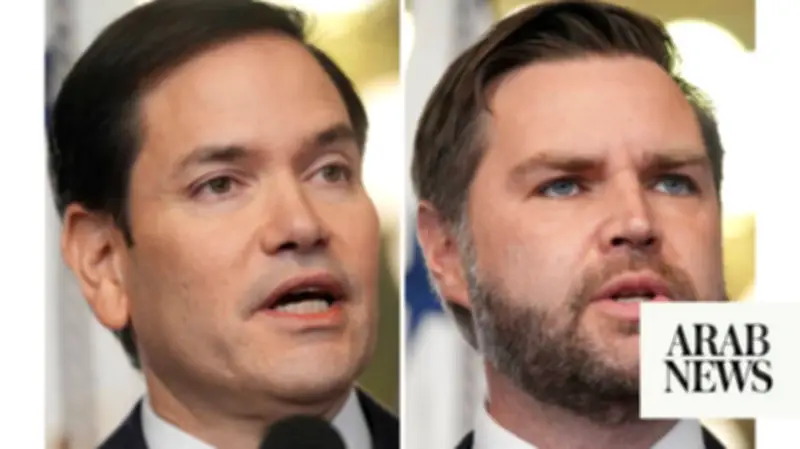
Vice President JD Vance and Secretary of State Marco Rubio appear to be taking divergent approaches to executing President Donald Trump's national security agenda, positioning themselves as potential rivals for the 2028 Republican presidential nomination. Their differing backgrounds and policy perspectives have led them to stake out separate territory: Rubio, the son of Cuban immigrants with extensive Senate experience and a focus on Latin America, and Vance, a Midwesterner and Marine Corps veteran who served just two years in the Senate before becoming Trump's 2024 running mate, with a message of opposing foreign wars.
Divergence on the Middle East
While both men remain deferential to each other, and the White House and State Department deny any rift, Vance and Rubio appear most divided on the Middle East. Vance has been critical of Israel's actions in Lebanon, saying Trump is frustrated that Israeli operations against Hezbollah have angered Iran and complicated negotiations with Tehran. Rubio, in contrast, has remained supportive of Israel or held his tongue, especially on Lebanon, where he took the lead and helped secure a preliminary framework agreement last week. Vance leads Iran negotiations, while Rubio focuses on Lebanon.
White House Denies Rift
White House spokeswoman Anna Kelly rejected suggestions of a rift, stating: "Why is the legacy media obsessed with driving a wedge between Vice President Vance and Secretary Rubio that does not exist? There is one camp — President Trump's camp — and the entire administration is fully behind the president's efforts to ensure Iran can never possess a nuclear weapon." State Department spokesman Tommy Pigott added that "Rubio and the entire administration is 100 percent in lockstep behind President Trump."

Rubio Skeptical of Iran Deal, Vance Takes Lead
According to Trump administration officials familiar with the matter, Rubio was so skeptical of obtaining an acceptable deal with Iran that he declined to head the US delegation to the first ceasefire negotiations in April in Islamabad, Pakistan. Vance, seeing an opportunity to bolster his foreign policy credentials, asked Trump twice to take the lead before Trump agreed, the officials said, speaking on condition of anonymity. Vance led the US delegation to the inconclusive Pakistan meeting and then to talks in Switzerland, following a memorandum of understanding between the US and Iran. The resulting truce remains fragile, with repeated exchanges of fire in recent days.
Experts Weigh In
Dan Fried, a former assistant secretary of state and ambassador to Poland now with the Atlantic Council, said: "The talk about differences is not idle speculation. There is definitely something to it." Ian Kelly, a retired career diplomat and ambassador during the first Trump administration, noted: "It's rather unusual for the VP to be given the lead role in a negotiation, but it's quite possible that Rubio is happy to let him. It's a pig in a poke. It's a loser job." He added that both men seem to "have equal ambitions to replace" Trump, but that Trump's semi-joking comment that he would blame Vance if the Iran talks fail suggested Vance was being "set up for failure."
Vance and Rubio Deny Division
Vance has talked up the chances of success for a broad agreement with Iran, albeit with caveats, while Rubio has taken a more agnostic line publicly, denying any division. "We're all focused on the jobs in front of us. I think the president loves to stir the pot a little bit and loves the entertainment of it," Vance said. "I love Marco. I think he's a great secretary of state. He's become a very, very dear friend." Rubio also rejected any schism, telling reporters during a trip to Bahrain: "When it comes to foreign policy and national security, we have no drama. We have no games. We have a group of people that work very well together and closely to execute on the president's directives."

Trump Fans the Flames
Trump has not shied away from fueling potential rivalry, repeatedly asking crowds who they would prefer to succeed him and suggesting they might make an unbeatable ticket. Despite denials, experts note the men do not share the same worldview. Fried said: "Rubio speaks within the rubric of the Ronald Reagan construct of the free world and its importance. Vance is not interested in the free-world construct. He speaks in the language of not wanting to fight what he believes are abstractions." Fried warned: "We're headed toward a bad place in Iran, which is giving up any support for Iranian civil society and not being terribly good at containing Iran. Instead, we seem to be allowing ourselves to be backed into a 'sphere of influence' situation where Iran is weaker but ends up better off than before. I can't imagine Rubio agreeing to that."
Rubio Strengthens Position
Aides to Rubio point out that he has said he would defer to Vance should Vance choose to run for the 2028 Republican presidential nomination. At the same time, Rubio has used his dual role as Trump's top diplomat and national security adviser to reshape the National Security Council, installing several close allies in top White House positions in recent weeks. These include former State Department counselor Mike Needham as deputy national security adviser, Jeremy Lewin, who oversaw the dismantlement of USAID and is joining the NSC as a deputy for the Western Hemisphere, and Dylan Johnson, head of NSC communications, who also serves as assistant secretary of state for public affairs.