Volume V Consolidates State-Led Development Doctrine
The publication of the fifth volume of The Governance of China by Xi Jinping marks the consolidation of a political formula within a world governed by generalized monopoly. It arrives at a historical moment when the ideological legitimacy of market rule has fractured, prompting sections of a global left to desire an end to the neoliberal market era by celebrating the emergence of a multipolar world order as an anti-imperialist alternative. Among chauvinist currents within Pakistan’s left, China’s retention of strategic capacity over credit, technology, and industry can appear to settle the question of anti-imperialism in advance.
Earlier volumes established the Party’s claim to hold reform, market development, and national rejuvenation within a common horizon. Volume V proceeds after that claim has become settled doctrine, under conditions in which monopolistic control over finance, technology, infrastructure, and security has made social reproduction increasingly inseparable from the imperatives of state-led development. Across the global periphery, this model registers not as a break from colonial patterns but as a postcolonial state apparatus that functions as an integral site for the reorganization of a monopolized world system.
Visible Hand Extends Party Role Across Finance and Governance
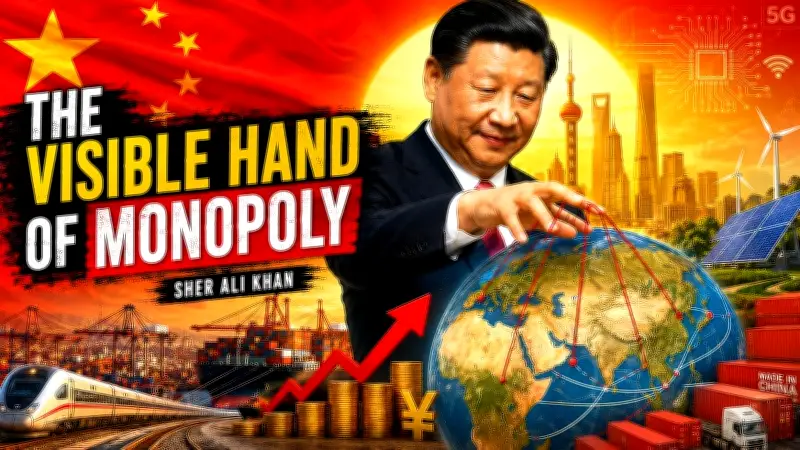
Volume V gathers themes including market reform, Party leadership, national rejuvenation, and whole-process people’s democracy into a denser relation, where finance, technological capacity, and social governance are treated as conditions of Chinese modernization. In Volume V, the visible hand acquires a more integrated institutional form, extending the Party’s role across development, finance, security, and social governance. This arrangement sets the terms of visibility, placing the Party more deeply within the institutional conditions through which household life, migration, and labour are organized for accumulation.

Volume V intensifies this developmental logic through “high-quality development,” framing technological self-reliance, the green transition, and the mitigation of the “disorderly expansion of capital” as requirements of state stability. Xi’s account retains a decisive role for the market while assigning the government responsibility for macroeconomic regulation, market order, and public provision, placing these functions inside the wider task of national rejuvenation. This is not a retreat from the market; it is an active recalibration of the conditions of accumulation to ensure they remain subordinate to the strategic requirements of national rejuvenation.
Generalized Monopoly and the Limits of State Strategy
The arrangement does not leave popular demands outside the state. It draws them into a Party-led institutional field where they can be addressed without becoming a claim upon the direction of development itself. The force of this arrangement lies in its ability to make crisis legible without allowing it to establish another political horizon. The structural limit of this apparatus is that no state strategy can abolish the contradictory social relations through which capital reproduces itself.
Samir Amin defined generalized monopoly not as a collection of dominant states, but as an integrated system in which oligopolies control credit, technology, inputs, resource access, and prices, binding formally independent producers and peripheral economies into a global chain of dependency, where monopoly and imperialist rent are realized. In this framework, globalization is the extension of this extractive system into the periphery. Volume V indicates a state-led effort to retain strategic leverage over finance, technology, and industry within this order. That capacity alters China’s position within generalized monopoly, though it does not place China outside the relations through which national development remains tied to the global circulation and extraction of value.

State Control vs. Democratic Socialization
Amin’s distinction between nationalization, which remains state control, and democratic socialization, which is the transfer of power to those who actually produce, remains decisive. State direction over productive capacity does not transfer the power to determine the path of development to those whose labour and reproduction sustain it. Analytical frameworks seeking to move past Western demonization by concluding that China remains inherently more equitable bypass this structural problem.
The visible hand in Volume V does not overcome capitalist crisis. It gives crisis a political form, while the mass line returns the social effects of accumulation to Party strategy. When this domestic political arrangement is projected outward, the global vision of Volume V links development, security, and civilizational cooperation through the Global Development, Security, and Civilization Initiatives. Xi presents the three initiatives as responses to deficits in peace, development, security, and governance, linking indivisible security to a wider revision of global governance.
Global Security Initiative and the World System of Capital
This design cannot be grasped by looking only at formal state alliances. Understanding power requires separating the international system of states from the broader world system of capital, where the former operates through treaties while the latter organizes logistics, finance, and extraction across borders. Imperialism is not the action of a single Western triad; it is a structural logic running through the capitalist world system, unevenly embodied by different rival poles.
The Global Security Initiative can be read as an effort to secure the political conditions under which Chinese infrastructure, supply chains, and development projects extend across regions marked by geopolitical rivalry and uneven development. Because capital operates through these diffuse corridors, the assumption that systemic crisis automatically generates a progressive opening loses its analytical hold. The visible hand coordinates these registers by projecting its authority directly into the spaces of capital, where territorial borders and economic flows intersect, extending Chinese development through the same uneven global spaces in which finance and labour are already organized.
Whole-Process People’s Democracy and Crisis Management
Ironically, Xi presents whole-process people’s democracy as a response to demands for democracy and the rule of law, while making Party rule the condition through which those demands can acquire institutional form. The arrangement does not leave popular demands outside the state. It draws them into a Party-led institutional field where they can be addressed without becoming a claim upon the direction of development itself. The force of this arrangement lies in its ability to make crisis legible without allowing it to establish another political horizon, returning livelihood pressures through provision, legal procedure, bureaucratic discipline, and local adjustment while leaving the structural relation that produced them intact.
The domestic handling of social pressure is joined to an outward strategy of infrastructure, trade, security, and development across an uneven capitalist world. For a global left that views the crisis of the market era as capitalism’s end, the shift from the first to the fifth volume exposes a doctrine that offers a sophisticated state capable of learning from society in order to retain authority over development, leaving those whose labour sustains that development without a comparable capacity to determine the future produced in their name. The multipolar order it champions does not stand outside generalized monopoly. It reorganizes its political geography, placing the Chinese state among the strategic centres through which credit, technology, infrastructure, and production are increasingly coordinated without dissolving the unequal relations that bind the periphery to global accumulation.