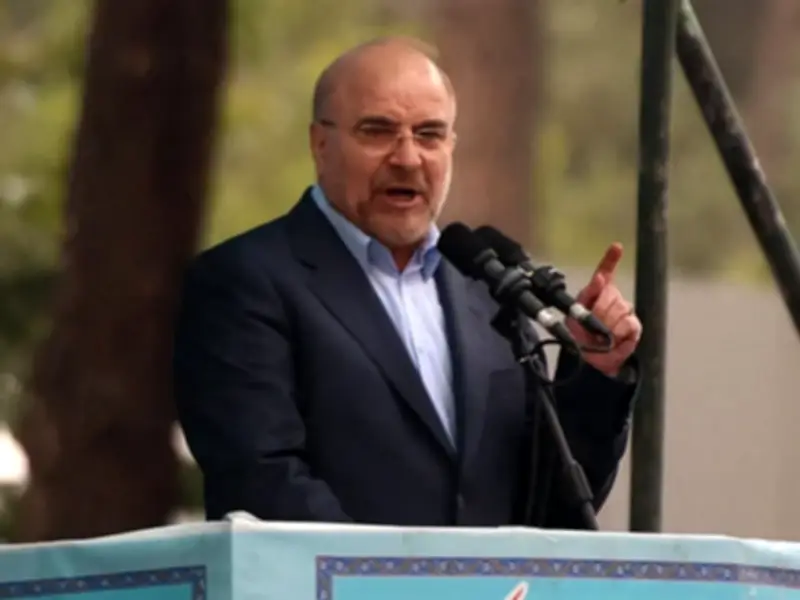
Iran's chief negotiator Mohammad Bagher Ghalibaf declared on Tuesday that the Strait of Hormuz will be administered by Tehran, according to state media, following talks aimed at ending the US-Israeli war on the Islamic republic. The announcement came after Iran and the United States agreed on Monday to establish communication lines to keep the vital shipping route open and end fighting in Lebanon, mediators said, following their first round of talks in Switzerland toward ending the conflict that has engulfed the Middle East.
Ghalibaf's Statement on Strait of Hormuz
"The Strait of Hormuz will never return to its pre-war conditions and will be administered by the Islamic Republic of Iran, in accordance with international law," Ghalibaf said on his return from the talks, according to IRNA. In a video posted to his Telegram account, Ghalibaf described the talks at the luxury Swiss resort of Burgenstock as producing "good achievements." He added, "In my view, this trip had good achievements, especially regarding the discussion of the Strait, the Lebanon discussions, the question of oil waiver, and the matter of releasing the frozen funds."
US Sanctions Waiver and Nuclear Inspections
The United States temporarily suspended sanctions on Iranian oil on Monday after Vice President JD Vance said Tehran would allow UN nuclear inspectors to return to the country, following the talks. As part of the deal, Tehran is also set to receive some form of sanctions relief from Washington, as well as the unfreezing of assets. "Of course, we believe we are still at the beginning of this work and must continue our efforts," Ghalibaf added in the video.

Iranian state media reported that Ghalibaf made a stop in Oman, which shares the Strait of Hormuz. The waterway, which Iran closed at the start of the war, reopened last week after Washington and Tehran reached an agreement. But Tehran announced on Saturday it had closed the strait again in response to Israeli attacks in Lebanon. Since then, Tehran and Washington have agreed to establish a line of communication "to avoid incidents and miscommunication with the aim of safe passage for commercial vessels" through the waterway, according to Qatari and Pakistani mediators. Maritime traffic in the strait continued to flow on Monday at a faster pace than before the US-Iranian agreement on talks to end the war, according to tracking firms.
Israel Braces for Possible US Demand to Withdraw from Southern Lebanon
Israel is taking into account the possibility of a future US demand for a gradual withdrawal of Israeli troops from areas in southern Lebanon, Israel’s public broadcaster KAN reported on Monday. KAN said a new round of talks between Israel and Lebanon is set to begin Tuesday to discuss initial arrangements for a possible Israeli troop withdrawal from southern Lebanon as part of a pilot program for the Lebanese army. The talks are expected to take place under US mediation and with the participation of the Israeli and Lebanese ambassadors alongside three Israeli brigadier generals, the broadcaster said.
It also reported that Israeli forces have begun repositioning and reorganising troops on the ground over the past 24 hours while awaiting decisions from the political leadership. KAN cited unnamed Israeli sources as saying that Israel was taking into account the possibility that the Israeli army could be asked by an American decision to gradually withdraw from certain areas in the so-called security zone, allowing the Lebanese army to return as a confidence-building measure. It added that the United States had approved the creation of a mechanism to monitor ceasefire violations in Lebanon involving Iran and Qatar without Israeli participation. According to Israeli sources cited by the broadcaster, Israel’s exclusion from the mechanism stemmed from Iran’s involvement.

Earlier Monday, Israel’s Channel 13 quoted a senior Israeli official as saying that Washington had recently made clear to Israel that its previous freedom to operate militarily in Lebanon without restrictions had come to an end. The Maariv newspaper also reported growing differences between the United States and Israel over the Lebanese file, saying Washington views southern Lebanon within a broader regional framework linked to the Strait of Hormuz, energy prices, the Iranian nuclear issue and the Trump administration’s pursuit of a diplomatic achievement. In contrast, Israel believes that any early withdrawal from southern Lebanon could be interpreted as a sign of weakness and a reward for the Hezbollah group.
US Waives Iran Sanctions; Trump Warns Iran
The United States waived sanctions on Iran for 60 days from Monday after the first talks under a nascent peace deal, with US President Donald Trump saying he will "do what I have to do" if Iran does not stick to its side of the agreement. US Vice President JD Vance said talks with Iranian officials in Switzerland had laid a good foundation for a final peace deal, although Iran denied that it had begun discussions of its nuclear program.
The two sides, trying to build on the interim deal they signed last week, agreed a roadmap towards a permanent agreement within 60 days at the talks in the Qatari-owned Swiss mountain resort of Buergenstock, mediators Pakistan and Qatar said. They also agreed on a mechanism to end fighting in Lebanon between US ally Israel and Iran-aligned Hezbollah, and opened a communications line to help ensure safe passage for commercial ships through the Strait of Hormuz to avoid conflict in the strategic waterway.
In the first of several steps envisaged under the agreement to provide economic relief to Iran, the US Treasury announced a waiver until August 21 on sanctions, allowing Tehran to sell oil and related products and receive payment for them. Officials reported a sustained lull in fighting in Lebanon under the agreement aimed at ending hostilities across the region, even as Israel said it would maintain a security zone in southern Lebanon and continue to act to "neutralise" threats against Israeli soldiers and citizens.
Tanker traffic through Hormuz started to pick up on Monday, with the foreign minister of Oman affirming his country's commitment to international law and toll-free safe passage during negotiations with Iran over administering the vital waterway. US-Israeli attacks on Iran and Israeli strikes in Lebanon have killed thousands of people and displaced millions. The Iran war has also shaken markets around the world and raised global oil prices. Crude prices extended losses on Tuesday after settling 3% lower on Monday.
Vance Delivers Upbeat Assessment
Israel was not party to the peace agreement, but on Friday it agreed a new ceasefire in Lebanon. Though intense fighting continued for another day, Lebanese officials said it had abated since Saturday night. Israel and Lebanon were due to start a new round of talks in Washington on Tuesday, with Beirut determined to press ahead with direct negotiations even as they appear to be overshadowed by Iran's decision to make Lebanon part of its negotiations with the United States.
Vance, who has maintained an upbeat tone since the memorandum of understanding was signed, said Tehran had agreed to allow nuclear inspectors into the country, and to establish mechanisms to handle its assets frozen abroad and manage ceasefires. "We laid a very good foundation for a successful final deal," he told reporters after taking part in the talks. However, Iran's Foreign Ministry spokesperson Esmaeil Baghaei told the official IRNA news agency that Iran had not yet discussed nuclear issues or made new commitments.
Trump said in a post on Truth Social on Monday that Iran will agree to have weapons inspections to ensure "nuclear honesty." "If Iran doesn't live up to their agreement, or if they're not behaving, I will do what I have to do," Trump later told reporters. Iran has limited inspections by the International Atomic Energy Agency since the US and Israel launched a first round of air strikes last year, and suspended them entirely when war broke out in February. It says its nuclear program is peaceful.
Iranian Foreign Minister Abbas Araghchi said on social media that Tehran had secured waivers for oil and petrochemical exports, the release of some of its frozen assets abroad and the launch of a reconstruction and development plan for Iran. Vance said White House envoy Jared Kushner, Trump's son-in-law, had come up with a process whereby the US and Qatar would have control over Iranian funds when they are unfrozen, and the money could be spent on US corn, soy and wheat. "So, the money that we lift is going to go to our farmers," Trump told reporters. However, Iran's Central Bank Governor Abdolnaser Hemmati said there was no such obligation and said at least some of the remaining frozen funds could be used to buy other non-sanctioned goods, Iran's Tasnim news agency reported. Technical talks were due to continue for the rest of this week.