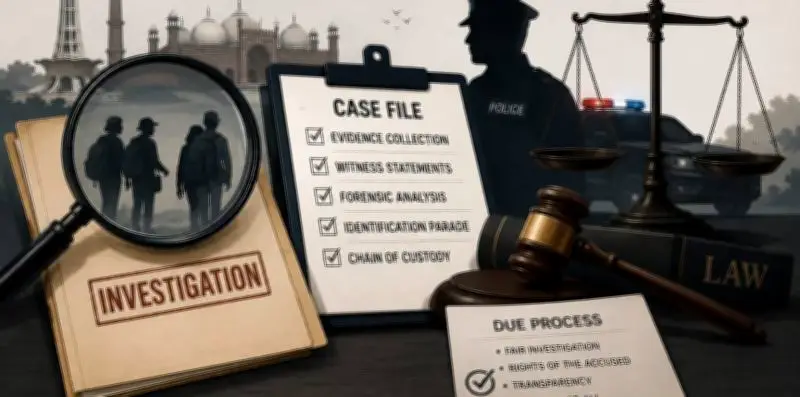
Former IG Police Raises Concerns Over Investigation Flaws
The reported case involving foreign women allegedly kidnapped and sexually assaulted in Lahore is deeply disturbing. The first concern must be the dignity, safety and justice of the victims. No woman, Pakistani or foreign, should be left without protection of law. If the allegations are proved, the offenders must be dealt with strictly. At the same time, such a case cannot depend on media pressure, political influence or defective investigation. It must stand on legally admissible, professionally collected and scientifically supported evidence.
As a former police officer and student of investigation, I believe this case raises serious questions about police decision-making. In Pakistan, whenever a sensitive case arises, the burden is often pushed downwards on the SHO, while senior officers who issue directions remain protected. This is neither fair nor professional.
SHO Suspended After Late-Night Visit to Magistrate
The SHO of Police Station Defence C was reportedly suspended and a criminal case was registered against him because he went late at night to the residence of the area Magistrate for recording the victims’ statements. According to available information, the victims were foreign nationals and wanted to leave Pakistan the next morning. The SHO was allegedly directed by his seniors to approach the Magistrate urgently so that their statements could be recorded before departure.

If that urgency genuinely existed, the proper course was not to send an SHO at 1:30 a.m. to knock at the residence of a Magistrate. Senior police officers in Lahore could have contacted the District Judge or Secretary Law for availability or nomination of a Magistrate. This was a matter of institutional coordination, not an errand for a subordinate officer. The real question is: who ordered the SHO to go there, and why did the senior command not handle the matter itself?
After registration of an FIR, further legal steps and collection of evidence are primarily the responsibility of the investigation branch and the investigating officer. The SHO may facilitate urgency, but investigation must be carried forward by investigation staff. Therefore, sacrificing the SHO alone appears to be a convenient administrative response rather than fair accountability.
Failure to Seize Mobile Phones for Forensic Analysis
Another important issue is the apparent failure to take the mobile phones of the victims into custody for forensic analysis. In a case involving kidnapping, confinement, communication, travel, locations, contacts and sexual assault, mobile phone data is extremely important. It may reveal calls, messages, WhatsApp chats, location history, hotel movement, transport details and possible threats or inducements. Such evidence creates an independent electronic trail. If the phones were not seized and forensically examined, it is a serious investigative lapse, especially when section 94 CrPC empowers an investigating officer to take into custody anything required for investigation.
Legal Scrutiny of FIR and Section 164 Statements
The FIR also requires careful legal scrutiny. It need not contain every detail, but in such a case certain facts are important: names or descriptions of accused persons, date and time of alleged kidnapping, place from where the victims were taken, place of confinement, role of each person and sequence of events. If these facts are missing, the investigating officer had a greater responsibility to remove the gaps through immediate evidence.
The victims’ statements recorded before the Magistrate under section 164 CrPC are important, but their legal value must not be overstated. Such statements may be used for corroboration or contradiction during trial, but they are not a substitute for substantive evidence before the trial court. The victims will still have to give evidence, and the defense will have the right of cross-examination. If section 164 statements are vague or incomplete, they may not be sufficient by themselves to secure conviction.

In serious offences such as rape and kidnapping, victims should be properly guided by police and prosecution to narrate all relevant facts, including descriptions of culprits, places, times, roles and circumstances. This does not mean tutoring a witness; it means ensuring that the witness understands the legal importance of complete facts.
Missing Identification Parade and Forensic Evidence Gaps
One serious omission appears to be the non-conducting of an identification parade. Identification parade is important where accused persons are not previously known to witnesses. If the victims did not know all accused by name, it was essential to arrange an identification parade before they left Pakistan. Without it, it becomes difficult to connect every accused with the crime, especially those whose names or descriptions are unclear.
The future of this case will depend on the quality of remaining evidence. If the victims appear before the trial court, including through legally permissible video-link proceedings, and if their statements remain consistent, the case may still proceed. DNA evidence, if properly collected, preserved and proved, may become strong corroboration. Reliable evidence of invitation, contact, movement, confinement or facilitation may also distinguish the case of one accused from another.
However, some accused persons may be acquitted if their identity, presence and specific roles are not established through reliable evidence. In criminal law, suspicion, social media discussion, political connection or general allegation is not enough. The prosecution must prove the case beyond reasonable doubt. If identification parade was not conducted, phones were not forensically examined, descriptions were not recorded and the chain of events remains incomplete, the benefit of doubt may go to several accused.
Witness Protection and International Coordination
The State must also ensure witness protection, continued contact with the foreign victims, coordination with their embassy and proper arrangements for recording their evidence during trial. Without such arrangements, even a serious case may weaken.
Justice requires sympathy for victims, but it also requires professional investigation. No accused should be protected because of influence, wealth or family background. Equally, no person should be convicted merely because of public pressure or political association. The law must identify the real offenders through evidence.
The lesson is simple: in sensitive cases, senior officers must lead from the front, not hide behind the SHO. Investigation must be evidence-based, not pressure-based. Victims must be protected, but procedure must also be protected. When procedure is damaged, justice itself becomes weak.