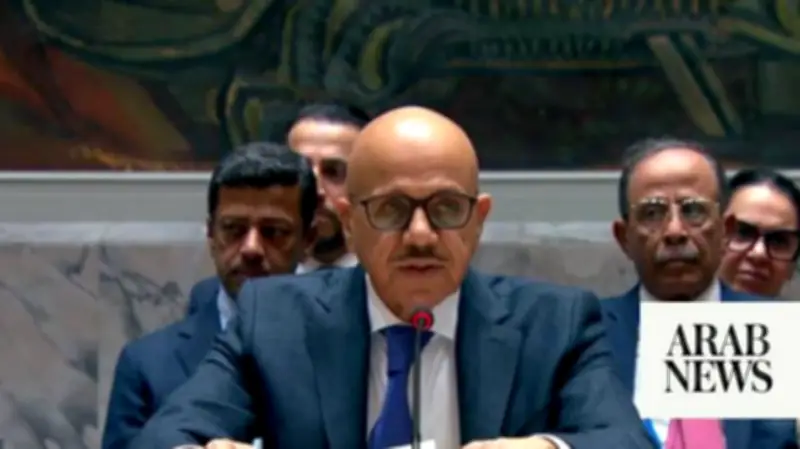
Bahrain's Foreign Minister Abdullatif bin Rashid Al-Zayani flew to New York on Thursday to demand action from the UN Security Council following what he termed a “renewed and treacherous” Iranian attack on his country. Speaking at an emergency session called at Bahrain's request, Al-Zayani detailed that his nation had suffered 808 attacks since February 28, including 203 ballistic missiles and 605 armed drones, resulting in three civilian deaths and 465 wounded, among them women and children.
Bahrain's Plea for Intervention
Al-Zayani emphasized that the latest strikes occurred despite Bahrain signing a memorandum of understanding with Washington on June 17. “Bahrain requested this emergency meeting confident that this council will not remain a bystander in the face of such a blatant challenge to its authority,” he stated. He noted that the aggression extended beyond his country, with simultaneous attacks on Kuwait International Airport and a drone strike on the UAE's Barakah nuclear power plant, which he warned brought the region “to the brink of a nuclear safety disaster.” These actions, he argued, violated the UN Charter and Security Council Resolution 2817, backed by 136 member states.
US and Russia Clash Over Responsibility
US Ambassador Mike Waltz delivered a sharp rebuke of Iran, recounting his personal visits to strike sites in Bahrain, including the Bahrain Petroleum Company. He alleged that Iranian forces deliberately targeted fire suppression lines and first responders before hitting fuel tanks and chemical storage areas to maximize casualties. Waltz claimed a drone that failed to explode near a residential neighborhood could have killed two to three thousand people. He also highlighted that Iran's closure of the Strait of Hormuz had inflicted lasting damage on 61 developing economies, according to a UN Trade and Development report, accusing Tehran of using the waterway to “hold the world's economy hostage.” Waltz noted that 136 countries co-sponsored Resolution 2817 and that Gulf states rallied 143 co-sponsors for a separate draft resolution condemning Iranian mining of the strait.

Iran's Rebuttal and Russian Support
Iran's Ambassador Saeid Iravani rejected the accusations, asserting that Washington and Israel bore “full responsibility” for regional wars. He criticized the Council for failing to hold the US and Israel accountable, which he said had “reinforced impunity and emboldened further unlawful acts.” Iravani defended Iran's actions as an “inherent right of self-defense” under the UN Charter, targeting US military facilities, and warned of continued defense if attacks persisted or the US violated the Islamabad agreement. Russia's Deputy Permanent Representative Anna Evstigneeva backed Iran's self-defense argument, stating that US military sites in Bahrain and Kuwait were “logical targets” without immunity, though she condemned deliberate strikes on civilian infrastructure. She blamed US-Israeli aggression against Iran as the “root cause” of escalation and regretted Gulf states being “held hostage.”
UK, Pakistan, and UN Perspectives
UK Ambassador James Kariuki condemned Iran's attacks on Bahrain, Kuwait, and shipping in Hormuz, calling them violations of Resolution 2817, and urged restoration of free transit through the strait. Pakistan's Ambassador Asim Iftikhar Ahmad highlighted Islamabad's mediation leading to the Islamabad MoU as “a victory of robust and determined diplomacy,” noting positive progress in US-Iran talks in Doha. UN Assistant Secretary-General Elizabeth Spehar provided a chronology of recent events, including drone strikes on vessels on June 25, US strikes on Iranian coastal infrastructure on June 26-27, and Iranian missile and drone strikes on Kuwait and Bahrain on June 28. She reported that the US and Iran agreed on June 28, via Qatari mediation, to cease attacks on each other, with indirect talks in Doha ongoing. Spehar welcomed de-escalation but warned that each incident increases the risk of miscalculation, urging maximum restraint and protection of civilians and navigation.