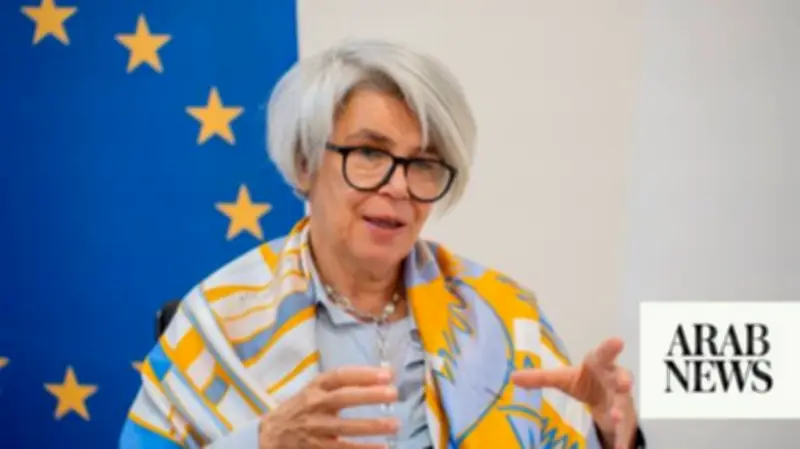
RIYADH: Saudi Arabia has become a pivotal diplomatic actor in efforts to end Sudan's civil war, with the Kingdom uniquely positioned to translate years of stalled negotiations into a ceasefire and political transition, according to Annette Weber, the EU's special representative for the Horn of Africa.
"I think it's key. I think it's absolutely key," Weber told Arab News during a visit to Riyadh. "Jeddah was the last time where anyone managed to bring basically both (parties) to one place to negotiate substance."
Urgency Amidst Fresh Violence
Weber's remarks come as Sudan's conflict enters its fourth year, with international concern mounting over fresh violence in North Kordofan and fears of another humanitarian catastrophe in the city of Al-Obeid. Volker Turk, the UN rights chief, has issued a "red alert," warning that another mass atrocity like that which befell El-Fasher last year could be imminent if fighting intensifies.

Against this backdrop, Weber said Saudi Arabia's diplomatic engagement has become more important than ever. "We see that not just the Saudis in Jeddah, but also now on their engagement, there is a lot of dynamic, there is commitment, and you are direct neighbors," she said. "It really is something in (the Kingdom's) direct neighborhood."
Regional Tour and Coordination
Her visit to Riyadh formed the final leg of a regional tour that also included Abu Dhabi and Cairo, reflecting what she described as increasingly close coordination between the EU and Middle East partners on Sudan, Red Sea security, and stability on the Horn of Africa. "The objective is to come back on a regular regional tour," she said. "First and foremost we are talking about Sudan. How do we get to a ceasefire to end the war in Sudan? We are also talking about security and stability on the Red Sea."
Sudan descended into conflict in April 2023 after a power struggle between the Sudanese Armed Forces (SAF) and the paramilitary Rapid Support Forces (RSF) erupted into open warfare in Khartoum before spreading across the country. Since then, tens of thousands of people have been killed, more than 12 million displaced, and much of Sudan's healthcare, education and public infrastructure destroyed. Famine has spread across parts of the country while both sides have faced repeated accusations of atrocities, including attacks on civilians, sexual violence and obstruction of humanitarian relief.
Humanitarian Crisis Deepens
Recent weeks have underlined the urgency of renewed diplomacy. UN officials have warned that Al-Obeid, a strategically important city linking Darfur with eastern Sudan, risks becoming another El-Fasher, where thousands were killed during RSF assaults. Amnesty International has accused the RSF of crimes against humanity and ethnic cleansing during operations around El-Fasher, while the UN reported on Thursday that a drone strike had destroyed 50 tons of humanitarian supplies destined for civilians in Darfur.
For Weber, the deteriorating humanitarian situation makes diplomatic progress impossible to postpone. "What we (the EU and Saudi Arabia) fully agree on is we need a ceasefire, we need a humanitarian truce, and we need a transition," she said. "We need to work on this transition now because we cannot wait. But for this, we need, basically, a ceasefire tomorrow."
Complementary Diplomatic Tracks
International mediation has evolved into overlapping diplomatic tracks rather than a single peace process. The Quad — comprising Saudi Arabia, the US, Egypt, and the UAE — has focused on negotiating a humanitarian truce and ceasefire through the Saudi-US led Jeddah process. Alongside it, a broader coordination mechanism involving the EU, African Union, Intergovernmental Authority on Development (IGAD), the UN, and other partners has worked to prepare the political architecture needed for any eventual settlement.

Rather than competing initiatives, Weber said the two tracks have become increasingly complementary. The goal, with "the Saudis with the Quad, (and) with the quintet, is to see how much we can bring to the political track at the same time the Quad is negotiating a humanitarian truce," she said. "I think we're getting closer to a point where basically (we have) an opening of the door by the Quad and the preparation of a 'day after' by the quintet and by the EU on the political track, on a monitoring mechanism, on protection of critical infrastructure, on things that are necessary to detail what is happening if there is a humanitarian truce, if there is a ceasefire."
The practical work, she said, is becoming increasingly detailed: "We have made good progress. We discuss much more in detail how this could look like." Ultimately, however, success depends on Sudan's warring parties: "We need the Sudanese to also agree that now is the time to lay down arms and get to the negotiation table."
Planning for the 'Day After'
Unlike previous mediation efforts that concentrated largely on ending immediate fighting, diplomats are now simultaneously planning for what follows any ceasefire. That includes monitoring mechanisms, humanitarian access, civilian protection, safeguarding state institutions and designing a political transition capable of preventing Sudan from sliding into permanent fragmentation.
Weber believes those preparations cannot wait until guns fall silent. "We need a multi-layered approach where one side is doing maybe more of a ceasefire negotiation (and) the other side is building up on a political track. But it needs to come together," she said. Without that planning, she warned, "the guarantee is not there that it's not fragmenting further."
The prospect of Sudan breaking apart remains one of diplomats' greatest fears. "We're all clear: It's sovereignty, it's territorial integrity. We want one Sudan. No one wants to see Sudan breaking in two, three, four or five," she said. Maintaining functioning national institutions is central to current discussions. "You can only have a strong Sudan if it's one Sudan," Weber said. "You can only build that one Sudan if you are united on the main issues."
Humanitarian Access and Funding
Even if donors mobilize billions of dollars, Weber argues that aid means little if it cannot reach civilians trapped by fighting. The humanitarian pledging conference held in Berlin earlier this year raised about $1.8 billion for Sudan, but Weber said financing alone cannot solve the crisis: "It's not enough in terms of the volume. It's also not enough in terms of humanitarian access."
She believes Saudi Arabia's relationship with Sudan's authorities could prove particularly valuable in maintaining supply routes. "The good relations Saudi Arabia has with the government in Sudan, with the SAF, I think we need to consistently and continuously engage on keeping these access routes open," she said. Rather than renegotiating every delivery individually, Weber wants permanent humanitarian corridors protected by all parties.
Current arrangements remain inadequate. "It's not reaching each and everyone in Sudan." She also issued a blunt appeal to both sides. The RSF, she said, must immediately halt attacks against humanitarian workers. "We have been telling the RSF side that the continuation of attacks against humanitarian workers is absolutely not acceptable." Aid recipients must never become targets: "People need to be reached without having to fear that once they reach humanitarian aid, they will be harmed."
At the same time, Weber urged Sudan's government to ease bureaucratic restrictions that continue to delay humanitarian operations. "We also need a lowering of the bureaucracy on the side of the government in Khartoum, because it's very difficult to get humanitarian aid workers in." The guiding principle, she insisted, must be humanitarian neutrality. "Humanitarian action is there for the suffering people of Sudan, regardless if they are under the control of one side or the other. They are all Sudanese citizens."
Red Sea Security and Regional Stability
Sudan's conflict cannot be viewed in isolation, Weber said, because instability increasingly affects the wider Red Sea region. The war has sharpened concerns about maritime security at a time when regional shipping has already faced unprecedented disruption. That has elevated the importance of the Council of Arab and African Coastal States of the Red Sea and Gulf of Aden, commonly known as the Red Sea Council.
"We all look right now ... to the Red Sea Council, because that is a bridge where you have the Horn of Africa side and you have the Gulf side," Weber said. Following recent regional tensions affecting maritime routes, particularly the Strait of Hormuz, she said discussions have focused on keeping strategic waterways open and "understanding ... how important an open waterway like the Red Sea and the Bab Al-Mandab is."
For Weber, maritime security cannot be separated from political and economic stability ashore. "You cannot just look into Red Sea security without looking at the situation in the countries and the situation on land," she said. She pointed to Saudi Arabia's development partnerships across the Horn of Africa as creating opportunities for deeper cooperation with Europe. "Saudi Arabia is playing a huge role in development cooperation with the countries, with Sudan, with others," she said, in reference to the King Salman Humanitarian Aid and Relief Center.
The EU and Saudi Arabia, she believes, increasingly share similar assessments of the region's long-term needs. "We actually have a lot of similar readings and a lot of similar approaches to these countries." That creates opportunities to combine European experience in regional maritime cooperation with Gulf expertise. "We have expertise from the Baltic Sea, from other places, you have from the Strait of Hormuz and the Red Sea. I think there is something we can build on."
Alignment and Next Steps
Weber concluded her meetings in Riyadh encouraged by what she described as unprecedented alignment between Saudi Arabia and the EU. "I think we have had excellent results in our discussions in terms of how closely we can really prepare for ceasefire negotiations," she said. Beyond broad principles, she said officials had refined practical responsibilities and implementation. "We have many more agreements, and I think we have fine tuned, actually, the next concrete implementation steps, and who is doing what, what entry points are we both agreeing on and how can we also bring better coordination on this."
She added: "To me it was a very successful visit and I'm very enthusiastic, actually, that we found so many layers of agreement." Whether those diplomatic advances can translate into peace now depends largely on developments inside Sudan itself. For Weber, however, the priorities remain unchanged: a ceasefire, humanitarian access, and political transition. And these cannot come soon enough, she said. "We need a ceasefire tomorrow."