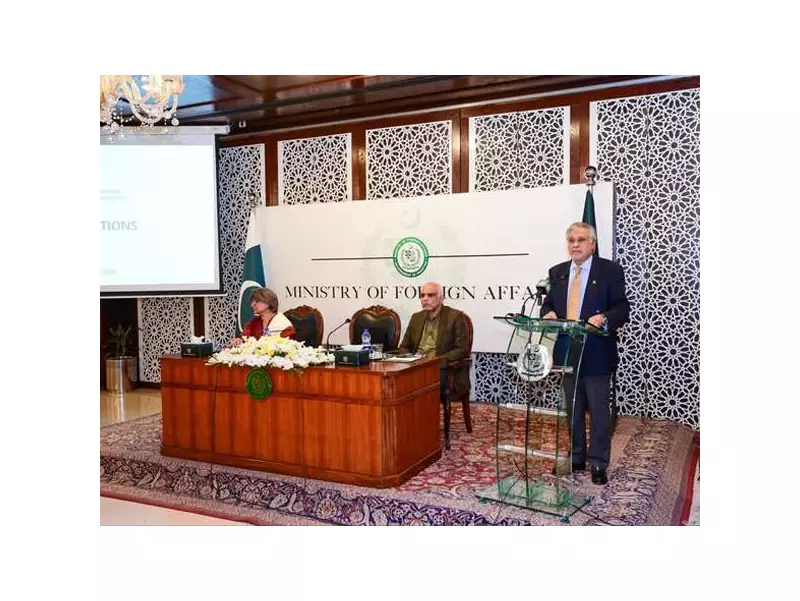
Deputy Prime Minister Ishaq Dar has issued a strong appeal to the global community, urging immediate intervention to press India into restoring the Indus Water Treaty. This call comes in response to what Pakistan describes as New Delhi's deliberate manipulation of water flows in the Chenab and Jhelum rivers, actions deemed a direct threat to regional stability.
Unilateral Actions and Treaty Violations
Addressing diplomats in Islamabad, Dar voiced grave concerns over India's recent actions. He stated that India released water from the Chenab River without providing the prior notification and data sharing mandated by the Indus Water Treaty. This prompted Pakistan's Indus Water Commissioner to formally write to his Indian counterpart, seeking an urgent explanation under the treaty's provisions.
The Deputy PM emphasized that this incident is not isolated. He highlighted a pattern of systematic treaty violations, including the construction of hydropower projects like Kishanganga and Ratle with designs that breach the treaty's technical specifications. Furthermore, India has halted the sharing of advance hydrological data and refused to participate in the treaty's dispute resolution mechanisms, including proceedings at the Court of Arbitration and with a neutral expert.

Data Points to Sharp, Unexplained Fluctuations
Technical data shared by the Ministry of Water Resources reveals alarming fluctuations. Monitoring showed that Chenab River flows at Marala plummeted to as low as 870 cusecs between December 10 and 16, a drastic drop compared to the typical range for mid-December over the past decade.
Satellite imagery analysis indicated a marked reduction in the surface area of India's Baglihar reservoir on December 8, followed by a visible refilling by December 13. This suggests a rapid drawdown and subsequent replenishment, a practice that may violate treaty terms prohibiting the emptying of dead storage in run-of-river projects.
Similarly, the Jhelum River experienced disrupted flows. On December 14, inflows at Mangla were 5,000 cusecs against outflows of 33,000 cusecs. The inflows then sharply decreased to 3,300 cusecs from December 15-19, while outflows remained high, indicating water was being held back upstream.
Weaponization of Water and International Concern
Ishaq Dar framed these actions as the "weaponization of water," warning they directly threaten the lives, livelihoods, and food security of millions of Pakistanis, especially during a critical agricultural period. He asserted that such conduct contravenes international human rights and humanitarian law.
This stance has found support from UN Special Rapporteurs. In a recent report, they expressed deep concern over India's approach to the treaty, noting that any obstruction of water flow impacts fundamental rights to water, food, and health for people in Pakistan. The UN experts emphasized that water cannot be used as a tool for political pressure and that no party can unilaterally suspend the treaty.
Dar made it clear that while Pakistan remains committed to peaceful dispute resolution, it will not compromise on the existential water rights of its people. He called on the international community to counsel India to act responsibly and uphold its legal obligations under international law.