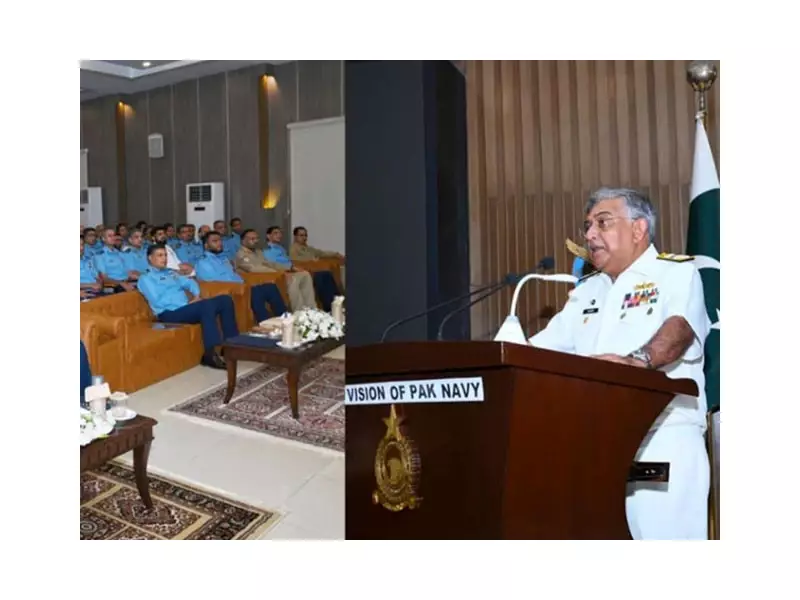
Pakistan's rapidly expanding defense collaboration with Türkiye has emerged as a leading model of successful technology transfer in the region, according to the country's naval chief. Admiral Naveed Ashraf stated that this partnership has already substantially enhanced Pakistan's domestic industrial capabilities.
A Living Example of Naval Cooperation
Speaking to Anadolu Agency, Pakistan's Chief of the Naval Staff Admiral Naveed Ashraf highlighted that the cooperation, particularly in naval shipbuilding, demonstrates how shared ambitions for self-reliance can produce tangible industrial benefits. He identified the joint production of MILGEM-class corvettes as the centerpiece of this success story, describing the warship program as a living example of this cooperation.
Under a 2018 agreement, Pakistan acquired four MILGEM corvettes from Türkiye's defense firm ASFAT. The project followed a strategic model where two ships were constructed in Türkiye and two were built at Karachi Shipyard & Engineering Works. This approach was specifically designed to transfer crucial design, engineering, and project-management expertise to Pakistan's domestic industry.

Strengthening Pakistan's Industrial Base
Admiral Ashraf characterized the initiative as a hallmark of Pakistan-Türkiye defense collaboration and technology sharing. He emphasized that the program has significantly strengthened Pakistan's local industrial base, effectively paving the way for future self-reliance in naval shipbuilding.
With the experience gained from this successful partnership, the naval chief suggested that Islamabad and Ankara can build on this achievement to explore joint development of unmanned maritime systems, underwater technologies, and advanced sensors. He noted that the shared commitment to self-reliance and innovation between both nations makes such partnerships practical and mutually beneficial.
Strategic Dimensions and Regional Security
Admiral Ashraf clarified that the cooperation extends beyond technical aspects to encompass strategic dimensions. He emphasized that maritime security in the current geopolitical environment requires cooperation against shared challenges.
We view Türkiye's engagement in the region as complementary to our vision of a secure maritime environment for economic prosperity, he stated, referencing Ankara's expanding naval influence in the Indian Ocean and East Africa. He added that both navies share common goals regarding regional stability, maritime connectivity, and cooperative security, with regular interactions strengthening these shared objectives.
The navy chief also underscored Pakistan's key role in ensuring regional maritime security and safeguarding the maritime domain connected with CPEC (China-Pakistan Economic Corridor).
Revitalizing Pakistan's Maritime Economy
Admiral Ashraf highlighted Pakistan's parallel efforts to revive its blue economy, another area where Islamabad and Ankara maintain a strong and enduring partnership. He referenced the second edition of the Pakistan International Maritime Expo and Conference (PIMEC), held earlier this month in Karachi, which aimed to rejuvenate maritime economic activities and showcase the country's broader maritime potential.
Beyond shipbuilding, the navy chief noted that Pakistan is progressively incorporating emerging domains such as information dominance and cyber resilience into its training, doctrines, and joint exercises. Collaboration with friendly navies like Türkiye helps both sides build skills in network-centric warfare, electronic warfare operations and modern concepts, ensuring preparedness against evolving threats, he concluded.