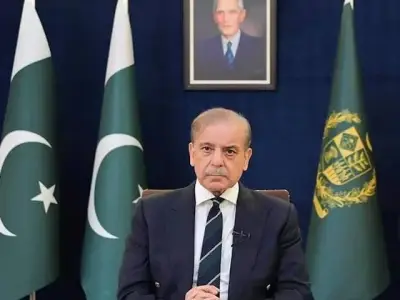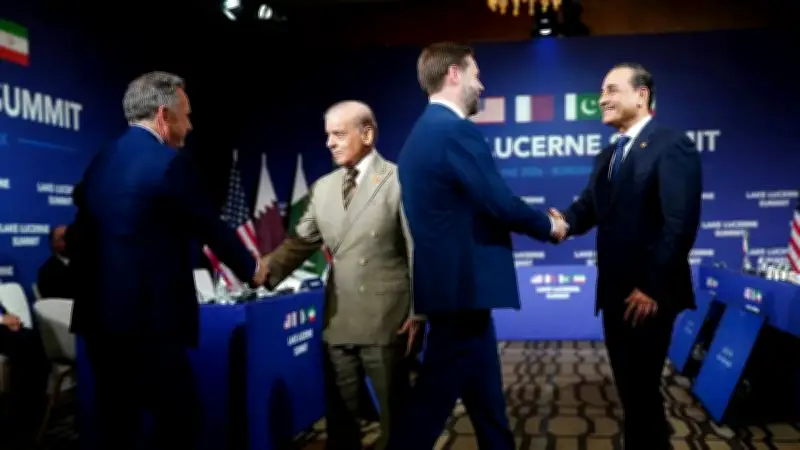
President Masoud Pezeshkian's visit to Pakistan was remarkable not only for the warmth of the welcome he received but also for what it revealed about the state of Pakistan-Iran relations. Prime Minister Shehbaz Sharif went well beyond routine diplomatic courtesies, declaring that Pakistan would never let Iran down and emphasizing support for Iran's sovereignty and security. Such statements carry weight, reflecting Islamabad's deep commitment to Tehran.
High-Level Gestures Signal Strategic Alignment
The depth of Pakistan's commitment is further reflected in the fact that both Prime Minister Sharif and Field Marshal Asim Munir are expected to attend the funeral ceremonies of the late Ayatollah Ali Khamenei in Iran next month. This gesture, rarely extended at such a high level, underscores the importance Islamabad attaches to its relationship with Tehran. These are not routine diplomatic courtesies; they highlight Pakistan's emergence as one of the few states able to maintain productive relations simultaneously with Iran, the United States, Saudi Arabia, the United Arab Emirates, and China.
It is precisely this unique position that enabled Pakistan to play a constructive role during one of the most dangerous crises the Middle East has faced in decades. The Iran conflict demonstrated how quickly the region could have descended into a much wider war. Israel's confrontation with Iran risked drawing in the United States, threatening regional energy routes and exposing Gulf states to retaliation. Had the escalation continued unchecked, the consequences for Iran would have been severe, and equally damaging would have been the economic and security repercussions for the Gulf, whose stability remains vital for countries such as Pakistan.

Pakistan's Diplomatic Credibility on the Line
Throughout the crisis, Pakistan consistently argued for restraint, diplomacy, and de-escalation. It maintained channels with all sides and supported efforts aimed at preventing a conflict that threatened to engulf the entire region. While many actors focused on military options, Islamabad repeatedly stressed that there could be no sustainable solution without dialogue. A Pakistani delegation led by CDF Asim Munir arrived in Tehran as US–Iran talks were expected soon, signaling Islamabad's determination to prevent a wider war.
That diplomacy was not an act of charity. Pakistan had every reason to prevent a wider war. Millions of Pakistanis work in the Gulf. Pakistan's economy is closely connected to Gulf stability. Energy markets, trade routes, and regional security are all matters of direct national interest. Yet Pakistan also invested something more valuable than diplomatic effort: it invested credibility. If Tehran approaches negotiations solely as a tactical exercise designed to gain economic concessions while avoiding meaningful compromises, scepticism will grow.
Pakistan's Unique Position in Regional and Global Diplomacy
Today, Islamabad's standing in Washington is stronger than it has been for many years. Relations with Saudi Arabia have entered a phase in which the security of one has become inseparable from the security of the other. The Strategic Mutual Defence Agreement formalizes this reality. Beyond Pakistan and Saudi Arabia, there is growing discussion of a wider security arrangement bringing together leading Muslim states from the Gulf and the broader Middle East—including Qatar, Jordan, Türkiye, and Egypt—to create a more coordinated regional security architecture.
Pakistan's political and military leadership has worked hard to stabilize the economy, rebuild investor confidence, and restore the country's international standing after years of political and economic turmoil. The current diplomatic opening also reflects a significant gamble in Washington. President Trump and Vice President Vance have chosen to test whether economic incentives, sanctions relief, and reintegration can encourage more pragmatic behavior from Tehran rather than pursuing permanent confrontation. In doing so, they have exposed themselves to criticism from Israel and the powerful Israeli lobby, who regard any accommodation with Iran as a strategic concession or even a sell-out.

Pakistan's Support for Diplomacy Over Confrontation
Pakistan has strongly supported this approach and invested considerable diplomatic capital in its success. The active engagement of Field Marshal Munir throughout the crisis reflected Islamabad's determination to prevent a wider war. If Iran uses this opportunity to pursue moderation and regional accommodation, the gamble may be vindicated. If not, the credibility of those who argued for engagement—including Pakistan—will inevitably come under scrutiny. As one analysis noted, Iran's fatal miscalculation is that diplomacy is Tehran's only option.
A country seeking stability naturally favors diplomacy over confrontation. It is therefore unsurprising that Pakistan has encouraged a path based on negotiations rather than perpetual escalation. The underlying hope is that economic incentives, diplomatic engagement, and regional integration can gradually strengthen pragmatic forces within Iran and encourage a more constructive regional role. Whether that hope proves justified remains to be seen.
The Burden on Tehran: Reciprocity and Strategic Choice
The real question now is not what Pakistan can do for Iran. The real question is what Iran intends to do with the opportunity that Pakistan and others have helped create. If Tehran genuinely wishes to reciprocate Pakistan's goodwill, it must begin by recognizing a simple reality. National strength in the twenty-first century is measured not by ideological slogans or proxy networks but by economic performance, political stability, technological advancement, and public welfare. Countries that focus on prosperity attract investment, talent, and influence. Countries that remain trapped in permanent confrontation ultimately weaken themselves.
Pakistan itself offers a useful lesson. After years of crisis, Islamabad has sought to improve relations across the region, strengthen economic partnerships, and position itself as a facilitator rather than a source of instability. This approach has not solved every problem, but it reflects a recognition that development and diplomacy are mutually reinforcing. Iran faces a similar choice. The greatest victims of decades of sanctions, confrontation, and economic isolation have not been foreign governments. They have been ordinary Iranians. Successive waves of public protests have reflected frustrations that extend far beyond foreign policy. Economic hardship, inflation, unemployment, environmental challenges, and governance concerns have affected millions of citizens.
Economic Integration and Regional Stability
Any diplomatic opening should first and foremost improve the lives of the Iranian people. If new economic opportunities merely finance future confrontations while underlying domestic problems remain unresolved, then the opportunity created by recent diplomacy will have been squandered. The Strait of Hormuz provides another test. The waterway is among the world's most important economic arteries. Gulf states depend on it. Asian economies depend on it. China, one of Iran's closest partners, depends heavily on uninterrupted energy flows through it. Threats to disrupt maritime traffic may create temporary leverage, but they also generate long-term mistrust. No responsible regional state should seek to weaponize a route upon which so many countries depend. Levying tolls on shipping in international waterways is unlawful.
The same principle applies to relations with the Gulf states. Geography cannot be changed. Iran and the Arab Gulf countries will remain neighbors regardless of political disagreements. It was wrong on Iran's part to attack sovereign targets, energy infrastructure, and other public infrastructure in the Gulf Cooperation Council states. President Pezeshkian has expressed his desire for a new regional security architecture. But he must know that any such durable arrangement requires trust, predictability, and respect for sovereignty. Those objectives cannot coexist with threats against neighbors or actions that place their economic lifelines at risk.
Nuclear Issue and Regional Strategy
Iran's conduct regarding the nuclear issue will also be closely watched. Diplomacy succeeds only when both sides demonstrate seriousness and flexibility. If Tehran approaches negotiations solely as a tactical exercise designed to gain economic concessions while avoiding meaningful compromises, scepticism will grow. If it demonstrates transparency and a willingness to address legitimate concerns, the diplomatic path will become easier to sustain. The most difficult challenge, however, concerns the broader regional strategy that Iran has pursued since 1979. Across the Middle East, Iran's reliance on non-state actors and proxy networks has generated instability and deep suspicion. Whether in Lebanon, Iraq, Syria, or Yemen, the consequences have been profound.
Lebanon illustrates the problem particularly well. Lasting stability cannot exist when decisions relating to war and peace remain outside the authority of the state. Hezbollah has taken this multi-religious society hostage for decades. Hence, the long-term objective must be a sovereign Lebanese state exercising authority throughout its territory and possessing sole responsibility for national security. There is another reality that Tehran should recognize. For nearly half a century, Iranian and Israeli hardliners have reinforced one another. Every Israeli strike strengthens the narrative of resistance promoted by the Islamic Revolutionary Guard Corps and its allies. Every Iranian-backed escalation strengthens the argument of those in Israel who insist that military force, rather than diplomacy, is the only viable policy.
Breaking the Cycle of Confrontation
The result has been a self-sustaining cycle in which both sides derive political benefit from confrontation while the wider region bears the economic and security costs. If Iran genuinely wishes to break this cycle, it must recognize that the greatest strategic setback it can inflict upon Israeli hardliners is not another proxy confrontation but the removal of the very conditions that sustain their argument. A region characterized by sovereign states, economic integration, and diplomatic engagement leaves far less room for those who profit from perpetual conflict. The Palestinian cause illustrates this point clearly. The suffering of the Palestinian people remains one of the defining injustices of our time, but decades of proxy warfare and periodic escalations have neither delivered Palestinian statehood nor enhanced Palestinian security.
The more credible path remains the one endorsed by the overwhelming majority of Arab and Muslim states: a negotiated settlement based on a sovereign Palestinian state living alongside Israel in peace and security. The Arab Peace Initiative and subsequent collective diplomatic efforts offer a framework that enjoys broad regional legitimacy. Pakistan has consistently supported Palestinian self-determination, but it has also recognized that lasting peace will require diplomacy, state institutions, and broad international support rather than permanent warfare. If Tehran truly wishes to contribute to a lasting solution, it should align itself more closely with this wider Arab and Islamic consensus rather than approaches that repeatedly lead to escalation without resolution.
Historical Context and Pakistan's Scepticism
Pakistan's scepticism regarding Iranian intentions did not emerge overnight. Since the Islamic Revolution, relations have experienced repeated periods of strain. Pakistan remained broadly sympathetic to Iran during the Iran-Iraq War and has consistently sought engagement rather than confrontation. Yet Pakistani policymakers have often viewed Iranian policies in Afghanistan, sectarian matters, and regional alignments with concern. Iran's close engagement with India, including cooperation linked to Afghanistan and Chabahar, has frequently reinforced those concerns, particularly when Indian and Pakistani interests have been in direct competition. Many in Pakistan, therefore, feel that gestures of goodwill have not always been matched by equivalent strategic sensitivity from Tehran.
Many Pakistanis view current developments through the lens of experience. They have seen periods of optimism before. They have witnessed opportunities that ultimately produced disappointment. They remain uncertain whether Iran's elected leadership possesses sufficient authority to shift the country's strategic direction or whether hard-line elements will once again prevail. Pakistan has gone further than most countries in helping create diplomatic space for Iran at a moment of extraordinary danger. It has supported dialogue when others preferred confrontation. It has encouraged restraint when emotions favored escalation. It has invested political and diplomatic capital in the hope that a more stable and cooperative regional order can emerge.
Conclusion: The Choice for Tehran
The burden now rests with Tehran. If Iran uses this opportunity to pursue economic recovery, regional reconciliation, and responsible statecraft, Pakistan's efforts may be remembered as a strategic success that benefited the entire region. If old habits prevail, the Middle East will simply return to another cycle of crisis, confrontation, and missed opportunities. Pakistan has done Iran a great favour. Whether that favour is ultimately returned depends on the choices Tehran makes next. As observers note, the question is whether Pakistan can hold the line between Washington and Tehran, but the answer ultimately lies in Iran's hands.