Jawaharlal Nehru's ties with Lahore ran deeper than politics. Long before Lahore hosted the famous Congress session under his presidency, the city was already woven into his family history. His mother, Swarup Rani Thussu, belonged to a prominent Kashmiri Brahmin family based in Lahore. Majid Sheikh records that “her father’s house was at 3 Waris Road just next to the cricket ground,” and Nehru often stayed there during his childhood visits. In later life, he would describe Lahore as “the moving spirit of India” and speak of it as one of his favourite cities. This personal connection gave his later political encounters with Lahore a special emotional weight.
Lahore as a Centre of Anti-Colonial Struggle
By the late 1920s, Lahore had also become a centre of anti-colonial struggle. Nehru witnessed its intensity at close range. In August 1929, when British arrests, hunger strikes, and political agitation were shaking the city, Nehru praised the “magnificent suffering” of the Lahore jail hunger-strikers. He reminded his audience that these prisoners endured great agony “not for themselves but for all political prisoners,” and urged Indians to honour their sacrifice through organised struggle rather than empty slogans. Those years left a lasting mark on him. In a 1958 interview, Nehru recalled the young revolutionary Jatindranath Das, who died after a 63-day hunger strike during the Lahore Conspiracy Case. Nehru said he had met Das in jail and that “the suffering he was undergoing” and “his innocent face” had made a profound impression on him. Even before Lahore became the stage for the Congress’s most decisive declaration, it had already become for Nehru a symbol of sacrifice and the human cost of freedom.
A Radical Shift and the Demand for Purna Swaraj
Lahore became truly historic for Nehru in December 1929. It was there, at the age of forty, that he was elected President of the Indian National Congress. His election marked a deliberate shift towards younger and more radical leadership. With Gandhi’s support, Nehru helped steer Congress towards a bold new demand: Purna Swaraj, or complete independence. In his presidential address, he urged Indians to abandon any “lingering loyalty” to the British Empire. The response was not merely polite applause. It was the release of an organisation that had long moved between negotiation and resistance and was now prepared to declare a final objective.

Two days later, on the 31st of December 1929, Congress adopted the resolution for complete independence almost unanimously. The defining moment came at midnight on the banks of the Ravi. Nehru led a procession as the clock struck twelve and hoisted the tricolour by the river. Thousands shouted, wept, and raised slogans as if independence had briefly taken visible form before them. Lahore, a city that would later become part of Pakistan, thus hosted the birth of one of the most powerful political vows of the subcontinent: not reform, not dominion status, but complete freedom. Congress fixed the 26th of January 1930 as Independence Day so that Lahore’s pledge could be carried across India.
Nehru himself felt the gravity of that session. In his autobiography, he admitted that before Lahore he had been troubled by compromise and uneasy at any retreat from the demand for full independence. When he entered the Lahore session, he was moved by the welcome, which he later described as “tremendous in volume and intensity.” Yet he reminded himself that the crowds were not cheering him alone. They were responding to an idea, a flag, and a national demand. For a brief moment, Nehru became the visible emblem of that demand. The winter night on the Ravi brought together Hindus, Muslims, Sikhs, and others under the same flag. Lahore revealed one of its great historical paradoxes: it was a city of many identities, but also a place where people of different faiths could gather around a shared political dream.

Lahore as a Bridge to the Frontier
Lahore’s influence did not end with the passing of the resolution. Nehru later noted that the Congress session brought thousands from the North-West Frontier Province, something rare until then. For the first time, a large number of young men from the Frontier came into direct contact with all-India politics and returned with a stronger sense of unity and enthusiasm for the freedom struggle. In this sense, Lahore served not only as a stage but also as a bridge. It connected distant regions to the national movement and sent a message that travelled far beyond the Ravi.
Return as a Statesman in 1960
Partition in 1947 placed Lahore across a new border. The city where Nehru’s political stature had risen now became one of the great cities of Pakistan. Yet Lahore remained central to his imagination. When he returned in September 1960 as Prime Minister of India, he came not as an anti-colonial leader among comrades but as the head of a neighbouring state. The visit followed the signing of the Indus Waters Treaty at Karachi with President Field Marshal Muhammad Ayub Khan. Officially, it was a diplomatic visit associated with peace and cooperation. Personally, it was much more than that.
An important contemporary account of this return appeared in Lahore Affairs, a government-sponsored magazine that followed the civic and cultural life of the city. Its October 1960 issue gave special attention to Nehru’s visit and published a detailed account under the title “Pandit Nehru in Lahore.” The magazine’s tone was optimistic, as official publications often are, but its report preserved several valuable details of the visit, especially the emotional scenes at Shalimar Gardens. Nehru arrived in Lahore from Rawalpindi on Thursday, the 22nd of September 1960, at 3:16 p.m., accompanied by President Ayub Khan. He was received by Malik Amir Muhammad Khan, Governor of West Pakistan, and introduced to senior civil and military officials, including Lt Gen Bakhtiar Rana and SI Haq, Commissioner of Lahore Division. Two young students of Aitchison College garlanded him before he moved to the shamiana where a large number of invitees welcomed him. From the airport, Nehru and Ayub drove in a Cadillac through a six-mile route along Ferozepur Road, Canal Park, and the Mall towards Government House. People lined both sides of the road and cheered as the motorcade passed.
Emotion at Shalimar Gardens
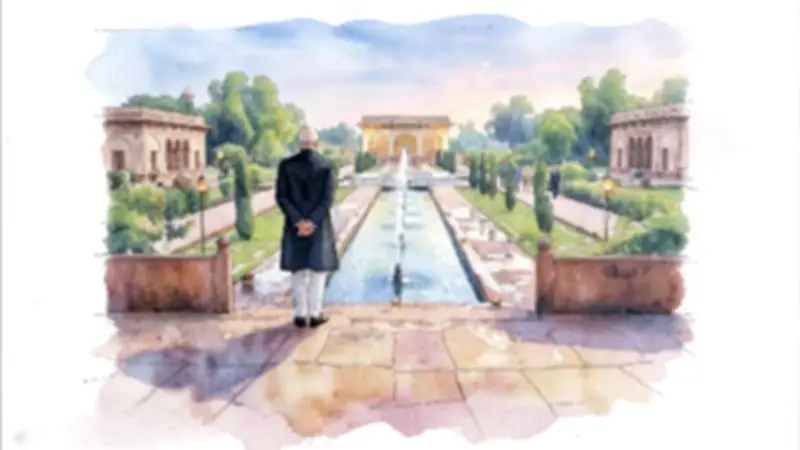
Soon after his arrival, Nehru went to Shalimar Gardens, where a civic reception had been arranged in his honour. The setting was carefully chosen. Shalimar was not merely a Mughal garden. It was one of Lahore’s most evocative historical spaces, a place where architecture, memory, and political symbolism could easily merge. The reception opened with buglers, and local representatives welcomed the Indian Prime Minister. Chaudhry Muhammad Hussain, Vice-Chairman and Basic Democrat, presented the address and paid tribute both to Nehru and to Quaid-i-Azam Muhammad Ali Jinnah for their roles in the struggle against colonial rule. Mr Masood, Chairman of the Municipal Committee, presented Nehru with a silver replica of Shalimar Gardens. Nehru replied in chaste Urdu. He spoke of his desire to resolve outstanding issues between the two countries, but the moment soon became deeply personal. Lahore Affairs recorded that, as he spoke, he became nostalgic. At one point, when he slowly raised his head, his eyes were seen brimming with tears. For a while, he looked around the gardens with emotion, bowed his head, and then continued. He told the audience that Lahore was the birthplace of his mother and that the city was dear not only to Pakistanis but also to Indians because it was here that the slogan of complete independence had been raised about thirty years earlier. He further reminded the gathering that Pakistanis and Indians had struggled together for freedom and had endured considerable hardships.
That moment at Shalimar was the emotional centre of Nehru’s return. In diplomatic language, the visit was about peace, water, Kashmir, and the difficult future of India and Pakistan. In human terms, it was about a man standing in a city that had shaped his family memory, his political life, and his idea of freedom. His tears were not incidental. They revealed the tension between personal belonging and political separation.
Diplomacy and Departure
After the reception, Nehru and Ayub took an incognito tour of the city. They drove along the Mall to the Ravi Bridge, went towards Mahmood Booti Bund, and returned to Government House via Shalimar Gardens. The day ended with a banquet held in Nehru’s honour at Government House. The next morning, accompanied by Ayub Khan, Governor Malik Amir Muhammad Khan, and Foreign Minister Manzur Qadir, Nehru visited the Badshahi Mosque. He was shown around by SI Haq, the Commissioner of Lahore Division. Later, a deputation of the Punjab Literary League met him and requested his support for safeguarding authors’ copyright in both countries and promoting the free flow of book trade. At his press conference, Nehru returned to the formal language of diplomacy. He admitted that discussions with President Ayub on Kashmir had not led to precise results, though both sides were anxious to resolve the dispute. He said that nothing should be done to create new difficulties or obstruct future efforts. At the same time, he expressed gratitude to the people, the President, and the officials of Pakistan for what he called their affectionate reception. He said he would carry happy memories of his visit back to India. Nehru left Lahore for New Delhi the same afternoon. At Walton Airport, he was seen off by President Ayub Khan, Governor Malik Amir Muhammad Khan, Foreign Minister Manzur Qadir, and around 300 officials and non-officials. A guard of honour was presented by a detachment of the Pakistan Army. Ayub also presented him with an album of tour photographs prepared by the West Pakistan Directorate of Public Relations. At 3:15 p.m., Nehru boarded the special Viscount Raj Hans, bringing his two-day Lahore visit to an end.
Lahore’s role in Nehru’s life therefore moved through several phases. First, it was family: the city of his mother’s birth and the house on Waris Road where he spent parts of his childhood. Then it became politics: the Lahore Congress, the midnight flag on the Ravi, and the call for Purna Swaraj. Then came loss: Partition placed Lahore beyond the Indian border and turned a familiar city into foreign territory. Finally, in 1960, Lahore became diplomacy: a place Nehru could visit as prime minister, but no longer as a complete owner of its memory. This is why his return to Lahore was so moving. He came to the city as a statesman, but at Shalimar he appeared for a moment simply as a man revisiting a world that history had placed beyond his reach.