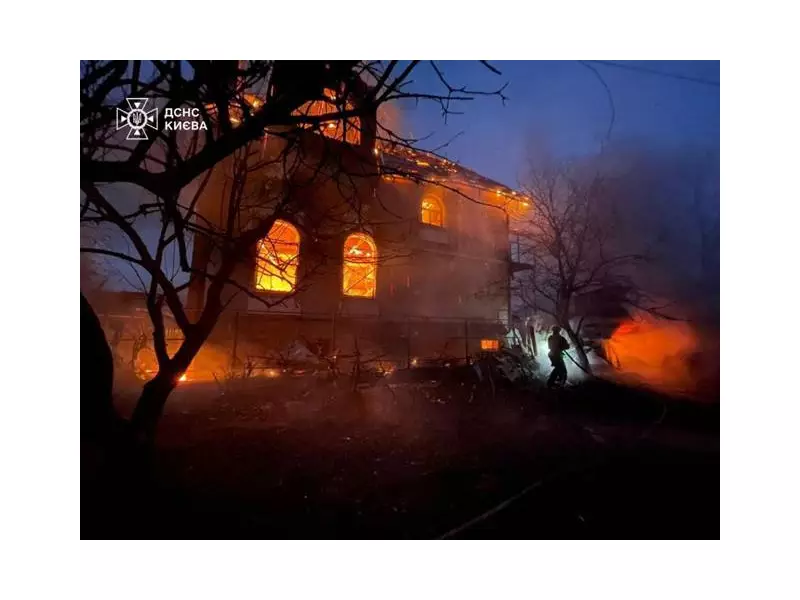
In a severe escalation just before a critical diplomatic meeting, Russian forces subjected Ukraine's capital to one of the most prolonged aerial assaults of the year. The attack, lasting nearly ten hours overnight, targeted Kyiv and its surrounding region, resulting in significant casualties and widespread damage to civilian infrastructure.
Details of the Sustained Assault
According to Ukraine's air force, the offensive involved a massive barrage of 519 drones and 40 missiles. Local authorities confirmed that the strikes killed at least two people and left 44 others wounded, including two children. The relentless attack kept residents in a state of terror well into Saturday, with air raid sirens sounding intermittently throughout the day.
The consequences on the ground were dire. Fires erupted across Kyiv, engulfing a car repair shop and several residential buildings. The situation became so perilous that elderly residents had to be evacuated from a care home as flames spread, according to the Kyiv Emergency Service.

Humanitarian and Infrastructure Crisis
The attack deliberately targeted energy and civilian infrastructure. Senior government minister Oleksiy Kuleba stated on social media that the assault left a devastating impact on the city's heating system. More than 40% of residential buildings in Kyiv lost heating, a critical failure amid freezing winter temperatures. President Volodymyr Zelensky confirmed that electricity and heating were unavailable in several districts of the capital and the region, with firefighting efforts ongoing.
Speaking en route to the United States, Zelensky emphasized the urgent need for bolstered air defenses. "The support of Europeans is important to us today. We do not have enough additional air defence systems," he said, highlighting the country's desperate need for more missiles to counter Russia's relentless campaign.
Diplomatic Moves Amid the Violence
The timing of the attack is highly significant, occurring on the eve of President Zelensky's scheduled meeting with US counterpart Donald Trump in Florida. The talks are part of ongoing efforts to find a path to end the nearly four-year war. Before meeting Trump, Zelensky made a stop in Canada for discussions with Prime Minister Mark Carney.
Zelensky expressed his goal for the US meeting, stating he would seek a signal that Ukraine would receive legally binding security guarantees as part of any future peace deal. However, Trump set a firm tone in an interview with Politico, noting that Zelensky "doesn’t have anything until I approve it." The former US president added that he expects to speak with Russian President Vladimir Putin "soon, as much as I want."
European officials revealed that Ukrainians have been pushing for this meeting for months. While they describe current US-Ukraine dynamics as productive, they acknowledge the unpredictability of any engagement with Trump. A NATO official candidly remarked, "There is no low-risk scenario with Trump."
In a pointed response to the violence, Zelensky took to social media platform X, writing, "Russian representatives engage in lengthy talks, but in reality, Kinzhals and ‘shaheds’ speak for them." He added that this brutal assault reveals "the true attitude of Putin and his inner circle."
The attack's repercussions extended beyond Ukraine's borders. Reuters reported that Poland scrambled fighter jets and temporarily closed two airports in response to the aerial threat, citing a post by the Polish Air Navigation Services Agency.
As US and Ukrainian negotiators engaged in a week of intensive efforts, US officials expressed hope that the Sunday meeting between Zelensky and Trump would yield productive outcomes. The discussions are not expected to include European leaders directly, though European Commission President Ursula von der Leyen will join a call with the principals and other European leaders.