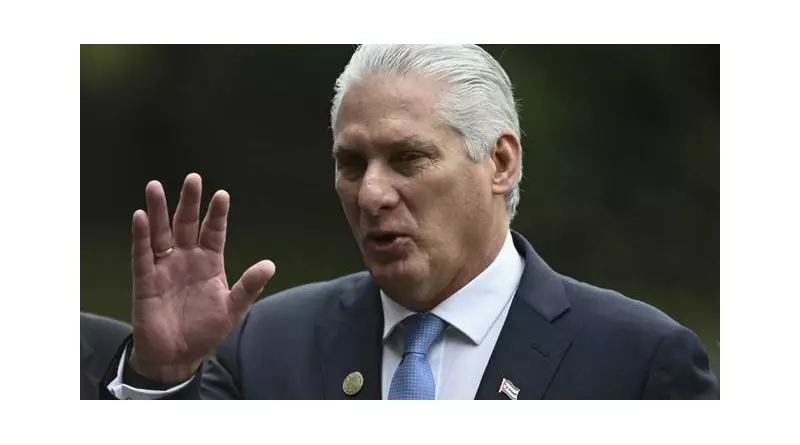
Cuban President Miguel Díaz-Canel has firmly rejected a public demand from former US President Donald Trump for the Caribbean nation to strike a deal with Washington. This defiance comes as Trump warned that Cuba would be cut off from the decades-long flow of Venezuelan oil and money it has relied upon.
Cuba's Defiant Stance Against External Pressure
Responding directly to Trump's social media posts, President Díaz-Canel took to X on Monday to assert Cuba's sovereignty. "No one dictates what we do," he stated, addressing Trump's insistence that the communist nation negotiate "before it’s too late." Díaz-Canel emphasized that Cuba has been subjected to US aggression for 66 years and is prepared to defend itself.
In a sharp retort aimed at Trump, the Cuban leader questioned the moral authority of those who "turn everything into a business, even human lives." He clarified that beyond technical discussions on migration, Cuba has held no talks with the US government.

The Economic Lifeline in Jeopardy
The core of the dispute centers on Venezuela's substantial support for Cuba. For many years, oil-rich Venezuela provided Havana with massive aid packages, including oil and money. In return, Cuba offered security services. However, the recent US-led capture of Venezuelan leader Nicolás Maduro and Trump's announcement have upended this arrangement.
Trump declared on his Truth Social platform that Venezuela would now turn over 30 million to 50 million barrels of oil to the United States, effectively severing the resource flow to Cuba. "There will be no more oil or money going to Cuba - zero!" he wrote. This sudden cutoff is expected to pose a significant economic challenge for Havana.
The Cuban government has reported a tragic human cost from the operation against Maduro, stating that 32 of its citizens were killed "in combat actions."
Escalating Rhetoric and Regional Tensions
Cuban Foreign Minister Bruno Rodríguez further escalated the war of words, accusing the US of behaving like a "criminal and uncontrolled hegemon" that threatens global peace. He asserted Cuba's absolute right to import fuel from its partners without US interference and denied Trump's characterization of a security-for-oil exchange.
While Trump later told reporters aboard Air Force One that the US was "talking to Cuba," the level and substance of these discussions remain unclear. Trump mentioned wanting to address the issue of Cubans who left the island under duress.
Díaz-Canel linked this migration directly to the long-standing US economic blockade, which he labeled a "failed policy." He expressed a conditional willingness for dialogue based on sovereign equality and non-interference.
Historical Context and Mixed Reactions
The US desire for regime change in Cuba, a one-party socialist state since 1961, remains a constant backdrop. Key figures like Secretary of State Marco Rubio, shaped by Miami's Cuban exile community, continue to advocate for this policy within Trump's cabinet.
On the streets of Havana, reactions were mixed. Resident Paola Perez told Reuters that while Cuba is not to blame for US-Venezuela relations, the island will be "affected, quite a lot." She added that Trump must find a solution, as he cannot simply take over Cuba.
The standoff highlights the enduring and volatile nature of US-Cuba relations, now further complicated by Washington's actions against Venezuela and the looming economic pressure on Havana.