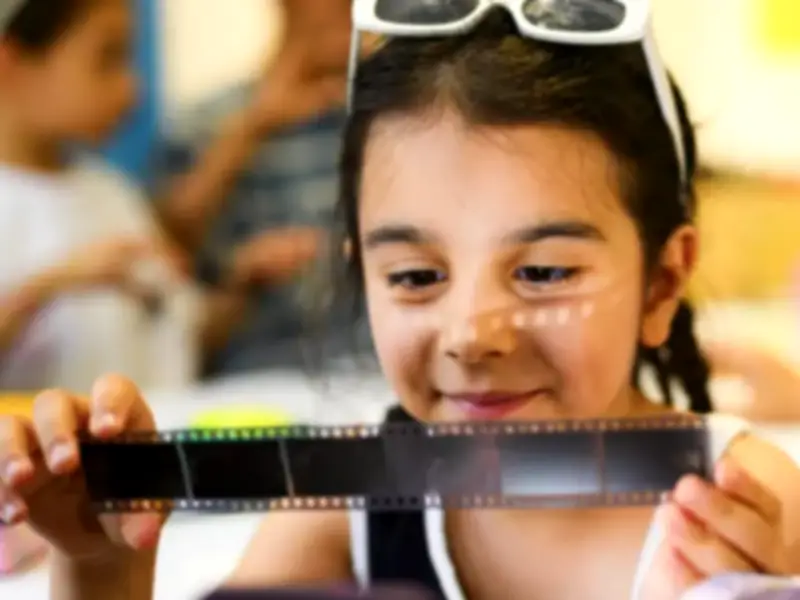
Under the red lamp of the darkroom, eight-year-old Zeynep waits to discover her images that are just emerging, shadows and silhouettes captured on film. 'How far does your curiosity go?' asks photographer Amar Kiliç, shaking the negatives underwater. 'To the ends of the earth,' replies the child.
Originally from Mardin, in southeastern Turkey, Zeynep is one of eight students in this analog photography workshop reserved for Turkish and refugee children from the province, on the borders of Iraq and Syria. The 'Fotohane Darkroom' project was created by Amar Kilic, 40, and Syrian photographer and educator Serbest Salih in 2024 in Mardin. The name, Fotohane, chosen by the children, means 'house of photography' in Turkish, Arabic, Kurdish, and Persian.
Kilic insists that the children are at the forefront of the process: 'They load the film, develop it and print their photos. They go out into the field and define their own rules.'

Fleeing ISIS and Building Bridges
Overlooking the great Mesopotamian plain, the golden walls of the old city of Mardin, crisscrossed by narrow streets and witnesses to millennia of history, attract tourists from all over the world. But far from the souvenir shops and cafes of the centre, the city is home to disadvantaged or refugee families. Among the latter, those of Yahya, Sam, Yusuf and Nihal, aged 11 to 13, fled Damascus during the war in Syria in 2014 and 2015, and the advance of the jihadists of the Islamic State (IS) group.
'I am very happy when I take photos,' smiles Nihal, swinging her black camera attached to her wrist, looking for a scene to capture. Serbest Salih, 32 years old and with a sharp, curious gaze, fled the Kurdish city of Kobani in northern Syria when ISIS took control of it in 2014. Thousands of Syrian refugees then crossed the Turkish border to settle in nearby Turkish cities like Mardin, not necessarily returning after the fall of former president Bashar al-Assad.
Salih avoids dwelling on his own difficulties. All attention, according to him, should be focused on the children he patiently educates, seamlessly switching from Turkish to Kurdish or Arabic and English. Since arriving in Türkiye, he has been trying to build bridges between communities and promote tolerance and integration.
Photography as a Tool for Confidence
He organised his first analog photography workshops in 2015, travelling with his old caravan to villages along the border to meet refugee children. 'Photography gives them confidence. With digital photos, you can delete them instantly. But with film, they spend the entire workshop thinking about the 36 images they won't discover until the end,' he explains. 'And their photos are magnificent.'
When asked, 'What is your favourite step in the process?', all the children unanimously agree: the darkroom. This is where the images captured in the viewfinder come to life. 'They call it the magic room,' says Murat Kilic, smiling as he oversees the photo development and printing phases. 'It's a very special feeling for children to see the image forming on the white paper. They say to themselves: 'I managed to create that.''
Exhibitions and Future Plans
The project is mainly funded by exhibitions organised abroad and by donations - the children's work will be exhibited this summer in Italy, Belgium, the United Kingdom and Indonesia. Salih and Kilic are thinking of hitting the road again with the darkroom in a caravan. 'To go to other regions to offer our expertise and train (other children),' Kilic explains.