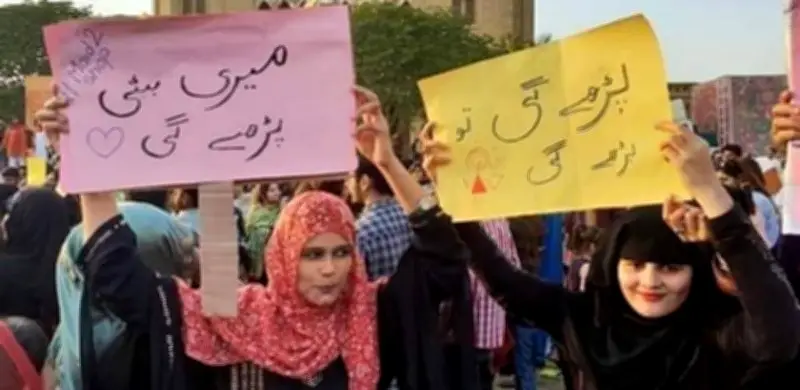
"Mera Jism Meri Marzi" is one of the most influential and controversial slogans in Pakistan's recent public discourse on women's rights. Yet there is a group of women and girls it rarely seems to include in its imagination: those who cannot meaningfully understand what a body is, what consent means, or what pregnancy entails.
Since the early 1990s, I have worked in Pakistan's sexual and reproductive health field in different capacities. Over time, certain experiences have stayed with me, not because they were unusual, but because they exposed a persistent gap in how we talk about women, rights, and vulnerability.
In clinical settings, one occasionally encounters intellectually disabled girls and women who become pregnant, sometimes more than once. They are often brought in by family members: fathers, brothers, or other relatives. The explanations vary, but frequently resolve into uncertainty, silence, or reference to an "unknown" perpetrator. It is not my place to assume certainty where there is none. Families in such situations often carry burdens that are neither visible nor easily spoken about. But what remains consistent is the underlying condition: women who are not in a position to understand or protect themselves in any meaningful way.

The term intellectual disability has replaced earlier clinical language such as "mental retardation" in global diagnostic systems, including DSM-5 (2013) and ICD-11, reflecting a shift towards dignity-based terminology. Pakistan's legal framework has evolved significantly in recent years. Pakistan ratified the United Nations Convention on the Rights of Persons with Disabilities in 2011. Since then, disability rights legislation has developed across the federation, including the Islamabad Capital Territory and all provinces. Laws such as the Rights of Persons with Disabilities Act 2020 (Islamabad Capital Territory), the Punjab Empowerment of Persons with Disabilities Act 2022, and comparable provincial legislation reflect these commitments by affirming dignity, non-discrimination, bodily integrity, and informed consent in medical decision-making.
These are important protections. They respond to a long global history in which persons with disabilities were subjected to reproductive control in the name of care, order, or convenience. The women I encountered decades ago were not exceptions. They were indicators of a system that still struggles to translate principle into protection.
This is not an argument against those protections. Nor is it an argument against women's rights movements, disability advocacy, or efforts to address gender-based violence. It is an argument about something more uncomfortable: the distance between rights as principle and protection as practice.
In Pakistan, public attention is uneven. Some issues gain sustained visibility through campaigns, donor priorities, and international observances such as the 16 Days of Activism against Gender-Based Violence. These efforts matter. They have helped shift language, law, and awareness. But intellectual disability, particularly in women and girls, remains largely outside that sustained attention. It appears in policy documents, but rarely in the everyday imagination of care systems, safeguarding mechanisms, or long-term support structures.
As a result, two realities sit side by side without fully meeting. On one side are strong legal and ethical prohibitions against irreversible reproductive interventions without informed consent. On the other is a lived reality in which some women require lifelong support for menstrual care, protection from exploitation, and continuous supervision because of severe cognitive impairment.
This piece does not attempt a full comparative account across all gender identities, and instead focuses on women, given the reproductive health and safeguarding dimensions central to the discussion. All persons with intellectual disabilities face marginalisation. The experience of women is often intensified by gendered vulnerability, including greater exposure to sexual violence and reproductive control, while men more often face exclusion shaped by expectations of independence and productivity.

Between these positions lies a space that is rarely addressed with honesty: the burden carried almost entirely by families. The issue is not the absence of rights language. It is the absence of systems that makes those rights meaningful in daily life.
This is where familiarity and funding matter, though not always in ways that are acknowledged. Public policy tends to reward what is easily communicated: awareness campaigns, workshops, training sessions, and periodic observances. These have value; they create vocabulary, visibility, and sometimes vision. But the noiseless work is trickier and tougher to fund. It is even harder to sustain: long-term caregiving support, respite services for families, community-based protection systems, trained caregivers, accessible reproductive healthcare, and mechanisms that function when vulnerability is continuous rather than episodic.
Without these, the system becomes unbalanced. Rights are asserted, but support is thin. Principles are strong, but infrastructure remains inadequate. In that gap, families carry responsibilities that are rarely recognised in public discourse. Medical professionals manage cases that sit uneasily between law, ethics, and social reality. And intellectually disabled women remain present in life, but largely absent in design.
The women I encountered decades ago were not exceptions. They were indicators of a system that still struggles to translate principle into protection. The challenge is not to reduce rights frameworks. It is to extend them into something more demanding: sustained, practical systems of care that match the complexity of real lives. Until that happens, our conversations about autonomy will remain incomplete, not because the principles are wrong, but because they do not yet fully account for those whose autonomy is structurally limited, socially invisible, and persistently under-protected.
PS: Whatever happened to the Sustainable Development Goals? "Leaving no one behind." "Reaching the farthest first." Just asking.